The UK has launched Great British Railways (GBR), a publicly owned national rail body that will unify Britain’s fragmented rail system, introduce a new national identity, and implement sweeping reforms aimed at improving reliability, simplifying ticketing and strengthening passenger services.
The rollout includes a striking red, white and blue livery inspired by the Union Flag, a revived double-arrow logo, a unified ticketing app, and major structural changes set out in the Railways Bill. While ministers claim GBR will fix decades of fragmentation, legal experts warn that centralising power may limit competition and deter private investment.
Key Takeaways on Great British Railways Nationalisation & Branding
- GBR to Become UK’s Single Rail Authority: The Railways Bill establishes Great British Railways as a unified body overseeing both rail operations and infrastructure, merging 17 organisations.
- National Branding Unveiled for 2026 Rollout: GBR’s red-white-blue livery and updated double-arrow logo will appear on trains, stations, websites and apps beginning next spring.
- Public Ownership Accelerates Across Operators: Seven operators are already nationalised; more—including West Midlands Trains, GTR, Chiltern and Great Western—will shift to public hands by 2027.
- Unified Ticketing App & Fare Freeze: A GBR app will offer fee-free bookings, Passenger Assist, and simplified ticketing as regulated fares freeze for the first time in 30 years.
- Competition Concerns Raised by Legal Experts: Pinsent Masons warns GBR’s vertically integrated model could weaken scrutiny, limit competition and deter private investment.
- Passengers to See Early Changes at Major Stations: Branding demos, model trains and digital displays are being showcased at London Bridge, Leeds, Manchester Piccadilly, Birmingham New Street and Glasgow Central.
A Defining Moment for UK Rail Reform
In one of the most significant overhauls in modern British transport history, the UK government has formally unveiled the branding and operational vision for Great British Railways—the national body that will take control of the country’s railways under a sweeping programme of public ownership. The unveiling coincided with parliamentary debate on the Railways Bill, which lays out the legal foundation for a single integrated rail system after decades of fragmentation.
Transport Secretary Heidi Alexander, leading the reform, framed the launch as the symbolic beginning of a new era. “This isn’t just a paint job,” she said. “It represents a new railway, casting off the frustrations of the past and focused entirely on delivering a proper public service for passengers.”
A Unified National Identity: GBR’s Striking New Branding
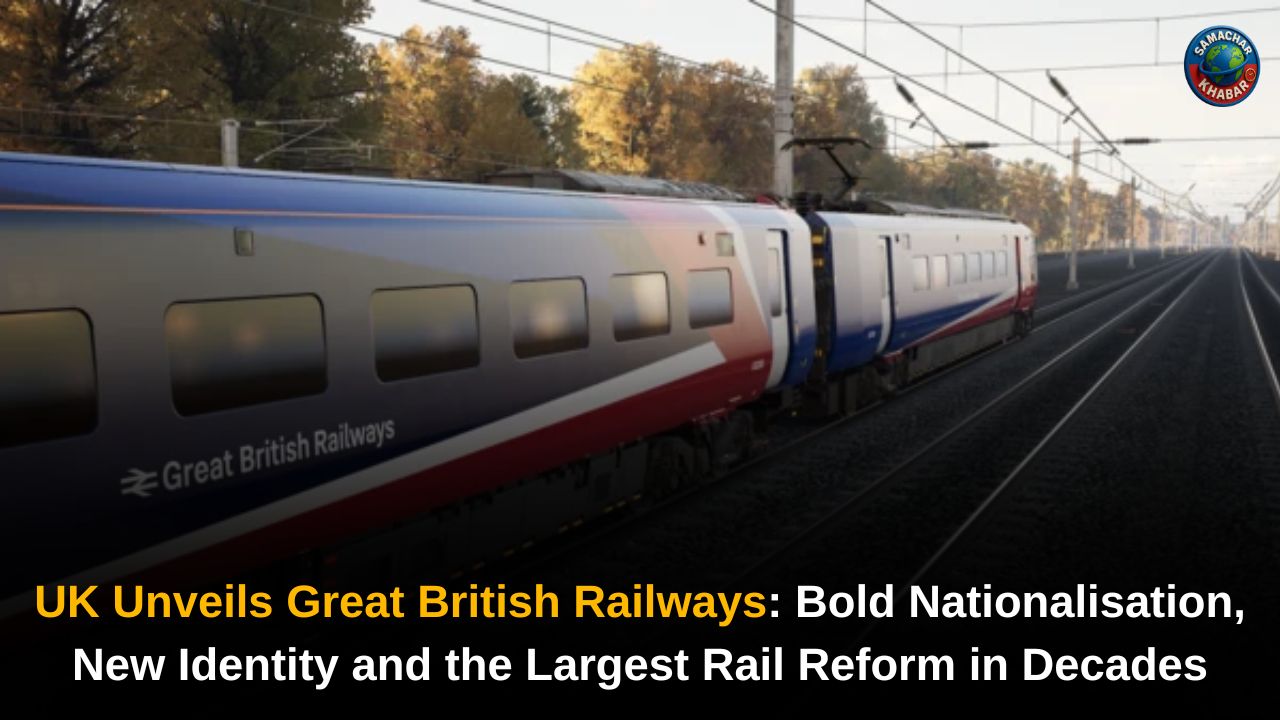
The new GBR identity adopts a crisp red, white and blue design—directly mirroring the Union Flag. The branding features sharp angles and a modernised double-arrow symbol, first introduced in the 1960s by British Rail and retained for National Rail services after privatisation. Ministers say the revived emblem reflects both continuity and public ownership.
Designed entirely in-house to reduce costs, the livery will roll out gradually from spring 2026 across nationalised operators, stations, websites and the GBR app. Early previews are already being displayed at London Bridge, where passengers can view a GBR-branded Hornby model, and in Train Sim World 6, which includes a digital rendering of the new trains.
Displays at Manchester Piccadilly, Birmingham New Street, Leeds City and Glasgow Central offer the public a wider preview.
Railways Bill: Merging 17 Organisations Into One Public Body
The Railways Bill, introduced to Parliament on 5 November 2025, is the backbone of the reform. It follows the Passenger Railway Services (Public Ownership) Act 2024, which removed the presumption in favour of private train franchises.
Under the new framework, GBR will:
- Combine 17 different organisations
- Take responsibility for both infrastructure and operations
- Oversee timetables, fares and revenue collection
- Introduce standardised, national ticketing practices
- Maintain closer accountability to passengers and freight customers
The model aims to streamline decision-making and eliminate bureaucratic overlaps that have led to decades of inconsistent service.
Public Ownership Expands Across England’s Railways
Britain’s transition back to state control is well underway. Seven major operators—including Northern, LNER, TransPennine Express, Southeastern, c2c, Greater Anglia and South Western Railway—are already under public ownership.
Upcoming transfers include:
- West Midlands Trains → February 2026
- Govia Thameslink Railway → May 2026
- Chiltern Railways → Expected in 2026
- Great Western Railway → Expected in 2026
By the end of 2027, virtually the entire network will be operated under GBR.
Government officials highlight early benefits:
South Western Railway has quadrupled its Arterio fleet, increasing capacity by 10%, while LNER will add 10,000 new services annually, offering 60,000 extra weekly seats. Southeastern has invested £2 million in advanced video systems for rapid fault detection.
Transforming Passenger Experience: GBR’s One-Stop App
A major feature of the reform is the new GBR digital app, designed as a single platform for:
- Checking real-time train schedules
- Booking tickets with no additional fees
- Reserving Passenger Assist services
- Accessing simplified, national fare structures
The app aims to unify a ticketing landscape currently dominated by third-party retailers, fragmented systems and inconsistent policies.
Legal Experts Warn: Reforms May Limit Competition
While the government promotes GBR as a fix for long-standing inefficiencies, international law firm Pinsent Masons warns that the vertically integrated structure may pose significant competition risks.
Transport law specialist Robbie Owen argues that GBR could become “judge and jury”, controlling both infrastructure and services while also shaping access conditions for open-access operators and freight companies. The firm says ORR’s independence could be weakened as key powers shift to the Secretary of State.
Competition lawyer Angelique Bret highlights concerns for ticket retailers and freight operators who depend on transparent, non-discriminatory access. Although safeguards exist—such as an enhanced ORR review system and a new ticketing code of practice—the effectiveness of these measures remains uncertain.
Parliament is expected to debate amendments to restrict GBR’s ability to rewrite existing access agreements, a power critics fear could unsettle investors.
A National Rail Identity on Display
Alongside the legislative changes, the government has launched a nationwide public showcase. At London Bridge, a one-day exhibition features:
- A GBR-branded Hornby model train
- A GBR train simulation in Train Sim World 6
- Digital displays previewing the new livery
The displays aim to introduce the public to GBR’s future look while symbolising the network’s shift toward unity and accountability.
Industry groups, including the Rail Delivery Group and Transport Focus, have broadly welcomed the direction—while stressing that GBR’s culture, not just its branding, will determine public outcomes.
A Defining Shift for Britain’s Rail Future
Great British Railways represents a turning point for UK rail travel—a shift intended to deliver reliability, clarity and a unified passenger experience after decades of fragmented management. With national branding, redesigned livery, a simplified ticketing ecosystem and sweeping legislative reforms, the government hopes to build a network that is easier to use and more accountable to passengers.
Yet legal experts warn that concentration of power within GBR could dampen competition and limit innovation. As reforms unfold, the success of this transformation will depend not on symbolism, but on whether Britain’s railways become more punctual, transparent and genuinely passenger-focused.
FAQs on Great British Railways Nationalisation, Branding and Rail Reforms
1. What is Great British Railways and why is it being created?
Great British Railways is a new public body unifying rail operations and infrastructure to fix fragmentation, simplify services, and improve passenger experience across the UK network.
2. When will GBR’s new branding and livery appear on trains?
The red-white-blue GBR branding and updated double-arrow logo will begin rolling out from next spring across trains, stations, websites and the upcoming GBR ticketing app.
3. Which train operators have already moved into public ownership?
Seven major operators—including Northern, LNER, TPE, Southeastern, c2c, Greater Anglia and South Western Railway—are already nationalised under the government’s reform programme.
4. What features will the new GBR ticketing app offer passengers?
The GBR app will provide fee-free ticket booking, real-time train information and integrated Passenger Assist services to simplify travel for all passengers, including disabled travellers.
5. What concerns have legal experts raised about GBR’s structure?
Pinsent Masons warns GBR’s vertically integrated model may reduce competition, weaken independent scrutiny and create challenges for freight companies, open-access operators and third-party ticket retailers.