[ad_1]
In the mid-to-late 1990s, Harvard Business School professor Clayton Christensen developed the theory of a “technology overshoot”. He posited that companies often innovate faster than their customers’ lives change, creating products whose utilities exceed the needs of an average user.
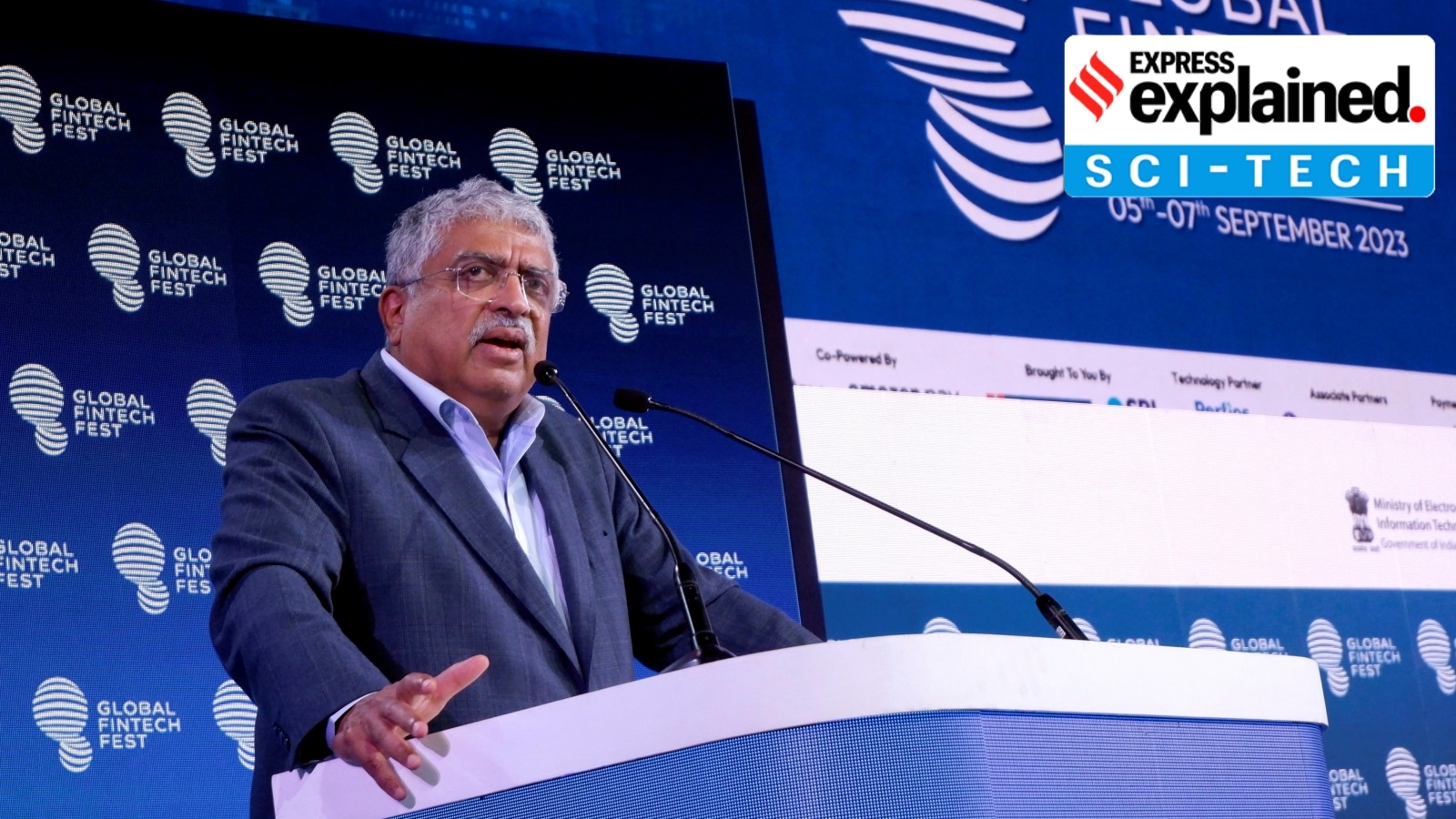
On Tuesday, Nandan Nilekeni, in a rare presentation as Infosys Chairman, brought up Christensen’s theory and rephrased the term as a “deployment gap” — between the power of artificial intelligence (AI) and the capacity of businesses to use it.
In essence, he made a case that companies such as Infosys can benefit from the latest AI wave by bridging this gap.
Nilekani’s presentation was a defence of India’s $300-billion software services sector that is now facing perhaps its greatest challenge ever — AI automation.
Stocks of both Indian and US companies crashed earlier this month following Anthropic and OpenAI’s releases of AI tools that promise to take over several tasks they currently perform. But Nilekani, and several others, still see opportunities for Indian IT companies in this new landscape.
Bridging the gap
Infosys, an Indian IT bellwether company alongside TCS, disclosed that AI accounted for 5.5% of its revenue in the December quarter. This was the first time the company shared the scale of its AI business.
On Tuesday, Infosys also announced a strategic partnership with Anthropic to create and implement advanced enterprise AI solutions for businesses in telecom, financial services, manufacturing and software development.
Story continues below this ad
According to Nilekeni, the problems in the AI space, apart from the one relating to the deployment gap, pertains to a hardware issue — the modernisation of legacy systems that has been long deferred by large companies around the world. Over the last 70 years, he said, companies have chosen not to replace the legacy system, but just add to it. As a result, 1960s mainframes coexist with computers from the 1980s and routers from the 2000s — all of which reside in parallel silos. Now, because of AI, the tools to modernise and integrate these legacy systems are available, he said. Also, as AI becomes a bigger part of a company’s tech spend, the balance of advantage is moving towards “build” rather than “buy”, which could benefit “folks like us”, Nilekeni said.
Going forward, the foundational systems will increasingly become systems of record, but the interface will be agentic, as enterprises put agentic layers on top of all their applications, he said. That too, he said, presents opportunities for companies such as Infosys that can build customised agentic tools for enterprise customers. Agentic AI comprises tools that can accomplish a specific goal with limited supervision.
One question still looms. To what extent can IT services companies retain their edge in the age of AI? The question grows ever more urgent, given the unveiling of tools such as Open AI’s GPT-5.3 Codex and Anthropic’s Opus 4.6, and especially as AI gets to a point where it is intelligent enough to meaningfully contribute to its own improvement.
Nilekeni is not alone in his spirited defence of India’s IT sector. Other top Indian IT leaders attending the AI Summit have asserted that the current productivity being unlocked in the tech sector is happening with humans in the loop, even though the extent of human involvement could progressively decrease.
Story continues below this ad
Analysts at JP Morgan have flagged investor concerns that Indian IT firms could miss growth targets as AI pushes clients to reallocate spending. But they have also indicated that it may be “overly simplistic” to assume that AI can automatically generate enterprise-grade software and replace the value IT services firms create across the cycle.
Could India’s global capability centres be hit due to AI?
From a policy perspective, though, a lingering concern within government circles is whether there could be a spillover impact of new AI tools on India’s value added services offerings.
Nearly a fifth of the world’s chip designers are in India, with almost all major design companies having a research centre in the country — Amazon’s biggest backoffice in the world is in Hyderabad, while nearly 20 per cent of Goldman Sachs’s staff are in Bengaluru and Hyderabad.
And while these global capability centres (GCCs) already represent close to 40% of India’s services exports, making them its biggest export category after IT services, there could be a growing overlap between these two categories. And this overlap has a section of India’s policymakers worried. An impact on IT today could potentially impact India’s GCC play next.
Story continues below this ad
Concerns around outsourcing replaceable work, potential threat to the IT services sector and lack of intellectual property coming India’s way: These are some of the questions the government is battling internally, even as it looks to promote the country as a destination for GCCs.
There are also worries that the growth of these centres is coming at the cost of domestic IT firms, undermining the very ecosystem they had helped establish.
An analysis of the type of the work undertaken by in-house GCCs and that executed by outsourced service providers such as the Indian IT and software companies have similarities: both essentially seem to be focused on tapping into outsourceable work and moving them in varying degrees to India.
Some of this, in very small amounts, includes instances of multinational firms vertically integrating their activities and bringing them in-house.
Story continues below this ad
Other than some rare cases, which could include automotive companies and semiconductor design firms, there is a feeling in policy circles that most of what is being done is still not a significant upgrade to what IT services companies are doing — that it is not non-outsourceable, high-end work that leads to intellectual property being vested in the Indian entity.
And while many in the government view the proliferation of GCCs as a net positive for the country, there are concerns on the quality of jobs that are being created, and whether they will ever become core to a company’s function in a way that is difficult to relocate. One yardstick that is being used to gauge the level of technology-mature work being done in Indian GCCs is to ask the question if the chief technology officer of the parent company, or any of the key subordinates of the CTO are in India. Or if any cutting-edge patents are vested with an Indian entity. Chances are that most of the GCCs would draw a blank on these counts.
With close to 1,600 GCCs of multinational companies in various sectors, India has become to the world what China is for tech hardware. Leading companies from across sectors — modern trade, apparel, finance, consumer electronics, automobile, and shipping — have opened big headquarters in India from where they manage a number of functions including designing, inventory and supply chain management and transportation. The movement has come on the back of some key trends: the country’s large pool of engineers, availability of relatively cheap labour, low real estate and rental costs compared to other Asian destinations, and comparatively simpler labour laws which allow for longer working hours.
Improvements in AI development, which could bridge the labour arbitrage in the due course, could progressively impact some of these value added service offerings.
[ad_2]
Source link