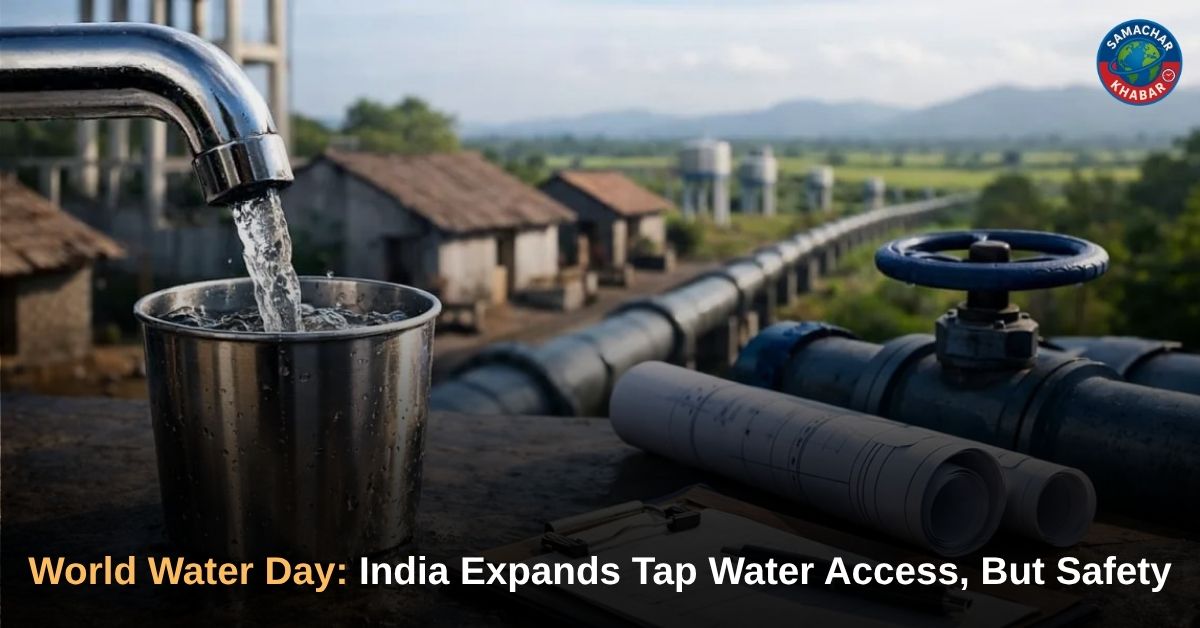
India marks World Water Day 2026 at a defining moment in its water journey. While the country has made remarkable progress in expanding tap water access through initiatives like the Jal Jeevan Mission, serious concerns around water safety, contamination, and inequality continue to grow. Reports of illnesses and deaths caused by contaminated tap water highlight a troubling reality — access does not always guarantee safety.
At the same time, the global theme “Water and Gender” underscores how water challenges are deeply linked to equality and human rights. As India advances its infrastructure, the real challenge lies in ensuring that every drop delivered is safe, sustainable, and equitable.
Key Takeaways on World Water Day 2026: India’s Water Access, Safety and Equality Challenge
- World Water Day is observed on March 22, focusing on freshwater conservation and sustainability.
- The 2026 theme “Water and Gender” highlights inequality and the role of women in water management.
- India has provided tap water to over 15.8 crore rural households under Jal Jeevan Mission.
- However, contaminated tap water has caused over 5,500 illnesses and at least 34 deaths recently.
- Nearly 19.8% groundwater samples exceed nitrate limits, raising safety concerns.
- Only 0.007% of Earth’s water is easily accessible freshwater.
- Government, industry, and citizens must act collectively for water security.
World Water Day 2026 Conclave in Delhi: A National Platform for Water Solutions
The Ministry of Jal Shakti is set to host the World Water Day Conclave 2026 on March 23 in New Delhi. The conclave, themed “Industry for Water,” will bring together policymakers, industry leaders, academia, startups, MSMEs, and innovators.
Union Minister C R Paatil will attend the inaugural session, with participation from over 700 delegates. The event will serve as a national platform for dialogue, innovation, and collaboration on sustainable water management.
The conclave will also felicitate Jal Shakti Hackathon winners, recognising impactful and technology-driven solutions in the water sector.
Theme, History and Global Significance of World Water Day
World Water Day, observed annually on March 22, was proposed at the 1992 United Nations Conference in Rio de Janeiro and first celebrated in 1993. It supports Sustainable Development Goal 6, which aims to ensure clean water and sanitation for all by 2030.
The 2026 theme, “Water and Gender,” with the slogan “Where Water Flows, Equality Grows,” highlights how water access is closely linked with gender equality. It calls for equal participation of women in water governance and decision-making.
Globally, over 2.1 to 2.2 billion people still lack access to safe water, making it a critical human rights and development issue.
PM Narendra Modi’s Message on World Water Day 2026
Prime Minister Narendra Modi extended his greetings on the occasion, emphasizing the importance of water conservation.
He stated that water sustains life and shapes the planet’s future, urging citizens to conserve every drop and use water responsibly. He also appreciated individuals and communities promoting sustainable practices and spreading awareness about water conservation.
India’s Water Progress: Jal Jeevan Mission and Integrated Governance
India has adopted a comprehensive approach to water management under the Ministry of Jal Shakti, integrating conservation, storage, distribution, and quality improvement.
The Jal Jeevan Mission, the world’s largest rural drinking water programme, has delivered tap water connections to over 15.8 crore households. It has significantly improved quality of life, especially for women, by reducing the burden of fetching water.
The government has also launched initiatives such as:
- Namami Gange for river rejuvenation
- Jal Shakti Abhiyan for conservation
- Catch the Rain – where it falls, when it falls campaign
- Jal Sanchay Jan Bhagidari
Since September 2024, more than 45 lakh water conservation structures have been created through community participation.
Unsafe Water Reality: When Access Does Not Mean Safety
Despite infrastructure growth, water safety remains a serious concern. Between February 2025 and January 2026, contaminated tap water sickened over 5,500 people and caused at least 34 deaths.
This highlights a critical gap: providing pipelines without ensuring water quality can turn access systems into carriers of contamination.
A parliamentary reply revealed:
- 19.8% groundwater samples exceed nitrate limits
- 3.1% exceed arsenic limits
- 9.04% exceed fluoride limits
Chemical Contamination: The Invisible and Long-Term Threat
Chemical pollutants such as arsenic, fluoride, mercury, cadmium, and nitrates are invisible and difficult to detect. Unlike bacterial contamination, they cause long-term health issues.
Health impacts include:
- Cancer from arsenic exposure
- Skeletal deformities due to fluoride
- Blue baby syndrome caused by nitrates
These contaminants silently accumulate, making water safety a major public health concern.
Polluted Rivers: A Growing Environmental Crisis
India’s rivers are under severe stress due to untreated sewage, industrial discharge, and agricultural runoff.
Major affected rivers include:
- Yamuna
- Musi
- Hindon
Pollution reduces water quality, harms ecosystems, and increases health risks for communities dependent on these water sources.
Also Read: International Mathematics Day: Why March 14 Is Also Celebrated as Pi Day
Water and Gender: The Inequality at the Core of the Crisis
Water challenges disproportionately affect women and girls. Globally, they spend nearly 200 million hours daily collecting water.
In India:
- 54% rural women spend significant time fetching water
- Equivalent to losing around 27 days of wages annually
Women also bear the burden of managing households affected by water-related illnesses, yet they hold less than 20% of leadership roles in water governance.
The Science of Scarcity: Only 0.007% Water Is Usable
| Category | Percentage |
| Saltwater | 97% |
| Freshwater | 2.5% |
| Accessible freshwater | 0.007% |
Most freshwater is locked in glaciers or exists underground, leaving only a tiny fraction available for human use. This highlights the urgency of conservation.
Industry Shift: From Water Consumption to Water Stewardship
Corporate India is increasingly adopting water stewardship practices.
Examples include:
- Water recycling and reuse
- Rainwater harvesting
- Groundwater recharge
Companies are also working with communities to restore water systems and improve sustainability, recognising water as a shared ecological resource.
Technology and Innovation: Ensuring Safe Water at the Last Mile
Technology is playing a key role in improving water safety. Real-time monitoring systems and purification technologies are helping reduce waste and improve efficiency.
ZeroB, with over 40 years of experience, has introduced Suraksha 2.0, a purification solution using silver-infused technology to eliminate 99.99% of bacteria and viruses.
This highlights the importance of ensuring water safety not just at the source, but also at the point of consumption.
Virtual Water and Daily Consumption: The Hidden Water Use
Water usage extends beyond direct consumption. The concept of virtual water highlights hidden water in products.
Examples:
- One cup of coffee requires around 130 litres of water
- Meat production uses significantly more water than plant-based foods
Understanding water footprints can encourage more sustainable consumption choices.
Water Conservation: Small Actions, Big Impact
Simple steps can help conserve water:
- Turn off taps when not in use
- Fix leaks immediately
- Use water-efficient appliances
- Harvest rainwater
- Avoid unnecessary wastage
Collective action at the individual level can significantly reduce water stress.
Spiritual Insight: Water Conservation Through the Teachings of Saint Rampal Ji Maharaj Ji
While efforts are being made at policy and societal levels, true change begins within. The teachings of Saint Rampal Ji Maharaj Ji emphasize that natural resources like water are divine gifts that must be used responsibly.
His spiritual knowledge promotes a disciplined and simple lifestyle, encouraging individuals to avoid wastage and respect nature. It highlights that real progress comes from both material development and inner transformation.
In the context of rising water scarcity, this wisdom inspires people to value every drop. When individuals become aware and responsible, it leads to sustainable living and a water-secure future for all.
India’s Water Future Depends on Safety, Sustainability and Equality
India’s journey towards water security is at a critical stage. While access has improved significantly, challenges related to safety, contamination, and inequality remain.
The focus must now shift from infrastructure alone to ensuring water quality, strong governance, and community participation. Water security cannot be achieved by policy alone — it requires behavioural change and collective responsibility.
Only when water is safe, accessible, and equitably distributed can India truly achieve sustainable development and build a resilient future where every drop counts.
FAQs on World Water Day 2026: India’s Water Crisis, Safety and Equality Concerns
1. What is the theme of World Water Day 2026?
The theme is “Water and Gender,” focusing on how water access impacts equality and highlighting the need for women’s participation in water management and decision-making.
2. What is the Jal Jeevan Mission and its progress in India?
Jal Jeevan Mission aims to provide tap water to every rural household. Over 15.8 crore households have already received connections, improving access across India.
3. Why is water safety a major concern in India despite increased access?
Contaminated tap water has caused illnesses and deaths, while groundwater shows high nitrate, arsenic, and fluoride levels, proving access does not always guarantee safe drinking water.
4. How does the water crisis affect women and gender equality?
Women spend hours collecting water daily, lose income opportunities, and face health burdens, yet remain underrepresented in water governance and decision-making roles.
5. How much usable freshwater is available on Earth?
Only about 0.007% of Earth’s total water is easily accessible freshwater, making conservation and efficient management critical for sustaining human life and ecosystems.