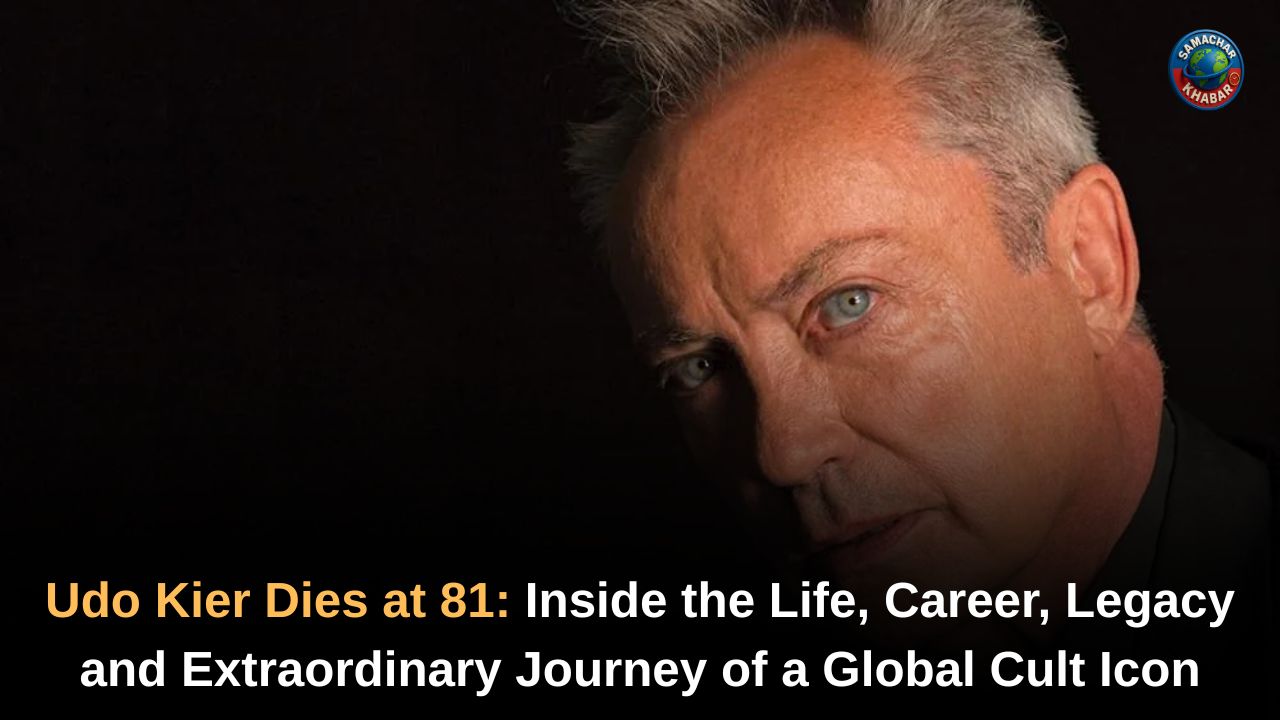
His partner, artist Delbert McBride, confirmed the news, while former manager Joe Roe also shared the announcement. With a career spanning more than six decades and over 200 films, Kier became one of cinema’s most distinctive cult figures — admired for his ability to elevate any role, whether in Andy Warhol’s provocative classics, Lars von Trier’s art-house masterpieces, or major Hollywood productions.
His life story, shaped by survival, reinvention and fearless creativity, stands as one of the most extraordinary journeys in global film history.
Key Takeaways on Udo Kier’s Life, Career, Journey and Legacy
1. Udo Kier Dies at 81; Death Confirmed by Partner and Former Manager
The news was confirmed by partner Delbert McBride and supported by a tribute from former manager Joe Roe.
2. A 60-Year Career With Over 200 Films Across Europe and Hollywood
Kier worked in more than 200 films, becoming one of the most prolific and recognizable cult actors of his era.
3. Breakthrough With Andy Warhol’s Iconic Horror Classics
Kier rose to global fame with Flesh for Frankenstein (1973) and Blood for Dracula (1974), directed by Paul Morrissey and produced by Andy Warhol.
4. Long-Standing Partnership With Lars von Trier Since 1987
Kier became one of von Trier’s most trusted collaborators, appearing in Breaking the Waves, Dogville, Melancholia, The Kingdom and Nymphomaniac.
5. Hollywood Presence With Memorable Villain Roles
He appeared in Ace Ventura: Pet Detective, Blade, Armageddon, Johnny Mnemonic and more.
6. Recent Acclaim in Cannes-Winning Film “The Secret Agent”
Kier most recently appeared in Kleber Mendonça Filho’s The Secret Agent, Brazil’s Oscar submission.
7. Early Life Shaped by WWII Survival and Struggle
Born during an air raid in Cologne in 1944, Kier and his mother were rescued moments after the hospital was bombed.
8. Openly Gay Actor Who Spoke Honestly About Identity
Kier was candid about his sexuality and believed authenticity never hindered his artistic life.
A Life That Began in the Rubble of War
Udo Kier’s life began with a dramatic and almost cinematic episode. Born as Udo Kierspe in Cologne in 1944, he entered the world just as Allied forces bombarded the city. The hospital where he was born was hit moments after his birth, forcing rescuers to dig him and his mother out of the rubble.
Raised without his father, Kier grew up in post-war Germany before moving to London at age 18. There, he worked as a church singer and studied English — unknowingly setting the stage for an international career.
Breakthrough With Andy Warhol’s Frankenstein and Dracula
Kier’s first major breakthrough came in the 1970s through Paul Morrissey and Andy Warhol’s legendary horror films:
- Flesh for Frankenstein (1973)
- Blood for Dracula (1974)
These films reimagined classic monsters through a provocative, experimental lens. Kier’s haunting, eccentric, yet oddly comedic performances made him instantly recognizable and placed him firmly in the global cult-film conversation.
His link to the Warhol circle came through a chance encounter — meeting Morrissey on a plane. Weeks later, he was offered the lead role in Frankenstein, changing the trajectory of his career forever.
European Stardom and the Fassbinder Years
During the 1970s and 1980s, Kier appeared in some of Europe’s most influential films. His key collaborations included:
- Rainer Werner Fassbinder
- The Stationmaster’s Wife
- The Third Generation
- Lili Marleen
- The Bitter Tears of Petra von Kant
- The Stationmaster’s Wife
- Dario Argento
- Suspiria (uncredited)
- Suspiria (uncredited)
- Walerian Borowczyk
- Docteur Jekyll et les femmes
- Docteur Jekyll et les femmes
This era shaped Kier’s identity as an actor unafraid of psychological darkness, surrealism and unconventional characters. There were also long-standing rumors of a romantic relationship with Fassbinder, though Kier himself treated his private life with modesty.
Gus Van Sant and Breakthrough in America
Kier’s path to U.S. cinema began unexpectedly at the Berlin Film Festival, where he met director Gus Van Sant.
Van Sant helped him secure:
- An American work visa
- A SAG membership
This opened the door to American films. Kier’s role as Hans in My Own Private Idaho (1991), acting opposite River Phoenix and Keanu Reeves, made him widely familiar to international audiences.
He later appeared in Madonna’s “Deeper and Deeper” video and her controversial Sex book — further cementing his cult status.
Iconic Partnership With Lars von Trier
Beginning with Epidemic in the late 1980s, Kier became a key figure in Lars von Trier’s creative universe.
He went on to appear in:
- Europa (1991)
- Breaking the Waves (1996)
- Dancer in the Dark (2000)
- Dogville (2003)
- Melancholia (2011)
- Nymphomaniac: Vol. II (2013)
- The Kingdom TV series
- The Idiots, The Boss of It All, Antichrist, The House That Jack Built (various roles mentioned in sources)
This multi-decade partnership is considered one of modern cinema’s most consistent actor–director collaborations.
Hollywood Roles: Villains, Eccentrics and Scene-Stealers
Kier’s Hollywood period included standout roles in major films:
- Blade — as the aristocratic vampire elder
- Ace Ventura: Pet Detective — as billionaire Ronald Camp
- Armageddon
- Johnny Mnemonic
- Barb Wire
- The Adventures of Pinocchio
- The New Adventures of Pinocchio
He often said he preferred villainous or horror roles because “audiences remember you more when you scare them.”
Voice Acting and Video Game Work
Kier’s voice became as iconic as his face. He lent his voice to:
- Professor Pericles – Scooby-Doo! Mystery Incorporated
- Dr. Peter Straub – Call of Duty: WWII
- Justice League
- Beware the Batman
- Command & Conquer: Red Alert 2
- Axe Cop
- Major Lazer
- Golan the Insatiable
His versatility across genres made him a favorite among animation and gaming creators.
Recent Work and Final Projects
Kier’s latest acclaimed appearance was in Kleber Mendonça Filho’s The Secret Agent, Brazil’s official submission for Best International Feature Film at the 2025 Oscars. The performance earned lead actor Wagner Moura the Best Actor award at Cannes.
He also appeared in Mendonça Filho’s earlier hit Bacurau, once again stealing scenes with minimal screen time.
One of his final credited projects is Hideo Kojima’s unreleased horror game “OD”, produced by filmmaker Jordan Peele — a fittingly experimental project for a performer known for unpredictability.
A Life Devoted to Art, Conversation and Creativity
Kier lived in Los Angeles and Palm Springs, where he immersed himself in architecture, mid-century design, art collecting and conversation. He was known for talking with strangers, inviting them into his home to discuss cinema and creativity.
Former manager Joe Roe described him as:
“An incredible force and energy — someone who made life brighter wherever he went.”
The Timeless Guidance of Saint Rampal Ji Maharaj and the Path to True Salvation
In moments when the world loses a great artist like Udo Kier, people often reflect on human life, its unpredictability, and its temporary nature. At such points, the spiritually rich and reality-revealing knowledge of Saint Rampal Ji Maharaj becomes especially meaningful.
His teachings explain that life’s true purpose goes far beyond fame, cinema, achievements or worldly brilliance — the ultimate goal is the attainment of true salvation (moksha) through the worship of the Supreme God described in our holy scriptures.
Saint Rampal Ji Maharaj emphasizes that:
- Human life is precious and fleeting.
- True peace cannot be found in material success.
- Permanent happiness comes only through devotion to the Supreme Kabir Saheb, as revealed in the scriptures of all religions.
- One must recognize the cycle of birth and death and aim to escape it through correct spiritual practice.
His message inspires millions to look beyond temporary worldly accomplishments and focus on the eternal journey of the soul. In an era filled with uncertainty, his guidance provides clarity, purpose and a path to liberation that aligns with the true meaning of human life.
A Journey That Changed Global Cinema Forever
Udo Kier’s extraordinary journey — from a bombed hospital in wartime Cologne to the screens of Cannes, Hollywood and global cult cinema — is unlike any other. His legacy is defined by boldness, originality and a refusal to play safe.
Across 60 years, he worked with some of the world’s most visionary filmmakers, reinventing himself across genres and generations.
Kier did not simply act; he transformed films with presence, risk and imagination. His legacy will continue to shape art-house, horror and international cinema for decades to come.
FAQs on Udo Kier’s Life, Career, Legacy and Death
1. Who was Udo Kier?
Udo Kier was a German actor known for 200+ films, including Warhol classics, Lars von Trier collaborations, and iconic Hollywood roles spanning six decades.
2. How did Udo Kier die?
His death at 81 was confirmed by partner Delbert McBride and former manager Joe Roe. The cause of death has not been publicly disclosed.
3. What were Udo Kier’s most famous films?
His major works include Flesh for Frankenstein, Blood for Dracula, My Own Private Idaho, Melancholia, Dogville, Blade, and Ace Ventura: Pet Detective.
4. What was Udo Kier’s last notable project?
Kier most recently appeared in Kleber Mendonça Filho’s The Secret Agent, Brazil’s official Oscar entry, and had a role in Hideo Kojima’s upcoming game OD.
5. Why is Udo Kier considered a cult icon?
Kier’s bold performances, eccentric characters, European art-house roots, and long collaborations with auteurs like Warhol and von Trier shaped his unmatched cult legacy.