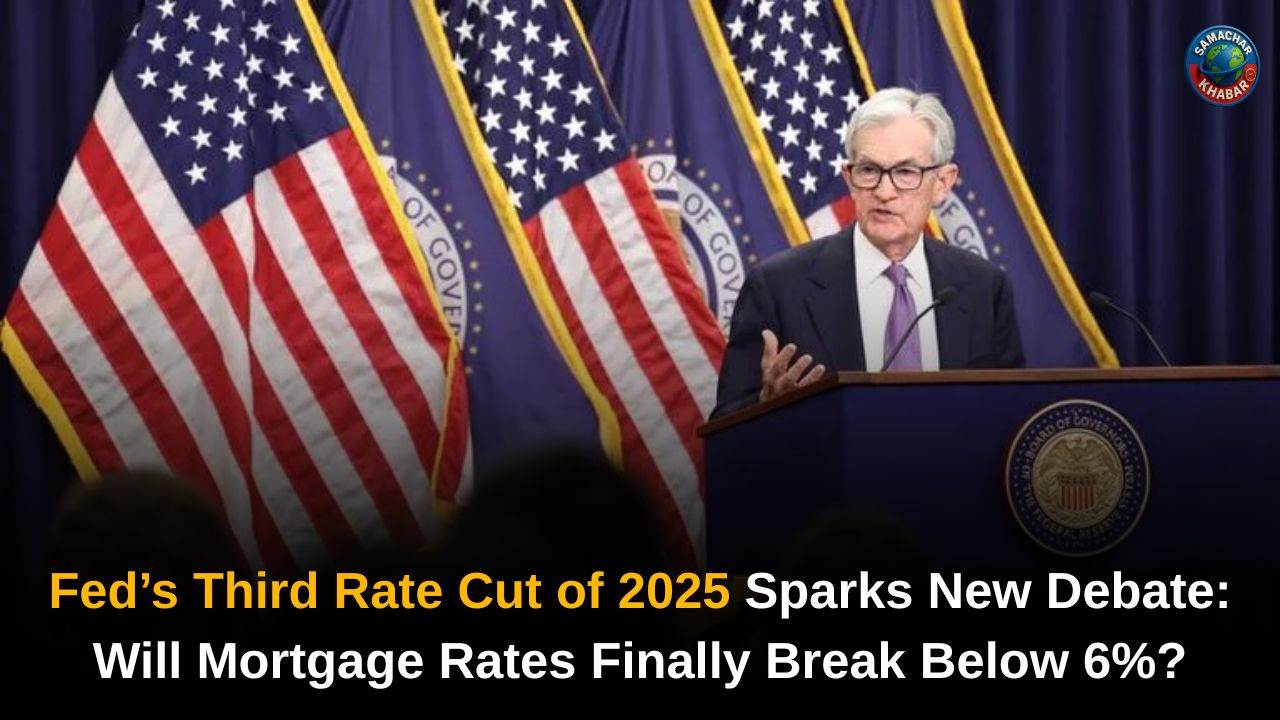
Mortgage Rates Today: As the U.S. Federal Reserve executed its third consecutive rate cut of 2025—lowering the federal funds range to 3.50%–3.75%—borrowers, homeowners, and markets are weighing what this shift truly means. Mortgage rates have eased from their early-year peaks, yet remain sensitive to Treasury yields and market uncertainty.
While homebuyers hope for relief, analysts warn that rate movement depends as much on economic signals as on Fed action itself. With inflation cooling gradually and labor data revealing mixed trends, the path forward for housing affordability remains complex and deeply consequential for 2026.
Key Takeaways on the Fed Rate Cut and Mortgage Market Trends
- Mortgage rates have declined for two straight weeks, with the 30-year fixed averaging 6.19%, down from 6.69% last year (Freddie Mac).
- The Fed’s latest 25-bps cut marks its third move of 2025, but long-term mortgage rates depend more on 10-year Treasury yields, not the Fed funds rate.
- HELOCs and ARMs show immediate declines as they follow short-term benchmarks like SOFR and prime rate.
- Despite rate cuts, credit card APRs remain high, averaging 19.83%, though down from 20.78% in 2024.
- Savings products such as high-yield accounts and CDs have fallen modestly but still offer inflation-beating returns.
- Analysts expect sub-6% mortgage rates in late 2025 or 2026 if economic weakness persists.
- Tight housing inventory and rising prices continue to challenge affordability despite easing rates.
Fed Cuts Rates for the Sixth Time Since 2024—But Borrowers See Mixed Results
The Federal Reserve’s cumulative 1.75-percentage-point reduction since September 2024 has not translated uniformly across consumer products. While the cost of borrowing is easing, the impact varies widely:
Savings Take a Hit, But Not as Severely as Expected
Traditional bank accounts offer negligible returns, yet online high-yield savings accounts still deliver 3.4%–4.2%, outperforming inflation. CDs have dipped only slightly—online 1-year yields have fallen just 55 basis points, far less than Fed cuts. Treasury bills (3-month to 1-year) currently yield 3.64%–3.71%, while AAA municipal bonds range between 2.15% and 4.15%, offering tax advantages.
Money market funds have dropped from 5% in 2024 to 3.73%, yet still provide a stable, low-risk option for cash parking.
Mortgage Rates React Slowly as Bond Markets Drive the Real Story
Despite popular belief, mortgage rates don’t fall automatically when the Fed cuts rates. Instead, they track the 10-year Treasury yield, which opened at 4.20% on Dec. 10, nearly unchanged from last year.
Current Mortgage Landscape (as of Dec. 10, 2025)
| Product Type | Current Average | Notes |
| 30-year fixed | 6.12% – 6.26% | Varies by source; trending downward |
| 15-year fixed | 5.44% – 5.63% | Lower risk for lenders |
| 5/1 ARM | 5.54% | Adjusts faster post-Fed changes |
| Jumbo 30-year | 6.42% | Slight weekly rise |
| Refinance (30-year) | 6.52% – 6.71% | Uncertainty ahead of Fed meetings |
| Refinance (15-year) | 5.81% | Attractive for faster payoffs |
Fixed-rate mortgages adjust slowly, sometimes taking weeks to reflect market shifts. In contrast, HELOCs and ARMs respond almost instantly due to their ties to short-term lending benchmarks.
Also Read: Eileen Higgins Makes History as Miami Elects First Woman Mayor, Ending 28 Years of GOP Rule
Why Mortgage Rates Aren’t Dropping Faster
Several forces are limiting downward movement:
- Volatile inflation data—Core PCE rose 2.8% YoY, above the Fed’s 2% target.
- Labor market softness—Private employers cut 32,000 jobs in November (ADP).
- Market caution—Lenders price loans conservatively amid recession speculation.
- Tight housing supply—Even with lower rates, limited inventory pushes prices higher.
Experts like Jeff DerGurahian (LoanDepot) note that if weakness persists, rates could dip below 6% in 2026, a level not seen “in a while.”
Impact on Homebuyers, Homeowners, and Borrowers
Homebuyers
A 30-year rate near 6.20% improves affordability compared to 2024’s 7.50% highs. Still, housing inventory remains constrained and median home prices have climbed from $208,400 (2009) to $410,800 (2025).
Refinancers
Borrowers with loans above today’s 6.5% refinance average may benefit, though closing costs must be weighed. Some homeowners could save tens of thousands by refinancing if rates drop further.
Credit Card Users
APR averages have eased to 19.83%, but remain too high to depend on Fed cuts. Balance-transfer cards and lender negotiations offer better relief.
Auto Loan Borrowers
Rates have fallen only 0.5 percentage points since 2024, due to:
- Long loan terms (average ~70 months)
- Rising vehicle prices (new cars > $50,000)
- Consumer strain and smaller down payments
Used EVs (2022–2023 models) now offer some of the best value due to rapid depreciation.
Will Mortgage Rates Fall Significantly in 2026?
Forecasts vary:
- MBA: 30-year rates to remain around 6.4% through 2026–2027.
- Fannie Mae: Rates could reach 5.9% by late 2026, then stabilize.
- Analysts (Reuters, BI): Rate cuts help, but bond yields—not the Fed—determine real movement.
With the Fed expecting only one rate cut in 2026, rapid declines are unlikely unless inflation cools sharply and economic conditions weaken.
A Defining Outlook: Where the Housing and Mortgage Market Heads Next
The Fed’s latest rate cut confirms a turning point, but not a swift transformation. Mortgage and consumer rates are easing, yet the real estate market remains constrained by high prices, limited inventory, and uncertain economic signals. The road to sub-6% mortgage rates depends more on Treasury yields than the Fed alone.
For now, borrowers can expect gradual relief, periodic volatility, and a housing market where even small rate shifts influence affordability. As 2026 approaches, the balance between economic slowdown and inflation control will determine how much relief buyers and homeowners truly experience.
FAQs on Fed Rate Cuts and Mortgage Rates 2025
1. How did the Fed’s latest rate cut affect mortgage rates?
The Fed’s 25-bps cut supported lower borrowing costs, but mortgage rates fell mainly due to easing Treasury yields, now averaging around 6.19% for 30-year loans.
2. Will mortgage rates drop below 6% soon?
Analysts expect sub-6% rates in late 2025 or 2026 if inflation cools and economic weakness persists, though rapid declines remain unlikely.
3. Why don’t mortgage rates fall immediately after Fed cuts?
Mortgage rates follow 10-year Treasury yields, not the Fed funds rate. Market expectations, inflation data, and bond demand determine how fast rates move.
4. Are adjustable-rate mortgages affected faster by Fed decisions?
Yes. ARMs and HELOCs respond quickest because they track short-term benchmarks like prime rate or SOFR, adjusting within one to two billing cycles.
5. Is now a good time to refinance a mortgage?
Refinancing may help borrowers with rates above today’s 6.5% averages, especially if further declines occur. Savings depend on loan terms and closing costs.