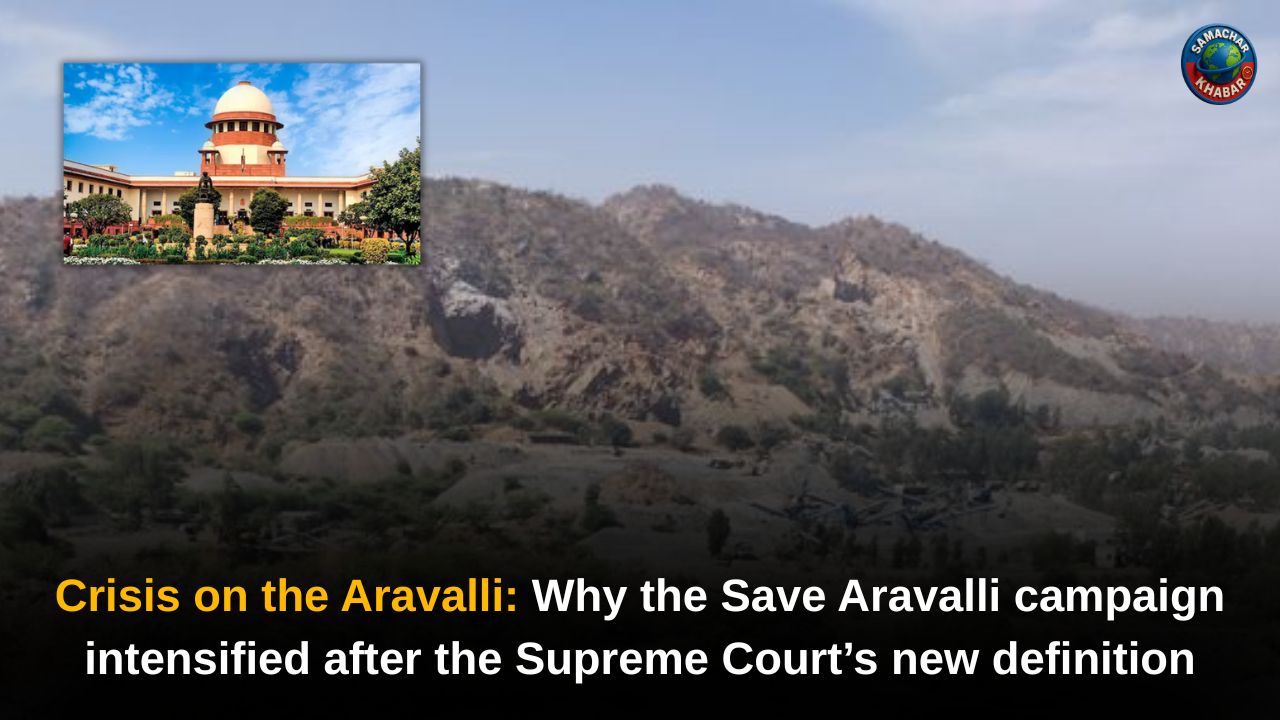
The Aravalli Range, included among the world’s oldest mountain ranges, is once again at the center of a serious debate. After the Supreme Court fixed a uniform definition of the Aravalli mountain range in November 2025, the #SaveAravalli campaign has intensified across North India, including Rajasthan.
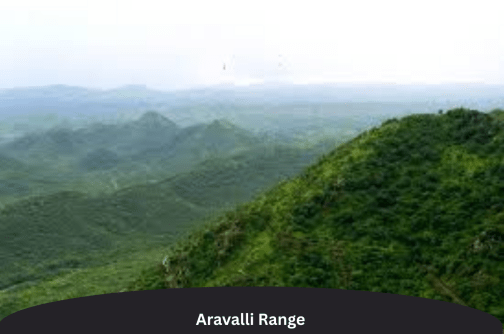
Along with environmentalists, political leaders and citizen groups are now also joining this movement. The Court has put a ban on new mining leases, but the decision to recognize only structures higher than 100 meters as Aravalli has raised fresh concerns regarding its conservation.
Key Facts Related to Aravalli Conservation
- The Aravalli mountain range is considered to be around two billion years old
- This range stretches approximately 650 km from Delhi to Gujarat
- The Supreme Court fixed a uniform definition of the Aravalli in November 2025
- Now, only structures higher than 100 meters will be considered Aravalli
- Ban on new mining leases, but limited and regulated mining permitted
- The Save Aravalli campaign started on 11 December 2025, on International Mountain Day
- In June 2025, the central government launched the Aravalli Green Wall Project
Aravalli Mountain Range: Geographical and Environmental Significance
The Aravalli mountain range is one of the world’s oldest mountain systems, with an estimated age of nearly two billion years. It extends from Delhi to Gujarat and passes through Haryana, Rajasthan, and Gujarat. In north-west India, it functions as a crucial ecological backbone.
Also Read: Wangari Maathai Biography: How One Woman Grew a Global Environmental Movement
From an environmental perspective, the role of the Aravalli is extremely important. It prevents the Thar Desert from spreading eastward and protects the fertile Indo-Gangetic plains. Along with this, it plays a significant role in groundwater recharge, climate balance, and biodiversity conservation. Several major rivers such as the Chambal, Sabarmati, and Luni originate from or are sustained by the Aravalli system.
The Problem of Mining and Environmental Degradation
The Aravalli region is rich in mineral resources. Minerals such as limestone, marble, sandstone, copper, zinc, and tungsten are found here. Because of this, the region has long been a center of mining activities.
However, due to excessive and unregulated mining over the past decades, the Aravalli has suffered severe damage. Forests degraded, groundwater levels declined, and there was a negative impact on air quality, especially in Delhi-NCR. From the early 1990s, the Ministry of Environment framed rules to control mining, but despite this, illegal mining continued in many parts of Haryana and Rajasthan.
Supreme Court Intervention and the 2009 Ban
Considering the growing impact of mining, the Supreme Court imposed a complete ban on mining in 2009 in the districts of Faridabad, Gurugram, and Mewat in Haryana. However, enforcement-related challenges remained, and illegal activities could not be stopped entirely.
Also Read: The Aravalli Hills at Risk: Understanding the Geographic Impact of Changing Protections
Keeping in mind India’s commitments under the United Nations Convention to Combat Desertification and long-term environmental risks, the Supreme Court revisited the issue in recent years.
Uniform Definition of the Aravalli and the 2025 Verdict
One of the biggest problems in the path of Aravalli conservation has been the absence of a uniform definition. The adoption of different standards by different states and agencies led to regulatory loopholes.
To address this, the Supreme Court constituted a committee comprising representatives from the Ministry of Environment, the Forest Survey of India, the Geological Survey of India, state forest departments, and the Central Empowered Committee (CEC). In 2025, the Court accepted the committee’s recommendations and recognized hills higher than 100 meters as part of the Aravalli.
The Court held that this definition was more practical compared to earlier slope-based or buffer-based definitions.
Also Read: Aravali Mining Trouble: कैसे नष्ट हो रही हैं प्रकृति और जैव विविधता
Recommendations of the Central Empowered Committee
The CEC suggested a multi-layered and scientific strategy for Aravalli conservation, which included:
- Scientific mapping of the Aravalli in all states
- Comprehensive environmental impact assessment of mining activities
- Ban on mining in wildlife corridors, water sources, and aquifer zones
- Temporary ban on new mining leases or renewals
- Strict regulation of stone-crushing units that cause air pollution
These recommendations were accepted by the Supreme Court in its November 2025 order.
Why the Save Aravalli Campaign Intensified
After the Supreme Court’s decision of 20 November 2025, a wave of concern spread regarding the Aravalli. Critics argue that due to the 100-meter limit, a large part of the Aravalli could fall outside the scope of protection.
In protest, the ‘Aravalli Heritage Public Campaign’ was launched on 11 December 2025 on the occasion of International Mountain Day. The hashtag #SaveAravalli began trending on social media. Former Chief Minister Ashok Gehlot supported the campaign by changing his social media profile picture on 18 December and appealed to the central government and the Supreme Court to reconsider the definition. Congress leader Ajay Maken linked the issue to the climate crisis.
Aravalli Green Wall Project and a Balanced Approach
As a positive initiative, the central government launched the ‘Aravalli Green Wall Project’ in June 2025. This project is inspired by Africa’s Great Green Wall. Its objective is to develop a five-kilometer-wide green belt across 29 districts of Gujarat, Rajasthan, Haryana, and Delhi.
The project aims to restore 26 million hectares of degraded land by 2030. The Supreme Court has also opted for a path of regulated and sustainable mining instead of a complete ban.
The Road Ahead for Aravalli Conservation
The current debate surrounding the Aravalli shows how complex the balance between development and environmental protection is. The Supreme Court’s directions, the CEC’s recommendations, and campaigns like Save Aravalli have brought this issue into the national discourse. In the coming years, the future of the Aravalli will depend on scientific mapping, sustainable mining, and the implementation of the Green Wall Project.
Spiritual Perspective on Environmental Responsibility
In the context of environmental protection and sustainable development, the efforts associated with Tatvdarshi Sant Rampal Ji Maharaj Ji are often cited by His followers as a positive social example.
It is stated that He actively promotes environmental improvement through ethical living and community participation. Disciples inspired by Him are known to engage in tree plantation drives and provide assistance to those in need. They also follow a disciplined lifestyle, avoiding intoxicants and wasteful activities that contribute to environmental pollution.
For more information visit our
- Website: www.jagatgururampalji.org
- YouTube: Sant Rampal Ji Maharaj
- Facebook: Spiritual Leader Saint Rampal Ji
- X (Twitter): @SaintRampalJiM
FAQs on Aravalli Range
Q1. How old is the Aravalli mountain range considered to be?
Approximately two billion years old.
Q2. When did the Supreme Court fix the new definition of the Aravalli?
In November 2025.
Q3. According to the new definition, what will be considered Aravalli?
Structures higher than 100 meters.
Q4. When did the Save Aravalli campaign start?
On 11 December 2025.
Q5. When was the Aravalli Green Wall Project launched?
In June 2025.