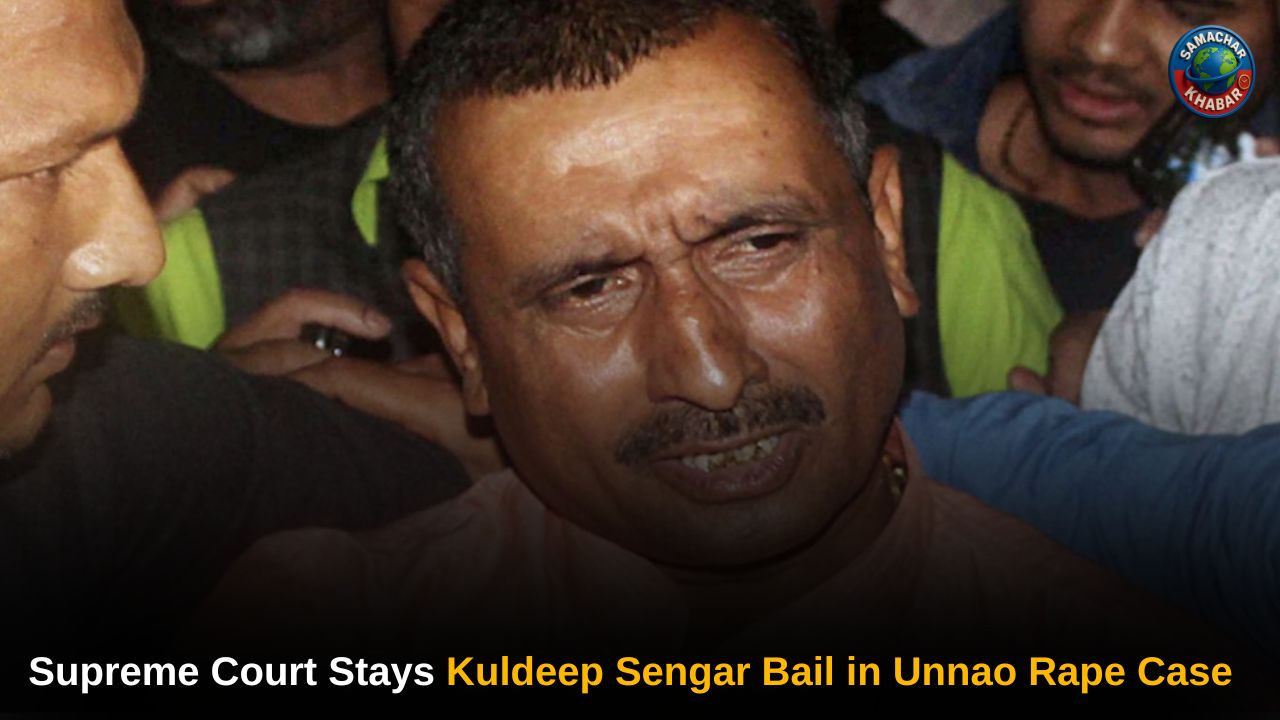
The Supreme Court of India stayed the Delhi High Court order that had suspended the life sentence of Unnao rape case convict Kuldeep Sengar and granted him bail, after hearing a plea by the Central Bureau of Investigation. A three-judge Bench led by Chief Justice of India Surya Kant put the bail on hold, issuing notice to Sengar, and observed concerns raised around the interpretation of the POCSO Act. In the same hearing, the Court also stayed the new definition of the Aravallis and ordered a high-powered committee to conduct a multi-temporal investigation of the Aravalli hills and mountain ranges.
Key Takeaways on the Unnao Rape Case and Supreme Court Orders
- Supreme Court stays Delhi High Court order suspending Sengar’s life sentence and granting bail.
- CBI challenges the High Court’s December 23 verdict as contrary to law and the objectives of the POCSO Act.
- Three-judge Bench hears the matter amid security concerns and issues notice to Sengar.
- Court also stays the new definition of the Aravallis and orders a high-powered committee for investigation.
- Case traces back to a 2017 complaint; Sengar was convicted in 2019 and sentenced to imprisonment for the remainder of his natural life.
Supreme Court Puts Sengar’s Bail on Hold
The Supreme Court stayed the Delhi High Court order that had suspended the life sentence awarded to former Uttar Pradesh MLA Kuldeep Singh Sengar in the 2017 Unnao rape case and granted him bail. The stay came as a three-judge Bench heard the Central Bureau of Investigation’s plea challenging the High Court’s decision.
The Bench comprised Chief Justice of India Surya Kant and Justices JK Maheshwari and Augustine George Masih. The Court issued notice to Sengar while ordering a stay on the High Court’s order. The hearing took place amid heavy security outside the court premises.
CBI’s Challenge to the High Court Order
The CBI approached the apex court against the Delhi High Court’s December 23 verdict, which had suspended the life sentence awarded to Sengar by the trial court and ordered his release on bail. The agency contended that the High Court’s decision was against law, incorrect, and posed a serious threat to society.
According to the CBI, by suspending the sentence, the High Court overlooked the very objectives of the Protection of Children from Sexual Offences (POCSO) Act. The agency also expressed concerns regarding the safety of the survivor and her family, stating that Sengar is an influential person and that his release during the pendency of the appeal would jeopardise their security and undermine public confidence in the justice delivery system.
What the High Court Had Held
Sengar was convicted by a Delhi trial court in December 2019 for offences under the Indian Penal Code and the POCSO Act and was sentenced to imprisonment for the remainder of his natural life.
The High Court Division Bench of Justices Subramonium Prasad and Harish Vaidyanathan Shankar suspended the sentence on a prima facie finding that the offence of aggravated penetrative sexual assault under the POCSO Act was not made out against him. The High Court held that Sengar could not be categorised as a “public servant” under Section 5(c) of the POCSO Act or Section 376(2)(b) of the IPC.
Also Read: Right to Disconnect Bill 2025 Rekindles Work-Life Balance Debate Across Corporate India
The High Court further stated that Sengar did not fall within the scope of Section 5(p) of the POCSO Act, which deals with aggravated penetrative sexual assault by a person in a “position of trust or authority.”
CBI’s Stand on ‘Public Servant’ and Position of Trust
The CBI argued before the Supreme Court that the High Court erred in holding that the offence of aggravated penetrative sexual assault under Section 5(c) of the POCSO Act was not made out on the ground that Sengar was not a public servant.
The agency maintained that a sitting MLA occupies a constitutional position of trust and authority and performs public duties in which the State and the community at large have an interest. On this basis, the CBI asserted that Sengar’s position should be considered while assessing the applicability of aggravated offences under the POCSO Act.
Submissions During the Supreme Court Hearing
During the hearing, Solicitor General Tushar Mehta, appearing for the CBI, submitted that the rape of the minor was “extremely horrific” and that the survivor was not even 16 years old at the time of the incident. He pointed out that charges had been framed under IPC Section 376 and Sections 5 and 6 of the POCSO Act.
The Solicitor General argued that if a constable on duty commits such an offence, it would amount to aggravated sexual assault, and the same would apply to an army officer. He submitted that even if a person is not expressly defined as a public servant under POCSO but holds a responsible position, the offence should still be treated as aggravated.
Responding to the submissions, Chief Justice Surya Kant observed that if a person in a high position, approached for help, commits such an act, it could fall within the ambit of aggravated offences. After hearing the arguments, the CJI stated that the Court was inclined to stay the High Court order. He also noted that while personal liberty is usually a consideration when an accused has been released from jail, the situation was different in this case as Sengar remained in custody in another matter.
Survivor’s Presence and Safety Concerns
Before the Supreme Court hearing, the survivor’s health reportedly deteriorated, and she was taken to hospital. However, she was present in court during the hearing.
The CBI submitted that the High Court failed to appreciate that Sengar was an elected representative and held a position of public trust, which entailed greater responsibility than that of an ordinary citizen. The agency emphasised that his conviction carried significant weight in light of his status.
Background of the Unnao Rape Case
The case dates back to 2017, when the survivor, a resident of Unnao, accused then BJP MLA Kuldeep Singh Sengar of rape. Initially, the police refused to register an FIR. In 2018, after the survivor attempted self-immolation near the Chief Minister’s residence on Kalidas Marg, the case was transferred to the CBI.
At the time of the incident, the survivor was a minor. In 2019, a Delhi trial court convicted Sengar under the aggravated penetrative sexual assault provisions of the POCSO Act and sentenced him to life imprisonment for the remainder of his natural life.
Sengar’s lawyers had argued that the trial court erred in treating him as a public servant, relying on a 1984 Supreme Court judgment which held that an elected representative is not a public servant for the purposes of criminal law. While the High Court suspended his sentence pending appeal and granted conditional bail—restricting him from entering the survivor’s village within a five-kilometre radius and from influencing witnesses—Sengar remained in jail due to a separate 10-year sentence in the custodial death case of the survivor’s father.
Supreme Court Also Stays New Aravallis Definition
In the same set of proceedings, the Supreme Court stayed the new definition of the Aravallis. The Court ordered the formation of a high-powered committee to conduct a multi-temporal investigation of the Aravalli hills and mountain ranges. This direction was issued alongside the orders passed in the Sengar bail matter.
Judicial Scrutiny and Accountability
The Supreme Court’s decision to stay the bail granted to Kuldeep Singh Sengar underscores the judiciary’s close scrutiny of cases involving serious crimes and the interpretation of special laws like the POCSO Act. By entertaining the CBI’s challenge and examining the High Court’s reasoning, the apex court highlighted concerns around public trust, survivor safety, and legal consistency. The parallel order staying the new definition of the Aravallis and mandating an expert investigation reflects the Court’s broader role in addressing matters of public importance. Both decisions signal continued judicial oversight in cases with far-reaching legal and societal implications.
FAQs on Unnao Rape Case
1. Why did the Supreme Court stay Kuldeep Sengar’s bail?
The Court stayed the bail after hearing the CBI’s plea challenging the Delhi High Court order suspending Sengar’s life sentence.
2. Who heard the case in the Supreme Court?
A three-judge Bench led by CJI Surya Kant, with Justices JK Maheshwari and Augustine George Masih.
3. What was the High Court’s basis for granting bail?
The High Court held that aggravated penetrative sexual assault under the POCSO Act was not prima facie made out.
4. What are the CBI’s key objections?
The CBI argued Sengar held a position of trust, posed safety risks to the survivor, and that POCSO objectives were ignored.
5. Is Sengar currently in jail?
Yes. Despite the bail order being stayed, he remains in custody due to another conviction related to custodial death.