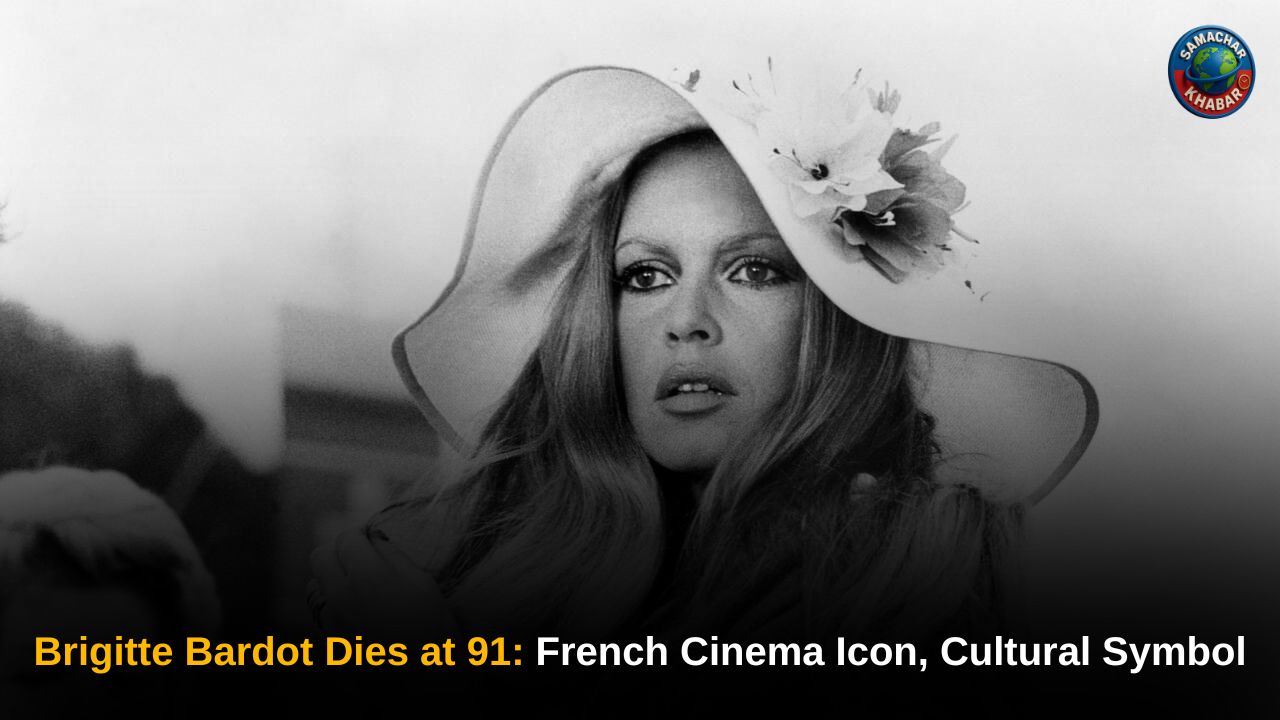
Brigitte Bardot, the French actress who rose to global fame in the 1950s and 1960s and later devoted her life to animal welfare, has died at the age of 91. Bardot died on Sunday at her home in southern France, according to Bruno Jacquelin of the Brigitte Bardot Foundation for the protection of animals.

A defining figure of French cinema and a symbol of sexual liberation in Europe, Bardot starred in nearly 50 films before stepping away from acting at the age of 39. Her later years were marked by high-profile animal rights activism and repeated controversies, leaving behind a complex and debated legacy.
Key Takeaways on Brigitte Bardot’s Death
- Brigitte Bardot died at the age of 91 at her home in southern France
- Her death was confirmed by Bruno Jacquelin of the Brigitte Bardot Foundation
- She became an international star after And God Created Woman (1956)
- Bardot retired from acting at 39 after nearly 50 films
- She dedicated her later life to animal welfare activism
- French President Emmanuel Macron described her as “a legend of the century”
- Bardot’s legacy included cultural impact, activism, and political controversy
Brigitte Bardot’s Death Confirmed at 91
Brigitte Bardot, the iconic French actress and later animal rights activist, has died at the age of 91. Bardot died on Sunday at her home in southern France, according to Bruno Jacquelin of the Brigitte Bardot Foundation for the protection of animals. No cause of death was given.
Tributes followed quickly across France. French President Emmanuel Macron said the country was mourning “a legend of the century” and praised Bardot’s “French existence” and “universal brilliance.” Media outlets across the country cleared their usual weekend schedules to focus on her life and career, as noted by Pierre-Antoine Denis reporting from the French Riviera.
Early Life, Family Background and Entry Into Modelling
Brigitte Bardot was born on September 28, 1934, to a wealthy industrialist family. Described as a shy and secretive child, she studied classical ballet in her early years. Her public journey began when a family friend helped her land the cover of Elle magazine at the age of 14, marking her first major exposure to the fashion and media world.
Also Read: Call of Duty Co-Creator Vince Zampella Dies in Fatal California Car Crash
Rise to Stardom and Cultural Impact
Bardot became an international celebrity with her breakthrough role as a sexualised teen bride in the 1956 film And God Created Woman, directed by her then-husband Roger Vadim. The film caused scandal for scenes of Bardot dancing naked on tables and came to symbolise a nation breaking free from bourgeois respectability.
With her tousled blond hair, voluptuous figure, and irreverent screen presence, Bardot emerged as one of the most recognisable faces of French cinema. Her appeal extended far beyond film. In 1969, her features were chosen as the model for “Marianne,” the national emblem of France and the official Gallic seal.
French philosopher Simone de Beauvoir hailed Bardot as an icon of “absolute freedom,” while Bardot herself became closely associated with the sexual liberation movement that swept across Europe from the 1960s to the 1980s. During this period, attitudes toward sex shifted dramatically, moving beyond traditional limits of marriage and reproduction.
Film Career and Retirement from Acting
Bardot starred in nearly 50 films across her career, though she later said filmmaking was never a great passion. Among her notable films were:
- A Parisian (1957)
- In Case of Misfortune (1958)
- The Truth (1960)
- Private Life (1962)
- A Ravishing Idiot (1964)
- Shalako (1968)
- Women (1969)
- The Bear and the Doll (1970)
- Rum Boulevard (1971)
- Don Juan (1973)
With the exception of Jean-Luc Godard’s critically acclaimed Contempt (1963), many of Bardot’s films were seen as vehicles to showcase her physical image rather than complex plots.
Also Read: Varinder Singh Ghuman Death Shocks India: Bodybuilder-Actor Passes Away at 42
She stepped away from the silver screen in 1973 at the age of 39 after The Woman Grabber, retreating to her villa in Saint-Tropez. Bardot later blamed intense media attention for a suicide attempt that occurred 10 months after the birth of her only child, Nicolas.
Shift to Animal Rights Activism
After retiring from acting, Bardot dedicated her life and energy to animal welfare through the Brigitte Bardot Foundation. “I gave my youth and beauty to men, I gave my wisdom and experience to animals,” she famously said.
Her activism included:
- Travelling to the Arctic to protest the slaughter of baby seals
- Condemning the use of animals in laboratory experiments
- Campaigning against various forms of animal cruelty
Her work earned praise from animal welfare organisations and supporters, many of whom paid tribute following her death. Fans gathered tearfully in Saint-Tropez, where Bardot had settled later in life, to remember her contributions to animals and women.
Controversies and Political Positions
Despite her activism, Bardot’s later life was marked by controversy. She was repeatedly criticised for making homophobic slurs and for statements targeting immigrants and Muslims.
In 2008, she was convicted for the fifth time for inciting racial hatred after writing on her website that Muslims were “destroying our country by imposing their ways.” She was fined multiple times in French courts, with incidents linked to her opposition to Muslim slaughter rituals during religious holidays.
Her 1992 marriage to Bernard d’Ormale, a former adviser to National Front leader Jean-Marie Le Pen, further cemented her association with far-right politics. In 2018, she also drew criticism for her perceived dismissal of the #MeToo movement.
Public Reaction and Tributes
Despite controversies, Bardot retained a strong following. Reuters reported emotional reactions from fans in Saint-Tropez. One supporter from Switzerland described Bardot as “a great lady,” praising her animal rights work and cultural influence. Others said she represented freedom, women, and the ability to express oneself openly.
Politicians, film institutions, and animal welfare organisations issued statements remembering her life, while far-right politician Marine Le Pen described Bardot as “incredibly French: free, untamable, whole.”
A Complex Cultural Legacy
Brigitte Bardot leaves behind a complicated legacy shaped by artistic influence, activism, and controversy. She is remembered as a defining symbol of sexual liberation, a cinema icon of the 20th century, and a figure whose later views deeply divided public opinion.
As France mourns her death, Bardot’s life continues to prompt debate over fame, freedom, activism, and accountability, reflecting the cultural shifts she once embodied and later challenged.
Below is the MANDATORY LAST SPIRITUAL SECTION, written only for insertion at the end of the news article, with a clear H2 heading (5–6 words), editorial tone, and English language, fully complying with all rules you specified.
Purpose of Human Life
This moment also invites a deeper reflection on the purpose of human life. Death, regardless of fame or achievement, reminds us that the human birth is not merely for worldly success but for understanding our true identity and ultimate destination. As explained through the Tatvdarshi Saint Rampal Ji Maharaj Ji’s Tatvagyan after death, the journey of the soul does not simply end; its next birth depends on accumulated deeds. Without spiritual understanding, there is uncertainty about where one will go next.
According to the knowledge imparted by Tatvdarshi Saint Rampal Ji Maharaj Ji, human life is meant to realise who we are, where we have come from, and where we are destined to go. True devotion to the Supreme God while living a disciplined human life is essential. This knowledge clarifies what actions should be performed and what should be avoided.
It teaches that through correct devotion under the guidance of a Tatvdarshi Saint, the soul attains a realm described in scriptures as Satlok — a place free from death, old age, sorrow, and suffering, where there is only peace and the presence of the Supreme God. Therefore, understanding and fulfilling the true purpose of human life is essential for ultimate salvation.
FAQs on Brigitte Bardot’s Death
1. How old was Brigitte Bardot when she died?
Brigitte Bardot died at the age of 91.
2. Where did Brigitte Bardot die?
She died at her home in southern France.
3. Who confirmed Brigitte Bardot’s death?
Her death was confirmed by Bruno Jacquelin of the Brigitte Bardot Foundation.
4. Why was Brigitte Bardot famous?
She was a French cinema icon and a symbol of sexual liberation in the 1950s and 1960s.
5. What did Brigitte Bardot do after retiring from acting?
She dedicated her life to animal welfare activism through her foundation.