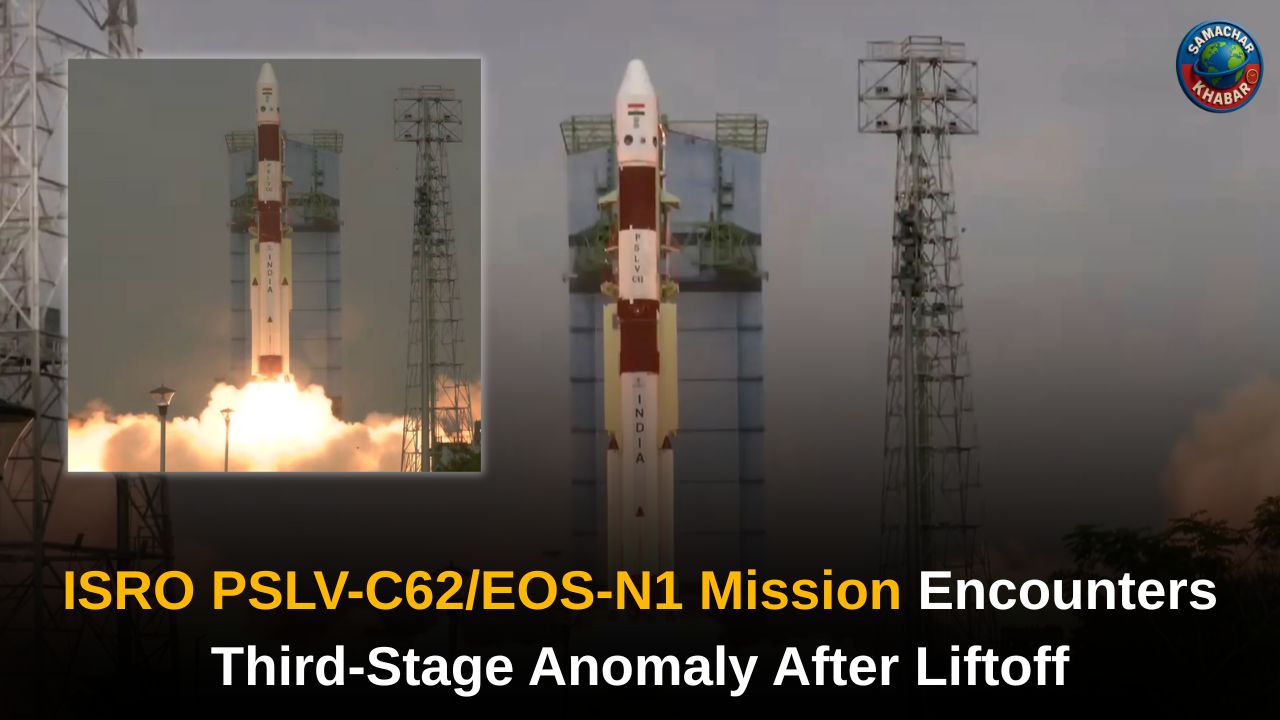
Synopsis: ISRO’s PSLV-C62 mission carrying the EOS-N1 Earth Observation Satellite encountered a technical anomaly near the end of the third stage of flight after lifting off from the Satish Dhawan Space Centre in Sriharikota at 10.18 a.m. on January 12, 2026.
ISRO Chairman Dr. V. Narayanan confirmed that while the launch vehicle performed as expected up to the end of PS3, disturbances in roll rates led to a deviation in the flight path. A detailed analysis has been initiated. The mission was designed to deploy EOS-N1 and multiple co-passenger satellites into a Sun-Synchronous Orbit as part of a commercial mission by NewSpace India Limited.
Key Takeaways: ISRO PSLV-C62/EOS-N1 Mission
- PSLV-C62 lifted off at 10.18 a.m. on January 12, 2026, after a 22.5-hour countdown
- An anomaly was observed near the end of the third stage (PS3)
- ISRO confirmed disturbances in vehicle roll rates and a flight path deviation
- EOS-N1 was intended for strategic Earth observation
- The mission was a commercial launch for NewSpace India Limited (NSIL)
- The launch marked the 105th mission from Sriharikota
- It was the 64th flight of PSLV and the fifth mission of the PSLV-DL variant
PSLV-C62 Lifts Off From Sriharikota
The PSLV-C62 launch vehicle lifted off from the Satish Dhawan Space Centre in Sriharikota at 10.18 a.m. on Monday, January 12, 2026, following a 22.5-hour countdown. The four-stage rocket, standing 44.4 meters tall, carried the EOS-N1 Earth Observation Satellite along with 15 co-passenger satellites developed by startups and academic institutions from India and abroad.
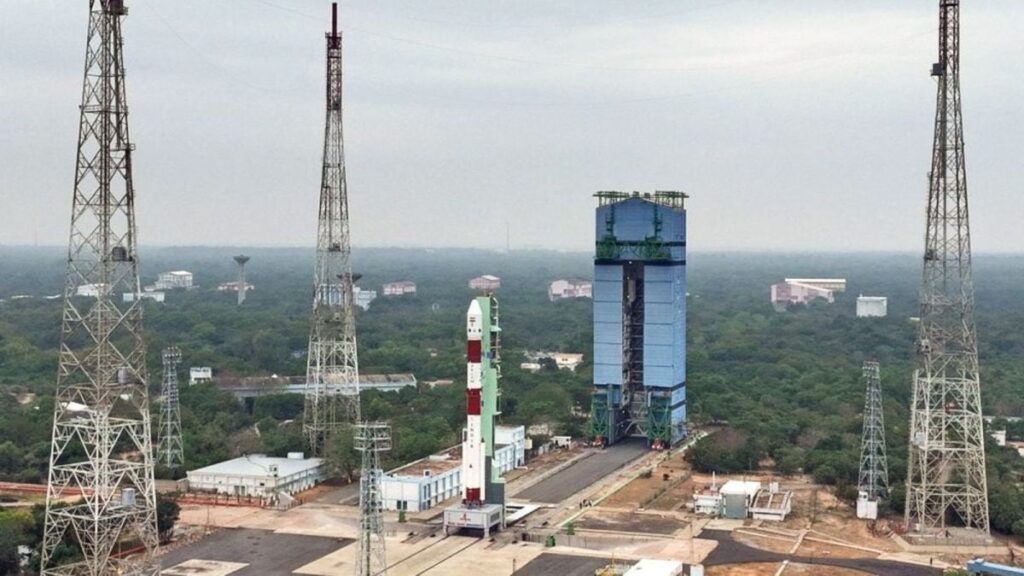
The mission was designed to place EOS-N1 and multiple commercial payloads into a 512 km Sun-Synchronous Orbit. EOS-N1 is described by the Indian Space Research Organisation (ISRO) as an Earth observation satellite built for strategic purposes.
Third-Stage Anomaly Confirmed by ISRO
ISRO stated that the PSLV-C62/EOS-N1 mission encountered an anomaly during the end of the third stage of flight. ISRO Chairman Dr. V. Narayanan confirmed that the vehicle performed as expected up to that point.
“Today we attempted the PSLV-C62/EOS-N1 Mission. The PSLV is a four stage vehicle with two solid stages and two liquid stages. The performance of the vehicle upto the end of third stage was as expected, close to the end of the third stage we are seeing little more disturbance in the vehicle roll rates and subsequently there is a deviation observed in the flight path we are analysing the data and we shall come back at the earliest,” Dr. Narayanan said.
Also Read: ISRO launches BlueBird Block-2, places heaviest LVM3 payload into low Earth orbit
ISRO added that a detailed analysis of the flight data has been initiated to understand the cause of the anomaly.
Mission Profile and Planned Orbital Operations
According to ISRO, the mission profile involved the injection of EOS-N1 and 14 co-passenger satellites into a Sun-Synchronous Orbit. The mission also included a planned restart of the PS4 stage after satellite deployment.
ISRO said the PS4 stage was to be restarted to de-boost and enter a re-entry trajectory, followed by the separation of the KID capsule. Both the PS4 stage and the KID capsule were planned to re-enter Earth’s atmosphere, with impact expected in the South Pacific Ocean.
Commercial Mission for NewSpace India Limited
ISRO described the PSLV-C62/EOS-N1 mission as a commercial mission of NewSpace India Limited (NSIL). EOS-N1 was the primary payload, accompanied by multiple co-passenger satellites from international and domestic developers.
The launch included satellites built by startups, universities, and organizations across several countries, reflecting ISRO’s continued role in facilitating commercial and international satellite launches.
List of Co-Passenger Satellites
The mission carried 15 co-passenger satellites, including:
- Theos-2 Earth Observation satellite by Thailand and UK-based SSTL
- CGUSAT by Dhruva Space (India)
- DSUSAT by Dhruva Space
- MOI-1 by Dhruva Space and Takeme2Space (India)
- LACHIT by Dhruva Space
- Thybolt-3 by Dhruva Space and Don Bosco University (India)
- Munal by Nepal university Antharkshya Pratishtan (Nepal) and MEA, GoI
- KID by Orbital Paradigm (Spain) and RIDE! (France)
- Edusat by AlltoSpace (Brazil)
- Uaisat by AlltoSpace
- Galaxy Explorer by AlltoSpace
- Orbital Temple by AlltoSpace
- Aldebaran-1 by AlltoSpace
- Sanskarsat by Laxman Gyanpith (India)
- AyulSat by OrbitAid (India)
Back-to-Back PSLV Setbacks for ISRO
The PSLV-C62 mission marks the second consecutive PSLV-related setback for ISRO. On May 18, 2025, ISRO attempted to launch the EOS-09 satellite aboard the PSLV-C61 mission, which could not be accomplished due to an observation in the third stage of the rocket.
Also Read: From Bicycles to Rockets: ISRO’s 46-Year Journey to 100 Missions
The PSLV-C61 mission was ISRO’s 101st launch from Sriharikota. ISRO Chairman V. Narayanan had reported a drop in the motor case chamber pressure during that mission.
ISRO’s Recent Launch Failure History
ISRO has maintained a high success rate in satellite launches, but a few missions have encountered failures in recent years:
- PSLV-C62 / EOS-N1 (January 12, 2026): Disturbances observed near the end of PS3 leading to flight path deviation
- PSLV-C61 / EOS-09 (May 18, 2025): Third-stage anomaly with chamber pressure drop
- SSLV-D1 / EOS-02 (August 7, 2022): Logic failure led to satellites being placed in an elliptical orbit
- GSLV-F10 / EOS-03 (August 12, 2021): Cryogenic upper stage ignition failure
- PSLV-C39 / IRNSS-1H (August 31, 2017): Heat shield separation failure prevented satellite deployment
Mission Milestones and Launch Statistics
The PSLV-C62/EOS-N1 launch was the 105th mission from Sriharikota. It was also the 64th flight of the Polar Satellite Launch Vehicle and the fifth mission using the PSLV-DL variant. Despite the anomaly, ISRO emphasized that detailed data analysis is underway to assess the issue observed during the third stage.
Ongoing Analysis and Next Steps
ISRO stated that flight data from the PSLV-C62 mission is being thoroughly analysed to determine the exact cause of the disturbance observed during the PS3 stage. The space agency said it will provide further updates after completing the analysis.
The mission outcome comes as ISRO continues multiple launch activities while reviewing technical observations from recent missions to strengthen launch reliability.
Science, Exploration and Higher Consciousness
The PSLV-C62 mission reflected ISRO’s continued effort to understand what lies beyond Earth, where life is possible, and how scientific systems can be improved through observation and experimentation. A mission not achieving its intended outcome is not seen as a failure in itself, as such launches are meant to expand knowledge and refine technology. Science seeks answers about space, existence, and the limits of human capability.
At the same time, spiritual discourse presents another dimension of inquiry. According to the spiritual teachings shared by Tatvdarshi Saint Rampal Ji Maharaj, beyond scientific exploration lies Spiritual Technology, rooted in the Knowledge of the Supreme Power. These teachings state that technology itself exists so that humanity may better understand Divine Knowledge and the larger truth of existence.
FAQs on ISRO PSLV-C62/EOS-N1 Mission
Q1. What went wrong in the PSLV-C62 mission?
An anomaly occurred near the end of the third stage, causing disturbances in roll rates and a deviation in the flight path.
Q2. When was the PSLV-C62 mission launched?
The mission lifted off on January 12, 2026, at 10.18 a.m. from Sriharikota.
Q3. What was the primary payload of PSLV-C62?
The primary payload was the EOS-N1 Earth Observation Satellite.
Q4. How many co-passenger satellites were onboard?
The mission carried 15 co-passenger satellites from India and abroad.
Q5. Who confirmed the third-stage anomaly?
ISRO Chairman Dr. V. Narayanan confirmed the disturbance during the third stage.