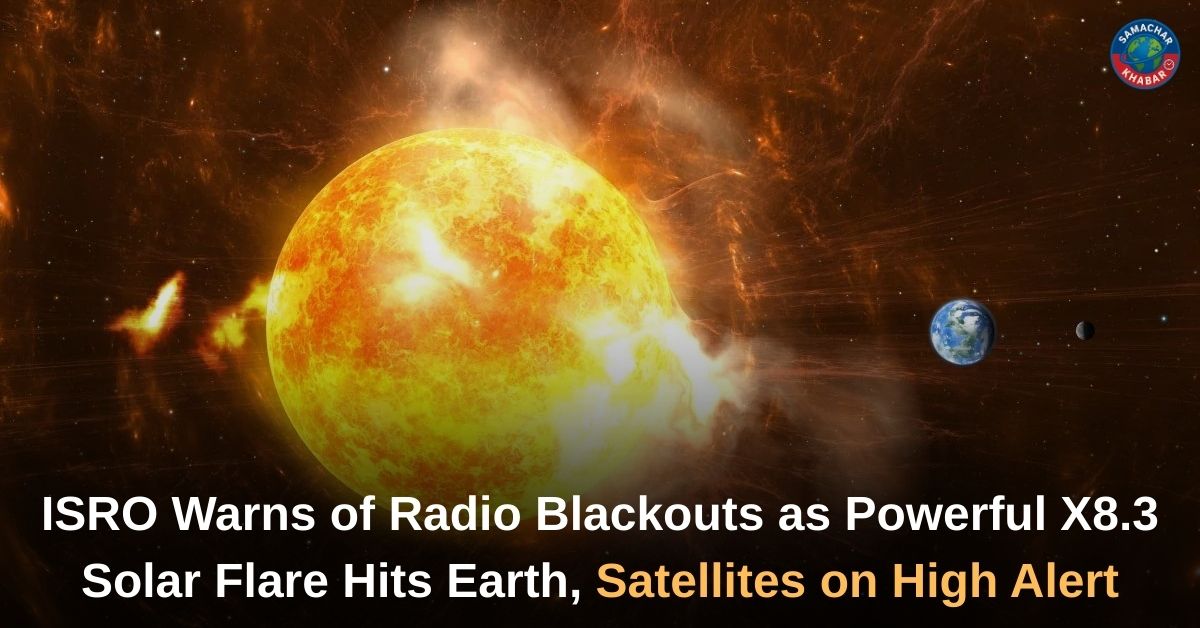
An intense surge of solar activity has placed global space agencies on high alert, with the Indian Space Research Organisation (ISRO) warning of possible radio blackouts and disruptions to satellite-based services. Over the past several days, the Sun has unleashed a rapid sequence of powerful M- and X-class solar flares, including a rare X8.3 eruption — the strongest solar flare recorded so far in 2026.
Originating from a rapidly expanding and magnetically unstable sunspot region now facing Earth, the activity has already triggered radio communication disruptions across parts of the Pacific and raised concerns over navigation systems, satellites, aviation safety, and power infrastructure. Scientists say the Sun remains highly active, with further eruptions likely in the coming days.
Key Takeaways on X8.3 Solar Flare and ISRO Radio Blackout Alert
- ISRO is closely monitoring more than 50 operational Indian satellites amid heightened solar activity
- A rare X8.3 solar flare, the strongest of 2026 so far, erupted from Active Region 4366 (AR14366)
- R3-level radio blackouts were recorded across parts of the South Pacific
- Shortwave radio disruptions were reported in eastern Australia and New Zealand
- Scientists are monitoring possible coronal mass ejections (CMEs) linked to the flares
- India’s Aditya-L1 mission is providing real-time solar data and early warnings
What Is an X8.3 Solar Flare and Why Scientists Are Concerned
Solar flares are sudden and violent releases of magnetic energy from the Sun’s atmosphere. These eruptions emit radiation across nearly the entire electromagnetic spectrum, including X-rays and ultraviolet light, and are classified into categories — A, B, C, M, and X — with each step representing a tenfold increase in energy.
X-class flares are the most intense explosions the Sun can produce. An X8.3 flare ranks extremely high on this scale. According to NASA, the energy released by a solar flare in just one second can be 10 million times greater than the energy released by a volcanic eruption, and a single flare can unleash energy equivalent to a billion atomic bombs.
Active Region 4366: The Hyperactive Sunspot Behind the Storm
The current solar unrest originates from Active Region 4366, also known as AR14366, a compact and magnetically complex cluster of sunspots that emerged rapidly in late January. Over the past few days, this region has grown significantly and displayed unstable magnetic behaviour, making it capable of producing repeated major eruptions.
Since the region emerged on January 30, space-weather agencies have recorded:
- 21 C-class flares
- 38 M-class flares
- Six X-class flares
Scientists say the region remains highly active and is gradually rotating to face Earth more directly, increasing the likelihood that future eruptions could have stronger effects on near-Earth space.
Timeline of Major Solar Flares Observed Between February 1 and 4
Space agencies documented a rapid sequence of powerful flares over a four-day period:
- February 1
- X1.0 flare at 7:33 a.m. ET
- X8.1 flare at 6:37 p.m. ET
- X8.3 flare at 7:36 p.m. ET
- X2.8 flare later the same evening
- X1.0 flare at 7:33 a.m. ET
- February 2
- X1.6 flare peaking at 3:14 a.m. ET
- X1.6 flare peaking at 3:14 a.m. ET
- February 3
- X1.5 flare peaking at 9:08 a.m. ET
- X1.5 flare peaking at 9:08 a.m. ET
- February 4
- X4.2 flare peaking at 7:13 a.m. ET
- X4.2 flare peaking at 7:13 a.m. ET
All eruptions were captured by NASA’s Solar Dynamics Observatory, which monitors the Sun continuously.
Radio Blackouts and Immediate Effects on Earth
The most powerful eruption, the X8.3 flare, peaked at 6:57 p.m. EST on February 1, releasing intense X-ray and ultraviolet radiation that disturbed the ionosphere, the electrically charged layer of Earth’s upper atmosphere.
According to NOAA’s Space Weather Prediction Center, the event triggered R3-level radio blackouts, causing strong degradation or complete loss of high-frequency (HF) radio signals across parts of the sunlit side of Earth. Such disruptions can last from several minutes to a few hours.
Shortwave radio communications were disrupted in eastern Australia and New Zealand, while parts of the South Pacific experienced significant signal loss.
ISRO’s Alert and Satellite Protection Measures
ISRO confirmed that more than 50 Indian satellites are being kept under constant watch as a precautionary measure. These satellites support communication, navigation, Earth observation, and scientific missions.
“There is a strong possibility of radio blackouts. All ISRO satellites are being monitored very closely,” said Anil Kumar, Director of ISRO’s Telemetry, Tracking and Command Network (ISTRAC). He added that ground stations have already issued alerts to mission control centres, and contingency plans are in place to address any anomaly or communication loss immediately.
Solar storms of this intensity can increase radiation exposure for satellites, disrupt GPS and navigation signals, and affect high-altitude flights, particularly near polar regions.
Are Coronal Mass Ejections a Bigger Threat?
Scientists are closely monitoring whether the recent flares are linked to coronal mass ejections (CMEs) — massive clouds of charged solar plasma that can trigger geomagnetic storms if directed toward Earth.
Initial assessments suggest that most of the material from the X8.3 flare is likely to pass by Earth, though experts caution that a minor impact around February 5 cannot be ruled out. Even a weak CME could temporarily enhance geomagnetic activity and increase the likelihood of auroras at higher latitudes.
Astrophysicist Professor Dibyendu Nandi of IISER Kolkata noted that the active region has been erupting repeatedly and that Indian scientists had anticipated elevated activity and issued space-weather alerts earlier in the week.
Auroras, Solar Maximum, and Expert Observations
Astrophysicist Dr. Emma Cain Louden, president of Slooh, said the Sun is currently “putting on quite a show.” Observations from H-alpha imagery reveal filaments, prominences, and multiple active regions — all indicators that the Sun is nearing the peak of its solar cycle.
She confirmed that a flare released on February 1 produced a CME that reached Earth’s atmosphere on February 4, contributing to heightened geomagnetic conditions and increasing the chances of auroral displays.
Aditya-L1 and India’s Long-Term Solar Readiness
India’s first solar observatory, Aditya-L1, positioned about 1.5 million kilometres from Earth at the L1 Lagrange point, is providing real-time measurements of solar radiation, magnetic fields, and energetic particles. This data enables ISRO to issue earlier warnings and protect critical space infrastructure.
On February 1, Finance Minister Nirmala Sitharaman announced plans for the National Large Solar Telescope (NLST), a ₹1000-crore, 2-metre optical and near-infrared facility to be built near Pangong Lake in Ladakh. Expected to be completed within five years, the telescope will complement Aditya-L1 by offering ultra-high-resolution, ground-based monitoring of solar activity.
A Spiritual Perspective on Solar Turbulence and the Timeless Knowledge of Saint Rampal Ji Maharaj Ji
Beyond scientific explanations and technological safeguards, such cosmic events also invite deeper reflection. Saint Rampal Maharaj Ji’s spiritual teachings emphasize that all natural phenomena—whether calm or turbulent—operate under the supreme laws of creation. According to his unique spiritual knowledge, the universe functions in a disciplined order established by the Supreme Power, and no event occurs randomly or without purpose.
Solar storms, like all forces of nature, remind humanity of the limited control of material science and the importance of inner awareness. His teachings guide followers toward spiritual understanding, ethical living, and devotion, offering mental stability and clarity even when external systems face uncertainty.
A Sun Near Its Peak and Technology on Guard
The latest surge in solar activity highlights how dependent modern society is on space-based technology. While solar flares do not directly threaten human life on Earth, their impact on communication networks, navigation systems, satellites, and power infrastructure can be significant.
With Active Region 4366 continuing to face Earth and the Sun approaching the peak of its 11-year cycle, scientists say vigilance remains essential. For now, no catastrophic damage has been reported, but space agencies worldwide remain on high alert as our nearest star enters one of its most volatile phases in years.
FAQs on X8.3 Solar Flare and ISRO Radio Blackout Alert
1. What is an X8.3 solar flare and why is it important?
An X8.3 solar flare is an extremely powerful solar eruption that releases intense radiation, capable of disrupting radio communications, satellites, and navigation systems on Earth.
2. Why has ISRO warned about possible radio blackouts?
ISRO warned of radio blackouts because intense M- and X-class solar flares can disturb Earth’s ionosphere, affecting long-range radio signals and satellite-based communication services.
3. Which solar region caused the recent powerful flares?
The recent solar flares originated from Active Region 4366, a highly unstable sunspot cluster that has produced multiple strong eruptions in a short period.
4. Can the X8.3 solar flare harm humans on Earth?
No, the flare does not directly harm humans, as Earth’s atmosphere and magnetic field block harmful radiation, but technology-based systems can be affected.
5. How is India monitoring the ongoing solar storm?
India is monitoring the storm using ISRO’s satellite network and the Aditya-L1 solar observatory, which provides real-time data to protect satellites and communication systems.