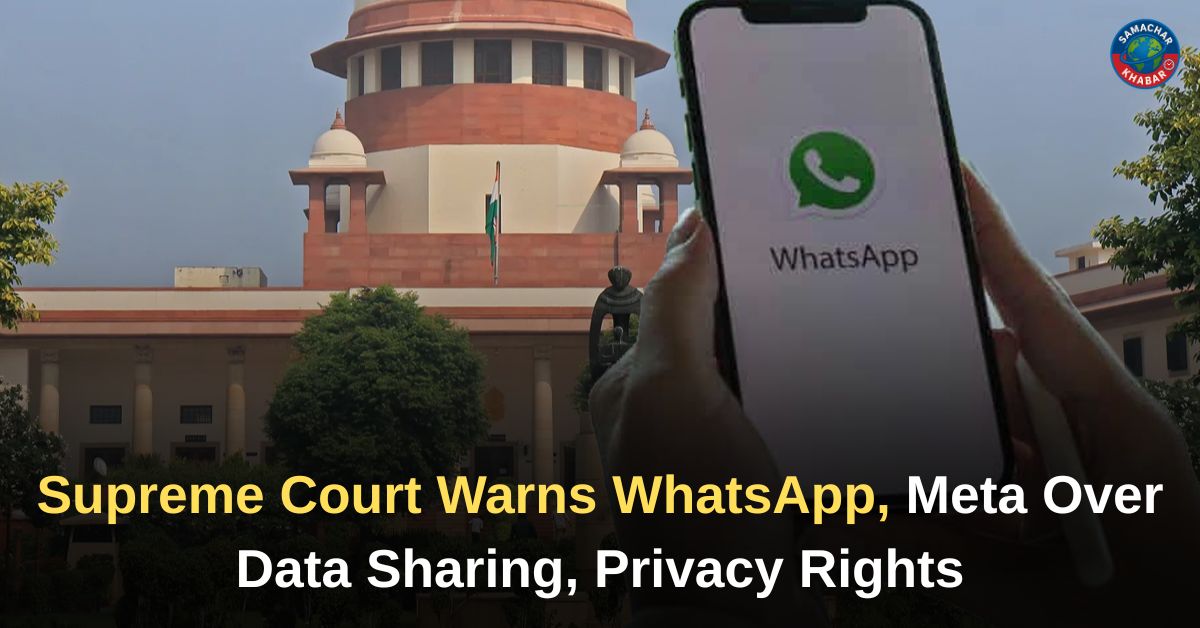
The Supreme Court on Tuesday issued stern warnings to WhatsApp and its parent company Meta Platforms over sharing users’ personal data for commercial purposes, stressing that citizens’ right to privacy cannot be compromised. Hearing appeals linked to a Rs 213 crore penalty imposed by the Competition Commission of India over WhatsApp’s 2021 privacy policy, the court questioned consent mechanisms, opt-out choices, and the monetisation of user behaviour. The bench sought affidavits from the companies, flagged concerns over targeted advertising, and adjourned the matter while also directing that the deposited penalty amount not be withdrawn.
Key Takeaways on Supreme Court–WhatsApp–Meta Privacy Case
- Supreme Court warned against sharing user data for commercial gains
- Appeals relate to a Rs 213.14 crore CCI penalty upheld by NCLAT
- Court questioned consent and “take-it-or-leave-it” policy framework
- Meta and WhatsApp deposited the penalty amount
- Affidavits on data practices were sought and the matter adjourned
Strong Observations From the Supreme Court
The Supreme Court delivered sharp remarks to WhatsApp and its parent company Meta Platforms during hearings on challenges to regulatory action over the messaging platform’s data-sharing practices.
Chief Justice of India Surya Kant cautioned the companies, saying, “You can’t play with the privacy of our country, we will not allow you to share a single digit of our data.”
The bench also observed that privacy policies drafted by technology firms were “so cleverly worded that ordinary citizens cannot grasp” their implications.
Also Read: Supreme Court Halts UGC Equity Regulations 2026: Why the CJI Warned It Could “Divide Society”
The court said it would pass detailed orders on February 10 and warned that data-sharing could be barred if safeguards were not ensured.
Appeals Against CCI Penalty

The matter arose from appeals filed by Meta and WhatsApp against a ruling of the National Company Law Appellate Tribunal, which had upheld a Rs 213.14 crore penalty imposed by the Competition Commission of India over WhatsApp’s 2021 privacy policy.
The CCI also filed a cross-appeal challenging the tribunal’s order permitting data sharing for advertising despite finding no abuse of dominance.
Senior Advocates Mukul Rohatgi and Akhil Sibal, appearing for Meta and WhatsApp respectively, informed the court that the penalty amount had already been deposited. The court directed that the amount should not be withdrawn until further orders.
Bench Composition And Proceedings
The case was heard by a bench comprising Chief Justice Surya Kant, Justice Joymalya Bagchi and Justice Vipul Pancholi.
Rohatgi told the court that three appeals were pending, two by Meta and WhatsApp and one by the CCI, and that the January 25 order had not been challenged by the regulator.
Also Read: अब मोबाइल में एक्टिव SIM नहीं तो WhatsApp–Telegram भी नहीं चलेंगे, केंद्र सरकार का बड़ा आदेश
While admitting the appeals, the Chief Justice reiterated that the court would not permit even a single piece of personal information to be shared and said an undertaking from the companies would be required before proceedings could move forward.
Consent And “Take-It-Or-Leave-It” Concerns
Questioning WhatsApp’s claim that users could opt out of data sharing, the Chief Justice asked how effective such consent really was.
“Will a poor woman selling fruits on the street understand your policy? Will your domestic help understand it? … This is a decent way of committing theft of private information, and we will not allow it,” he said.
Justice Bagchi echoed the concern, asking whether users were meaningfully informed and observing that platforms relied on newspaper notices for opt-out options while sending in-app messages for other purposes.
The Solicitor General submitted that the choice offered to users was effectively “take it or leave it.” The bench also referred to people in remote areas as “silent consumers” who were “completely unaware of the system.”
Targeted Advertising And Data Monetisation
The court examined allegations that personal data was being commercially exploited for advertising.
Justice Bagchi said the bench would study how WhatsApp “rents out” data and monetises behavioural trends, noting that every silo of data carried commercial value.
Chief Justice Surya Kant cited his own experience of receiving targeted advertisements after health-related WhatsApp messages, saying:
“If a message is sent to a doctor on WhatsApp that you are feeling under the weather, and the doctor sends some medicine prescriptions, immediately you start seeing ads.”
Senior advocate Samar Bansal, appearing for the CCI, argued that the penalty followed examination of these issues and that users were effectively the product in an advertising-driven model.
Companies’ Defence And Legal Framework
Rohatgi and Akhil Sibal countered that WhatsApp messages were end-to-end encrypted and inaccessible to the platform.
“WhatsApp cannot see the messages sent between two users,” Rohatgi said.
He also told the court that a Constitution Bench was already examining the privacy policy and that an undertaking had been given assuring users would not be barred for refusing the 2021 policy.
Also Read: Whatsapp Secret Tricks 2025: व्हाट्सएप में छुपे हुए पाँच फीचर्स जिन्हें शायद आप नहीं जानते
Rohatgi referred to the Digital Personal Data Protection Act, 2023, which allows time for compliance until May 2027, though Justice Bagchi noted that the law was yet to come into force.
The judge further observed that, unlike European Union regulations, India’s DPDP Act did not address the commercial value of shared data.
Facing sustained questioning, Rohatgi said Meta would file an affidavit explaining its data practices. The court accepted the proposal, adjourned the case to next Monday, and impleaded the Ministry of Electronics and Information Technology as a party.
Background Of The Case
The dispute stems from the CCI’s November 2024 ruling on WhatsApp’s 2021 privacy policy.
The regulator held that WhatsApp abused its dominant position in India’s messaging market by forcing users to accept expanded data sharing with Meta entities under a “take-it-or-leave-it” framework.
It concluded that access to WhatsApp’s messaging service was unlawfully tied to consent for data sharing, in violation of the Competition Act, 2002, and imposed a Rs 213.14 crore penalty.
The CCI also directed the company to restore user choice through:
- Clear opt-in and opt-out mechanisms
- Greater disclosure on data sharing
Court Signals Strict Scrutiny Of Tech Data Practices
The hearings underscored the Supreme Court’s focus on whether multinational technology firms could rely on complex consent mechanisms while monetising Indian users’ data. With affidavits sought, penalty amounts secured, and the IT Ministry added as a party, the case is set for detailed judicial examination. The bench repeatedly stressed that any commercial venture must not operate at the cost of citizens’ rights and that safeguards over personal information would remain central as the appeals proceed.
Privacy, Purpose, and Spiritual Self-Understanding
While the legal debate centres on how much individuals value their personal data and autonomy in the digital age, Tatvdarshi Sant Rampal Ji Maharaj explains that such concerns are connected to deeper questions about identity and the purpose of human life.
He teaches that people often focus on material matters while forgetting who they truly are, where they come from, and why human life is considered different from that of other living beings. According to His Knowledge, reflection on Spiritual Truth helps individuals understand life’s broader objective and encourages awareness beyond routine existence.
For more information visit our
Website:www.jagatgururampalji.org
YouTube: Sant Rampal Ji Maharaj
Facebook: Spiritual Leader Saint Rampal Ji
X (Twitter): @SaintRampalJiM
FAQs on Supreme Court–WhatsApp–Meta Privacy Case
Q1. Why did the Supreme Court warn WhatsApp and Meta?
It raised concerns over sharing user data for commercial purposes and questioned consent under WhatsApp’s 2021 privacy policy.
Q2. What penalty is involved in the case?
A Rs 213.14 crore fine imposed by the CCI and upheld by NCLAT.
Q3. What did the court ask Meta to submit?
An affidavit explaining its data-sharing and monetisation practices.
Q4. Why is the IT Ministry involved?
The court implemented the ministry as a party during the hearings.
Q5. What is the background of the dispute?
It arises from CCI’s November 2024 ruling on WhatsApp’s 2021 privacy policy and alleged abuse of dominance.