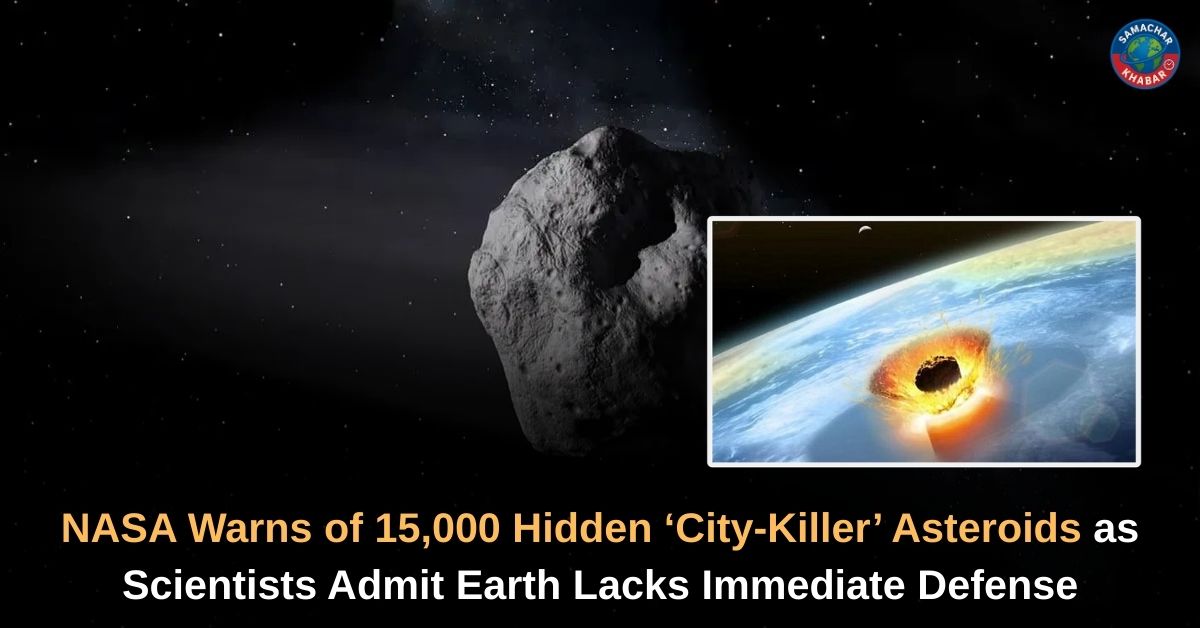
NASA scientists have issued a sobering warning: thousands of medium-sized asteroids capable of destroying an entire city remain undetected near Earth, and there is currently no ready-to-launch system to stop one if it were discovered on a collision course. The concern, voiced at a major scientific conference in Arizona, focuses not on extinction-level space rocks or tiny debris that burns up harmlessly, but on the dangerous “in-between” asteroids that experts say pose the most realistic regional threat.
Key Takeaways on NASA’s City-Killer Asteroid Warning
- Around 25,000 near-Earth asteroids measuring 140 metres (459–500 feet) or larger are believed to exist.
- Only about 40% have been identified, leaving roughly 15,000 undiscovered.
- These mid-sized objects could cause severe regional destruction, flattening a city.
- NASA currently has no rapid-response deflection spacecraft ready for deployment.
- The 2022 DART mission proved deflection is possible, but it is not an operational defense system.
- The upcoming Near-Earth Object Surveyor telescope aims to detect hidden asteroids using heat signatures.
- Recent cases, including asteroid 2024 YR4, demonstrate how quickly impact probabilities can shift with new data.
Why Scientists Are Most Concerned About Mid-Sized Asteroids
Speaking at the annual meeting of the American Association for the Advancement of Science in Phoenix, Kelly Fast, NASA’s planetary defense officer, was direct about her concern.
“What keeps me up at night is the asteroids we don’t know about,” she said.
Fast explained that small asteroids strike Earth frequently but usually disintegrate in the atmosphere. The largest, global-catastrophe asteroids are largely tracked. The real risk lies in the “in-between” objects — those roughly 140 metres or larger — capable of causing regional rather than global devastation.
Scientists estimate that approximately 25,000 such near-Earth objects exist. Yet only about 40 percent have been catalogued, leaving an estimated 15,000 unaccounted for.
The Detection Gap: Why So Many Remain Unseen
According to Fast, many of these asteroids are difficult to detect because:
- They travel in orbits that accompany Earth around the Sun.
- They approach from directions obscured by solar glare.
- Their size and composition make them faint in reflected light.
Even advanced ground-based telescopes struggle to identify every object in this size category.
To close this gap, NASA plans to launch the Near-Earth Object Surveyor space telescope next year. Unlike traditional telescopes that rely on reflected sunlight, it will scan for thermal signatures, enabling scientists to detect darker asteroids that were previously hidden.
Fast summarized her responsibility clearly: to find asteroids before they find us.
If a Threat Appeared Today, Could Earth Deflect It?
The uncomfortable reality, according to experts, is that Earth lacks an immediate defense capability.
Nancy Chabot of Johns Hopkins University led NASA’s Double Asteroid Redirection Test in 2022. The mission deliberately crashed a spacecraft into Dimorphos, a small moonlet orbiting the asteroid Didymos, at 14,000 miles per hour. The impact successfully altered the object’s orbit, proving that kinetic deflection can work.
However, Chabot emphasized that this demonstration does not mean a defense system is ready for use.
“We don’t have [another] DART just lying around,” she said. “If something like YR4 had been headed toward Earth, we would not have any way to go and deflect it actively right now.”
Building and launching a similar spacecraft requires years of preparation. If detection occurs late, response options would be extremely limited.
Media discussions have occasionally referenced theoretical use of nuclear devices to destroy or divert a threatening asteroid, drawing comparisons to science-fiction films such as Armageddon. However, no such operational plan exists, and experts stress that early detection remains the primary safeguard.
The 2024 YR4 Episode and Shifting Risk Calculations
Concern rose in 2024 when asteroid 2024 YR4 was briefly calculated to have a 3.1 to 3.2 percent chance of striking Earth in 2032 — the highest probability NASA had recorded for an object of its size or larger.
Subsequent analysis ruled out an Earth impact. Updated projections suggest there remains a small possibility of a Moon collision in December 2032. NASA has stated that the asteroid is currently too distant for observation and will be studied again when it returns closer to Earth in 2028.
The episode highlighted how impact assessments evolve as additional data becomes available.
Recent Flybys: What NASA Is Monitoring
NASA continues to track numerous asteroids passing safely near Earth. Recent examples include:
| Asteroid | Size | Closest Approach | Speed |
| 2026 CR2 | ~9.7 feet | 84,800 miles | 12,616 mph |
| 2026 BX4 | Stadium-sized | 1,830,000 miles | — |
| 2026 AJ17 | Airplane-sized | 4,140,000 miles | — |
| 2026 CU | Airplane-sized | 1,290,000 miles | — |
| 2026 CA2 | ~110 feet (34.68 m) | 2,630,000 miles (4,230,000 km) | 8.84 km/s |
NASA confirmed that 2026 CA2 was a flyby asteroid passing approximately six to seven times farther away than the Moon. It posed no atmospheric or gravitational threat, and the sky appeared normal during its approach.
Tracking efforts involve the Jet Propulsion Laboratory, the Minor Planet Center, and the Center for Near Earth Object Studies.
Understanding the “Potentially Hazardous” Label
Paul Chodas, manager of NASA’s Center for Near Earth Object Studies, clarified that the term “potentially hazardous asteroid” does not imply imminent danger.
The designation indicates that over centuries or millennia, an asteroid’s orbit could evolve into one that intersects with Earth. None of the currently known potentially hazardous asteroids are expected to strike Earth in the near future.
True Security Beyond Planetary Defense: The Spiritual Insight of Saint Rampal Ji Maharaj
As scientists warn about hidden asteroids and limited planetary defenses, the situation highlights a deeper truth — human control over nature has limits. Even with advanced telescopes and space missions, uncertainties remain.
According to the unique spiritual knowledge of Saint Rampal Ji Maharaj, lasting protection is not achieved through technology alone but through understanding the supreme power governing the universe. His teachings explain that true safety lies in devotion to the Supreme God described in holy scriptures.
While science works to prevent physical dangers, spiritual wisdom offers inner stability and a higher form of security beyond worldly systems.
A Call for Greater Preparedness
NASA’s warning does not predict an immediate catastrophe. Instead, it underscores two clear realities: thousands of mid-sized asteroids remain undetected, and Earth does not yet have a rapid-response planetary defense system. While missions like DART demonstrate technological promise, preparedness depends on sustained funding, improved detection systems, and international coordination.
Scientists emphasize that the greatest risk comes not from the asteroids we can see, but from those still hidden in space.
FAQs on NASA City-Killer Asteroid Warning
1. How many city-killer asteroids remain undetected near Earth?
Scientists estimate around 25,000 exist, but only 40% are identified. Roughly 15,000 mid-sized near-Earth asteroids remain undiscovered and potentially capable of regional destruction.
2. What is a city-killer asteroid according to NASA?
A city-killer asteroid measures at least 140 meters wide and can cause severe regional damage if it strikes Earth, though it would not trigger global extinction.
3. Can NASA currently deflect a dangerous asteroid?
No. While the 2022 DART mission proved deflection is possible, NASA has no ready-to-launch spacecraft available for immediate asteroid defense.
4. What was the risk from asteroid 2024 YR4?
Asteroid 2024 YR4 briefly showed a 3.1–3.2% chance of impacting Earth in 2032, but updated calculations ruled out an Earth collision.
5. How is NASA improving asteroid detection?
NASA plans to launch the Near-Earth Object Surveyor telescope, which will use infrared technology to detect heat signatures of hidden asteroids.