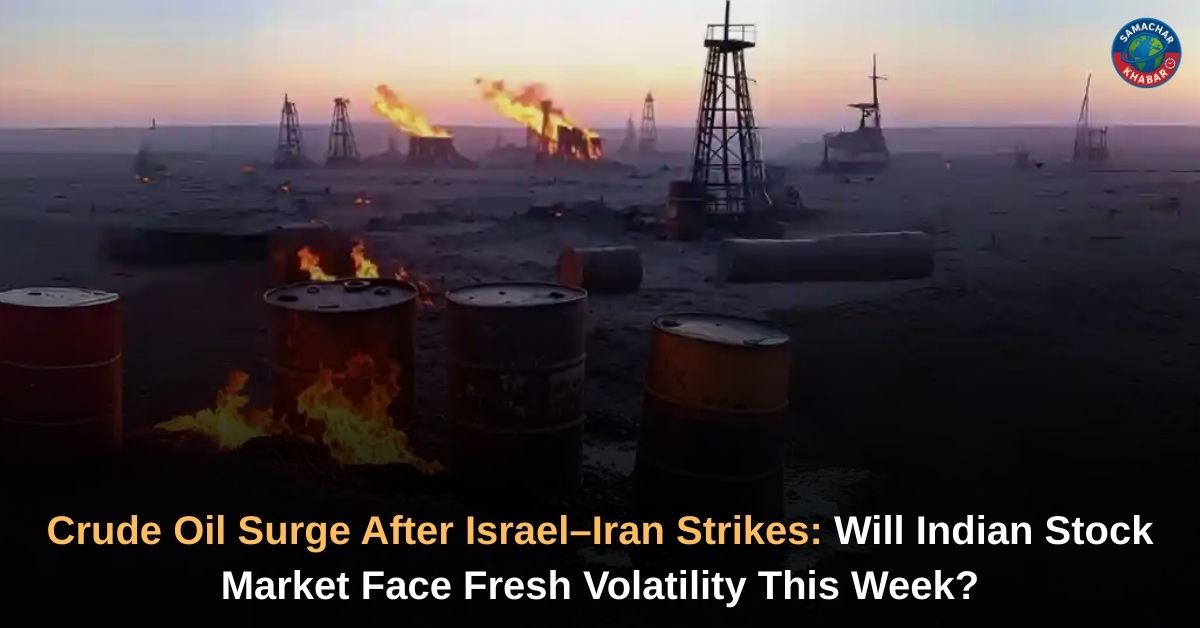
Global markets are confronting one of their most serious geopolitical and energy shocks in decades after joint U.S.–Israeli strikes on Iran triggered retaliatory missile attacks across the Gulf. While no confirmed blockade of the Strait of Hormuz has occurred, the threat alone has rattled oil traders, disrupted shipping movements and reignited inflation concerns worldwide.
Brent crude has climbed toward the $72–73 range after rising nearly 10% from recent lows near $65. Analysts warn that if escalation threatens supply routes, prices could surge toward $95–$110 per barrel. Gold and silver are attracting safe-haven demand, and Indian benchmark indices have already slipped nearly 1%. With 85% crude import dependency and about 50% routed via the Strait of Hormuz, India stands directly exposed to prolonged volatility.
Crude Oil and Israel–Iran War Impact: Key Takeaways for Indian Markets
- The U.S. and Israel launched large-scale military strikes on Iran.
- Iran retaliated with missiles and drones targeting Israel and U.S. bases in Bahrain, Kuwait, Qatar and the UAE.
- Conflicting reports emerged regarding Supreme Leader Ayatollah Ali Khamenei’s status; no official confirmation from Tehran.
- Nearly 20 million barrels per day pass through the Strait of Hormuz.
- 20% of global LNG exports transit the Strait, mostly from Qatar.
- Brent closed at $72.48; WTI at $67.02.
- Oil could reach $95–$110 if a geopolitical premium embeds.
- $100 oil may add 0.6–0.7 percentage points to global inflation.
- Sensex fell 1.17%; Nifty declined 1.25%.
- FIIs invested $2.44 billion in February.
- Gold trades near $5,300; silver above $93, with $100 possible.
Military Escalation and Conflicting Leadership Reports
U.S. President Donald Trump described the operation as “already a success,” stating severe damage had been inflicted and claiming it would take years for Iran to rebuild. Iranian state-run Islamic Republic News Agency reported that the strikes killed Supreme Leader Ayatollah Ali Khamenei.
However, Iranian authorities have not officially confirmed the report. Iranian Foreign Minister Abbas Araghchi told NBC News that Khamenei and President Masoud Pezeshkian were alive “as far as I know.” Two Israeli officials told The Associated Press that Khamenei’s death had been confirmed, but Tehran has not responded formally.
Iran retaliated with missile and drone attacks toward Israel and U.S. military bases in Bahrain, Kuwait and Qatar. The U.S. military said there were no American casualties. Qatar reported intercepting missiles. Explosions were also heard near Iran’s Kharg Island — the terminal handling about 90% of Iran’s crude exports — although shipping data suggests much oil had already been loaded onto tankers.
Strait of Hormuz: The Global Energy Lifeline
The Strait of Hormuz is 33 kilometres wide at its narrowest point and handles nearly 20 million barrels per day — about 20% of global oil consumption and roughly one-third of global seaborne crude exports.
Additional exposure:
- Around 20% of global LNG exports flow through it.
- More than 10 billion cubic feet per day of LNG transit the corridor.
- Three-quarters of crude passing through goes to China, India, Japan and South Korea.
- 50% of India’s crude and 54% of LNG imports are routed via Hormuz.
- January imports: 55% from the Middle East, 21.2% from Russia.
Iran has conducted live-fire drills and temporarily closed the Strait recently — the first such move since U.S. military threats.
Historically, the Strait has never been fully blocked, but Iran has disrupted shipping before. During the 1980s Iran–Iraq war, the U.S. launched Operation Earnest Will to escort tankers. In April 2023, Iran seized the Advantage Sweet tanker chartered by Chevron.
Iran’s Oil Production and Supply Risk
Iran currently produces about 3.1–3.3 million barrels per day, accounting for roughly 3% of global supply. It exports 1.5–1.6 million barrels daily, with more than 80–90% going to China.
In 1974, Iran was the world’s third-largest oil producer after the U.S. and Saudi Arabia, producing around six million barrels per day. Output declined after U.S. sanctions following the 1979 revolution.
Production costs remain low at roughly $10 per barrel, compared with $40–$60 in the U.S. and Canada.
If Iran’s 3% supply were disrupted mechanically, prices could rise 9–15%, pushing crude toward $76–$81. However, if Strait risk embeds a structural premium, analysts project $95–$110 per barrel.
Capital Economics estimates that $100 oil could add 0.6–0.7 percentage points to global inflation.
Shipping Suspensions and Freight Spike
Reuters reported that major oil companies and trading houses suspended shipments through the Strait for several days.
- Dozens of tankers diverted.
- Some sought refuge in Qatar and the UAE.
- A Shell-chartered supertanker idled before crossing.
- Another rushed through toward South Korea.
- Ships received Iranian radio warnings declaring passage unsafe.
Freight rates for very large crude carriers from the Middle East to China have more than tripled this year.
China’s Stockpiling and Demand Moderation
A significant portion of global oil demand growth came from China’s strategic stockpiling. Analysts suggest Beijing may pause purchases if prices surge sharply, potentially moderating demand pressures.
Indian Stock Market Reaction and Technical Outlook
Sensex closed at 81,287.19, down 1.17%.
Nifty ended at 25,178.65, down 1.25%.
MidCap fell 1.09%.
SmallCap declined 0.86%.
Technical levels:
- Nifty support: 25,100–25,000; break may expose 24,900–24,700.
- Resistance: 25,350–25,500.
- Bank Nifty support: 60,300–59,900.
- Sensex support: 81,200–81,000.
Vulnerable sectors include automobiles, financials, FMCG, aviation and oil marketing companies. IT and export-oriented firms may find relative support.
Gold, Silver and Currency Movements
Gold trades near $5,300 per ounce. Silver is above $93 and may test $95; a breakout could push toward $100. In India, that may translate near ₹3,00,000 per kilogram.
Try this Free Tool: The Ultimate Stock Market Calculator: Maximize Returns Across Global Markets
The Iranian Rial weakened to 1,749,500 per USD, down about 30% from 1,350,000 in January. Comparative rates:
- Pound: 2,353,500 IRR
- Euro: 2,067,500 IRR
- Russian Rouble: 22,650 IRR
The Israeli Shekel remained relatively stable between 3.09–3.14 per USD.
Strategic Reserves and Global Supply Cushion
The U.S. Strategic Petroleum Reserve holds approximately 415 million barrels. However, analysts warn duration and scale matter in supply crises.
Saudi Arabia increased shipments above 7 million barrels per day in February, the highest since April 2023. OPEC is scheduled to meet, with expectations of output increases from April, though escalation may alter decisions.
Spiritual Insight: Saint Rampal Ji Maharaj on True Peace Beyond Conflict
As global tensions escalate and crude oil shocks unsettle economies, deeper questions arise about the root cause of unrest. Saint Rampal Ji Maharaj teaches that wars and crises stem from human ego, greed and ignorance of true spiritual knowledge.
According to his discourses, lasting peace cannot be achieved through power or dominance, but through correct worship based on authentic scriptures. When humanity follows true spiritual guidance, harmony and stability become possible.
Amid market volatility and geopolitical uncertainty, his teachings emphasise inner peace, moral living and devotion to Supreme God as the path to lasting global peace.
A Conflict That Could Redefine Energy and Market Stability
The crude oil surge following Israel–Iran strikes reflects a shift from pricing geopolitical risk to pricing active conflict. Even without confirmed infrastructure damage or a full Strait closure, tanker suspensions and freight spikes are embedding a geopolitical premium in oil.
For India, where half of crude imports pass through Hormuz, sustained escalation could translate into higher import bills, inflationary pressure and equity volatility. Whether this becomes a temporary spike or a prolonged energy shock will depend on the duration and scale of the conflict. Until clarity emerges, oil, gold and capital flows will dictate market direction.
FAQs on Crude Oil Surge After Israel–Iran Strikes and Indian Stock Market Volatility
1. Why are crude oil prices rising after the Israel–Iran strikes?
Crude oil prices are rising due to fears of supply disruption through the Strait of Hormuz, which carries nearly 20% of global oil and LNG shipments.
2. Could crude oil hit $100 after the Israel–Iran conflict?
Analysts warn oil could surge toward $95–$110 if escalation disrupts Iranian supply or shipping routes, embedding a geopolitical premium into global crude prices.
3. How does the Israel–Iran war impact the Indian stock market?
India imports 85% of its crude. Rising oil increases inflation risk, weakens sentiment and pressures Sensex, Nifty, banking, aviation and FMCG stocks.
4. Why are gold and silver prices rising during the Israel–Iran crisis?
Gold and silver act as safe-haven assets. Geopolitical uncertainty and inflation fears push investors toward precious metals during conflict-driven market volatility.
5. What role does the Strait of Hormuz play in global oil markets?
The Strait of Hormuz handles nearly 20 million barrels per day. Any disruption can significantly affect global oil supply, LNG trade and energy prices worldwide.