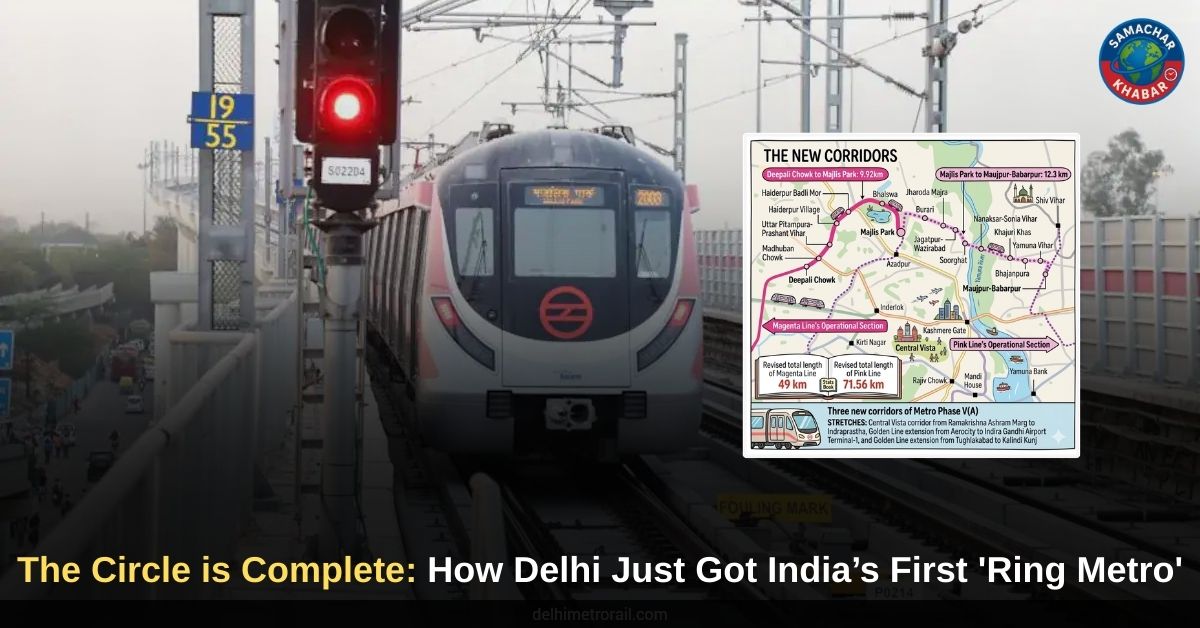
Ring Metro: For years, navigating across the sprawling edges of North and East Delhi meant relying on a chaotic mix of shared autos, crowded buses, or enduring the infamous traffic bottlenecks of the Inner Ring Road. Commuters often had to travel deep into the heart of the city, cramming into Rajiv Chowk or Kashmere Gate just to switch lines and head back out to the peripheries. But starting this Sunday, March 8, 2026, the commute geometry of the national capital changes forever.
Prime Minister Narendra Modi is set to officially inaugurate two highly anticipated extensions of the Delhi Metro network, projects collectively valued at over ₹18,300 crore. The crown jewel of this inauguration is the completion of the Majlis Park-Maujpur corridor. This vital 12.3-kilometer stretch finally closes the loop on the Pink Line, giving India its very first fully operational, continuous “Ring Metro” system.
Key Points at Glance
- The Ring is Closed: The Pink Line now spans 71.56 km, forming a complete circle around Delhi and eliminating the need to travel through central interchange hubs.
- Magenta Line Expansion: A new 9.92 km extension from Deepali Chowk to Majlis Park opens up crucial connectivity for underserved pockets in North-West Delhi.
- Engineering Marvels: The new routes feature a double-decker viaduct (metro and road flyover) and tracks that reach a staggering height of 28.36 meters.
- Phase-V Kickoff: Foundation stones will be laid for three new corridors, including the highly anticipated Central Vista line and airport extensions.
- Massive Investment: The ₹18,300 crore expansion aims to drastically cut vehicular emissions and road congestion across the NCR.
The Anatomy of the Ring Metro
The concept of a circular transit line is the hallmark of advanced global cities like London and Tokyo. Delhi has now joined that exclusive club.
The newly inaugurated 12.3 km elevated section from Majlis Park to Maujpur-Babarpur adds eight new stations to the network, including Burari, Khajuri Khas, and Yamuna Vihar. For a resident of Bhajanpura trying to reach South Extension, the journey previously involved multiple interchanges and significant time loss. Now, they can hop onto the Pink Line and ride the continuous loop directly to their destination.
This specific corridor also stands out for its structural ingenuity. It crosses the Yamuna River via a newly constructed bridge and features a unique double-decker viaduct, seamlessly integrating a road flyover with the elevated metro track to maximize space in densely populated neighborhoods.
Connecting the Forgotten Peripheries
While the Ring Metro dominates the headlines, the concurrent expansion of the Magenta Line is equally transformative. The new 9.92 km stretch from Deepali Chowk to Majlis Park adds seven elevated stations, pushing the total length of the Magenta Line to nearly 49 kilometers.
This extension cuts through the densely packed, historically underserved residential and industrial pockets of North-West Delhi, such as Bhalswa and Haiderpur. According to Delhi Chief Minister Rekha Gupta, these expansions are not just about laying tracks; they are about spatial equity. They provide millions of working-class citizens with high-speed, air-conditioned transit, fundamentally altering real estate dynamics and employment access in these areas.
Notably, this segment includes an engineering high point, literally. Near Haiderpur Badli Mor, the metro tracks climb to a dizzying 28.36 meters above ground level, making it one of the highest points in the entire Delhi Metro Rail Corporation (DMRC) network.
Also Read: Delhi Metro Museum Opens at Supreme Court Station, Showcasing the Journey of Delhi Metro
Looking Ahead: The Phase-V Blueprint
The event at the DDA Utsav Sthal isn’t just about celebrating completed work; it is about charting the next decade of urban mobility. Prime Minister Modi will also lay the foundation stones for three critical Phase-V (A) corridors.
The most prominent of these is the Central Vista underground corridor connecting Ramakrishna Ashram Marg to Indraprastha. Additionally, the Golden Line will see two major extensions: one linking Aerocity directly to Indira Gandhi International Airport’s Terminal-1, and another connecting Tughlakabad to Kalindi Kunj. These upcoming routes are heavily geared towards integrating the broader National Capital Region (NCR), making airport access seamless for residents of Noida and Faridabad.
The Decongestion Dividend
The true success of an infrastructure project of this scale is measured by what happens on the streets beneath it. Delhi’s air quality crisis is intrinsically linked to vehicular exhaust. By providing a reliable, circular transit alternative that directly connects the peripheries without forcing traffic through the center, the DMRC expects a significant drop in daily car and two-wheeler usage.
As the first trains roll out on the completed Pink Line this Sunday, they represent more than just transit. They signify a maturing megacity finally tying its fragmented edges together into one cohesive, moving circle.
The Real Path to Global Harmony
Just like the new Ring Metro now connects the scattered corners of Delhi into one smooth circle, true spiritual knowledge has the power to connect people across the world. Metro lines can join different parts of a city, but real spiritual wisdom connects human hearts, different mindsets, and even conflicting ideologies.
Today the world is facing serious tensions and conflicts, such as the growing hostility between Israel and Iran. Situations like these show that technology and development alone cannot bring peace. What the world truly needs is the right spiritual direction.
According to the teachings of Sant Rampal Ji Maharaj, true spiritual knowledge (Tatvgyan) teaches people to respect each other, rise above differences, and understand the real purpose of human life. He explains that the ultimate goal of life is attaining salvation (moksha) and reaching Satlok through true devotion.
Through this knowledge, Sant Rampal Ji Maharaj is guiding people away from blind traditions and social divisions, helping create a more peaceful, united, and compassionate world.
To know more about true spiritual knowledge download Sant Rampal Ji Maharaj App
FAQs on Ring Metro
1. What is the Delhi Ring Metro?
It refers to the completion of the 71.56 km Pink Line. With the new Majlis Park-Maujpur corridor opening, the line forms a continuous loop around Delhi, eliminating the need to switch trains at central hubs.
2. Which new stations are on the Pink Line extension?
The 12.3 km stretch includes eight stations: Burari, Jharoda Majra, Jagatpur-Wazirabad, Soorghat, Nanaksar-Sonia Vihar, Khajuri Khas, Bhajanpura, and Yamuna Vihar.
3. What is the new extension on the Magenta Line?
The Magenta Line has been extended by 9.92 km from Deepali Chowk to Majlis Park, adding seven new elevated stations to serve North-West Delhi areas like Bhalswa and Haiderpur.
4. When will these new Delhi Metro routes open to the public?
Prime Minister Narendra Modi will officially inaugurate the new corridors on Sunday, March 8, 2026.
5. What new Metro projects are starting under Phase-V?
Foundation stones will be laid for the Central Vista corridor (RK Ashram to Indraprastha) and two Golden Line extensions (Aerocity to IGI Terminal-1, and Tughlakabad to Kalindi Kunj).