[ad_1]
In early February, an Indian satellite named the Azista First Runner (AFR) captured photos of the International Space Station (ISS) from a distance of around 300 km.
Azista Space, the company behind the satellite, has said that the event demonstrates broader technical capabilities, including Space Situational Awareness (SSA), with implications for India’s Space operations. M Srinivas Reddy, the Managing Director of Azista Space, explains the idea and where India stands globally in this domain.
SSA refers to the ability to detect, track, identify, and predict the behaviour of objects in Earth’s orbit, including active satellites, debris, and other Space objects. As Space becomes more congested and strategically contested, SSA has become a critical capability for ensuring the safety and sustainability of Space operations.
It is considered critical for two main reasons: The rapid increase in satellite constellations and debris has significantly raised the risk of collisions, which can damage a spacecraft, shorten mission life, and generate more debris. SSA protects valuable Space assets by enabling collision avoidance.
Second, from a national security perspective, satellites are vital infrastructure for communication, navigation, Earth observation, and defence, and SSA enables the monitoring of hostile or anomalous activities in Space to protect national assets.
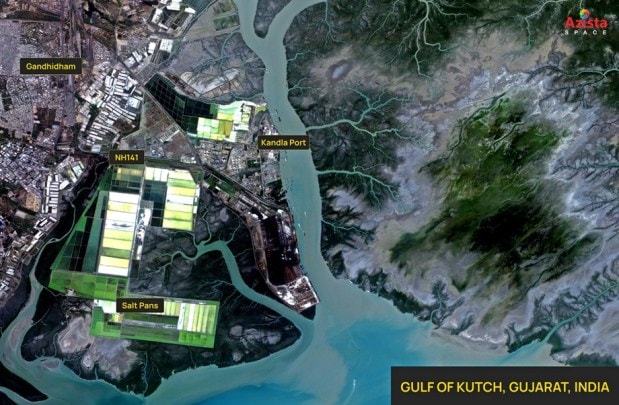
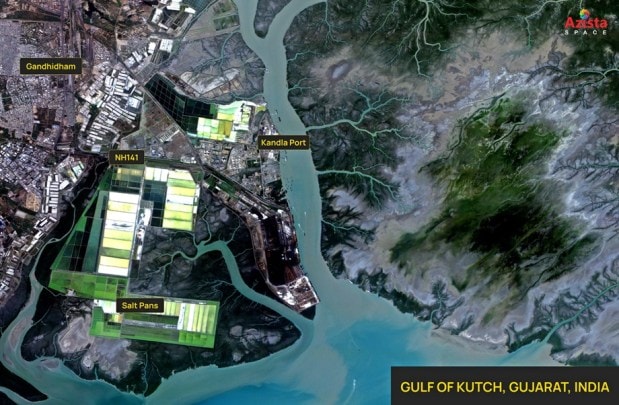 A photo of the Kandla port in Gujarat. (Azista Space)
SSA is built around three core capabilities. The first is detection and tracking, which involves the identification of objects and their continuous monitoring using ground-based and Space-based sensors. This forms the foundation for maintaining an accurate orbital catalogue and predicting close approaches.
The second capability is characterisation and identification of objects, including their manoeuvres, attitude changes, and proximity operations, allowing operators to distinguish between routine activity and potential threats. In this area, cameras and imaging are key.
Story continues below this ad
The third capability is prediction and decision support, where orbital data and analytics are used to forecast conjunctions, assess collision risks, and recommend avoidance manoeuvres.
The AFR is also India’s first privately built satellite providing electro-optical services for civilian and defence applications. What does this include, exactly?
Electro-optical (EO) services refer to imaging using cameras that capture light, across visible and sometimes infrared wavelengths, typically through lenses or mirrors. In simple terms, they are highly advanced versions of the camera in a smartphone, but designed to operate from aircraft or satellites in Space. An electro-optical satellite payload (the object transported to Space on rockets) can capture detailed images of objects on Earth from hundreds of kilometres in the sky.
The finer the resolution, the more detail you can see. The AFR’s photos of the ISS had a 2.2 metre resolution, but upcoming payloads are aimed at improving it to 25 cm.
Story continues below this ad
A 2.2 metre resolution image means each pixel represents a 2.2 m × 2.2 m area on the ground. At this level, one can clearly identify large features such as buildings, roads, ships, or large vehicles. However, smaller objects blur into a single pixel. You may be unable to distinguish a car from a small truck. A 25 cm resolution image is far more detailed. Each pixel represents just 25 cm on the ground. It allows object-level analysis rather than area-level observation.
In civilian applications, EO services are widely used in agriculture to monitor crop health (differentiating healthy crops from stressed ones at an early stage), assess irrigation patterns, and improve yield planning. They help track deforestation and environmental changes, monitor coastlines and illegal fishing activity, etc.
Urban planners use them to map cities and manage infrastructure. Essentially, electro-optical imaging provides governments and businesses with a “bird’s-eye view”, enabling better decision-making.
In defence, EO systems enable surveillance, reconnaissance, and border monitoring. They allow a nation to observe developments, track assets, and assess activities remotely and continuously. Modern security strategy increasingly relies on Space-based monitoring to avoid escalation and risks to human life.
Story continues below this ad
Which countries have forayed into this domain? Where does India stand?
The US leads in SSA with the world’s most advanced and integrated space surveillance network, combining ground radars, optical systems, and Space-based sensors, and maintaining the largest orbital catalogue.
Russia has maintained strong SSA capabilities since the Cold War, focused primarily on military Space monitoring and missile warning through radar and optical tracking systems.
China has rapidly expanded its SSA infrastructure over the past two decades, building extensive ground-based networks and enhancing Space-based surveillance to protect its growing satellite fleet.
Story continues below this ad
These nations treat SSA as a core element of national security and strategic deterrence. India entered the SSA domain later, but has accelerated significantly in recent years by establishing dedicated tracking infrastructure and institutional frameworks. It has developed indigenous radar and optical capabilities to monitor Space objects and protect national assets.
While still at a smaller building scale, India has made rapid progress in policy clarity, capability creation, and long-term strategic focus.
What sort of investment and engineering capabilities do these entail?
Azista plans to set up an electro-optical payload factory in Gujarat as a dedicated facility for designing, manufacturing and testing high-resolution Space cameras.
Story continues below this ad
These payloads are among the most complex systems in a satellite. They require high precision in optics, structural stability to withstand launch loads, thermal control to maintain focus in Space, and highly sensitive detectors. Industrialising their production can ensure consistent quality, repeatability, and reliability. But it requires deep process control, specialised infrastructure, and a highly skilled workforce.
We are investing approximately Rs 500 crores to establish a state-of-the-art electro-optical payload production facility. Along with the investment, we have created a highly specialised, multidisciplinary engineering team.
Such a facility also represents the culmination of years of capability building across many advanced domains, including precision optics, opto-mechanical engineering, proximity electronics, structural design, thermal engineering, detector integration, and high-accuracy assembly and testing of sensitive mirror systems.
Space is rightly called a deep-tech industry because development cycles are long, qualification standards are rigorous, and returns are realised over extended time horizons. Unlike conventional manufacturing sectors, this domain demands sustained capital investment, persistent R&D, and a long-term strategic vision. It is not an opportunistic business, but one that requires patience, technological depth, and institutional commitment to build globally competitive capabilities.
Story continues below this ad
How is security and confidentiality addressed in collaborations with competing nations?
The Space sector operates under a strict regulatory framework, and in India, all sensitive technologies and exports are governed by the SCOMET (Special Chemicals, Organisms, Materials, Equipment and Technologies) guidelines. Any transfer of controlled hardware, software, technical data, or services requires prior approval from the Government of India, following review by an inter-ministerial committee that evaluates strategic, security, and foreign policy implications.
Beyond regulatory compliance, we have robust internal controls. These include strict access controls, need-to-know data segregation, secure IT infrastructure, controlled documentation practices, and contractual safeguards.
In the Space industry, international collaboration is common, but it is always conducted within clearly defined legal and strategic boundaries.
[ad_2]
Source link