[ad_1]
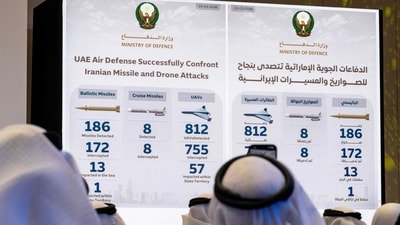
Caught in the war between the US-Israel and Iran, the United Arab Emirates (UAE) is facing consistent attacks from Iran on a daily basis, either via missiles or drones.

As per the latest update from the UAE’s Ministry of Defence (MoD UAE), there have been six deaths and 131 injuries among various nationalities in the UAE due to the war in the Middle East. Since the conflict started, the UAE authorities have intercepted over 1,700 missile and drone attacks.
Air defence systems have helped keep life in the UAE running smoothly, despite occasional sounds of interceptions across the country.
How does the air defence system work in the UAE?
Various official UAE government agencies, including the Ministry of Defence, update the citizens of a potential missile or drone attack and ask people to go to a shelter. The mobiles also get timely alerts. Within minutes, another update informs residents that the missiles have been neutralised and that there is no cause for alarm. In between these two alerts, the defence air systems do their job.
Brigadier Staff Mohammed Al Ketbi, who is the official spokesperson for the Ministry of Defence, UAE, explains how the air defence system works while speaking to The Khaleej Times. He says the system relies on advanced radar networks and sensing technologies that constantly monitor the skies for potential threats.
Also Read: 4 civilians killed in Iranian drone, missile attacks on UAE: What we know about the victims
When a potential threat is detected, the information is immediately relayed to command centres, where advanced systems combine data from multiple sources to create a comprehensive operational picture. The process unfolds within minutes, and sometimes seconds, enabling swift decisions. According to Al Ketbi, this rapid analysis helps activate interception systems in time to neutralise the threat before it can reach its target.
How threats are neutralised in the sky
The air defence system is multi-layered, said Al Ketbi. It combines several levels of protection that operate together to guard the country’s airspace.
The process begins with early warning and detection systems that constantly monitor the skies. Radar networks and other sensing technologies scan large areas of airspace to identify potential threats as early as possible.
Once a threat is detected, the system determines its type and trajectory. Based on this information, different layers of defence are activated, with each layer designed to intercept specific threats or operate within certain ranges of altitude and distance.
Some layers are intended to counter long-range threats such as ballistic missiles, while others are designed to deal with shorter-range targets like drones or incoming aircraft.
By working together in a coordinated manner, these multiple defensive layers create a comprehensive protective shield, increasing the chances of detecting, tracking, and intercepting aerial threats before they can reach their target, said Al Ketbi.
Also Read: Container ship hit off UAE coast by ‘unknown projectile’: UK maritime agency
Which all are the air defence systems that UAE has?
The UAE has built a multi-layered air defence network, deploying different systems depending on the altitude and nature of the threat. To counter high-altitude ballistic missiles, the country relies heavily on the US-made Terminal High Altitude Area Defense (THAAD) system. The UAE was the first country outside the United States to deploy this advanced shield.
For medium-altitude threats, the UAE operates several Patriot PAC-3 missile batteries, which are capable of tracking and destroying tactical ballistic missiles as well as hostile aircraft. At the lower tier, the military uses the Russian-supplied Pantsir-S1 system, a mobile platform equipped with rapid-fire cannons and short-range missiles to counter low-flying drones and aircraft.
More recently, the UAE strengthened this layered defence by acquiring South Korea’s Cheongung II (M-SAM) system, a medium-range interceptor designed to target hostile aircraft and precision-guided munitions.
[ad_2]
Source link