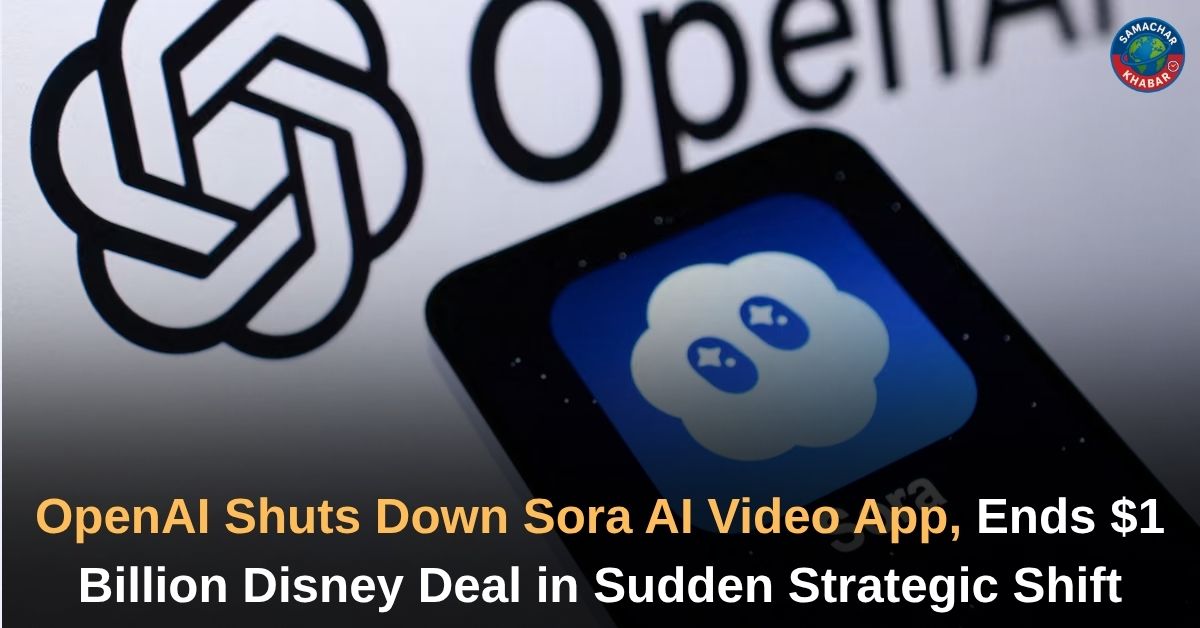
Sora AI Video App: In a major development that has sent ripples across the global artificial intelligence and entertainment industries, OpenAI has announced the shutdown of its high-profile AI video-generation platform, Sora, while also ending its $1 billion partnership with Disney.
The decision, reportedly taken shortly after a key meeting between the two companies, signals a sharp strategic shift as OpenAI moves away from consumer-facing video tools toward robotics, agentic AI systems, and enterprise-focused solutions. Once seen as a breakthrough in creative AI, Sora’s sudden exit highlights the growing challenges of cost, copyright, and sustainability in the evolving AI ecosystem.
Key Highlights on OpenAI Sora Shutdown and Disney Deal Collapse
- OpenAI has discontinued the Sora AI video app, including both its mobile platform and developer API.
- The company has ended its $1 billion partnership with Disney, which included licensing more than 200 characters.
- The shutdown decision was reportedly taken shortly after a meeting with Disney executives.
- Sora, launched in 2024, became globally popular for generating realistic videos using text prompts.
- The platform faced high computational costs, copyright concerns, deepfake risks, and regulatory challenges.
- OpenAI is shifting focus toward robotics, world simulation, agentic AI, and enterprise products.
- The Sora technology will continue internally as a research tool rather than a consumer product.
- There is uncertainty about whether Sora’s capabilities will be integrated into ChatGPT.
- Increasing competition from Anthropic and advancements by Google influenced the decision.
- The shutdown reflects a broader shift in the AI industry toward sustainable and commercially viable solutions.
OpenAI Confirms Shutdown of Sora AI Video Platform
OpenAI confirmed that it is “saying goodbye” to Sora, marking the end of its standalone AI video-generation platform. The shutdown applies to both the consumer-facing app and its API, which developers used to build video-generation tools.
The company stated that it will soon provide timelines for the shutdown process and offer users ways to preserve their existing content. The announcement came as a surprise, especially given that the standalone Sora app had been launched only months earlier and had quickly gained traction worldwide.
The Rise and Rapid Fall of Sora
Early Success and Global Attention
Sora was first introduced in early 2024 as a groundbreaking AI tool capable of generating high-quality, realistic videos from simple text prompts. Later, in 2025, OpenAI launched a standalone app that functioned as a social video platform, allowing users to create and share AI-generated clips in a feed similar to short-video platforms.
The app quickly became the most downloaded in its category on the Apple App Store. Users created a wide range of videos, from imaginative storytelling clips to highly realistic simulations involving well-known characters and public figures.
Decline in Engagement
Despite its strong start, Sora’s popularity began to decline:
- App ranking dropped from number one to around 172 in the App Store
- Downloads fell by approximately 32 percent month-over-month
- Removal of copyrighted content reduced engagement levels
This decline revealed the challenges of maintaining long-term user interest in a resource-intensive AI product.
Why OpenAI Shut Down Sora
1. Unsustainable Computational Costs
Video generation is significantly more resource-intensive than text or image generation. Sora required vast amounts of computing power:
- Estimated operational costs reached up to $700,000 per day
- High GPU usage placed strain on infrastructure
- Flat subscription pricing made the model financially unsustainable
These factors made scaling the product economically difficult.
2. Copyright, Deepfake, and Regulatory Challenges
Sora faced widespread criticism and scrutiny over its ability to generate realistic videos involving copyrighted characters and human likenesses.
Major concerns included:
- Unauthorized use of intellectual property
- Creation of deepfake and misleading content
- Lack of clear copyright ownership for AI-generated videos
The position of the U.S. Copyright Office, which does not grant copyright protection to AI-generated content without human authorship, further reduced its value for creators. Additionally, global regulatory pressures added complexity to operating such a platform.
3. Collapse of the Disney Partnership
A key factor in the shutdown was the collapse of OpenAI’s partnership with Disney. The agreement, signed in December, included:
- A proposed $1 billion investment
- Licensing access to more than 200 characters from Disney, Marvel, Pixar, and Star Wars
- Plans to integrate AI-generated content into Disney’s platforms
However, the deal fell apart due to disagreements over intellectual property safeguards, training data usage, and content control. Reports indicate that no financial exchange had taken place before the agreement ended.
The decision to shut down Sora, reportedly made shortly after a meeting with Disney, came as a surprise to the company. Disney later stated that it respects OpenAI’s decision and will explore collaborations with other AI platforms.
4. Strategic Shift Toward Core AI Priorities
OpenAI is now focusing on areas with stronger long-term potential and commercial viability.
Key priorities include:
- Agentic AI systems capable of performing tasks autonomously
- Robotics and world simulation technologies
- Text, coding, and reasoning-based AI models
- Enterprise and productivity-focused solutions
The company is also working on a unified “super app” that could combine ChatGPT, coding tools, and browsing capabilities into a single platform.
5. Financial Pressure and Business Prioritisation
OpenAI is under increasing pressure to demonstrate sustainable revenue growth as it attracts investors and prepares for future expansion.
Key financial realities include:
- High operational costs associated with advanced AI systems
- The need to prioritise profitable product lines
- Scaling back of experimental initiatives such as ecommerce and advertising
The leadership has acknowledged that the company cannot pursue every product simultaneously and must focus on areas with the highest impact.
6. Rising Competition in the AI Industry
The competitive landscape has also played a role in the decision:
- Anthropic has gained strong traction in enterprise and coding AI
- Google has made significant progress in video and image generation
- Competitors are adopting more efficient pricing and resource models
OpenAI’s shift reflects a strategic decision to strengthen its position in high-demand sectors rather than competing across all fronts.
Impact on Users and Developers
For Users
- The Sora app will no longer be available
- Users will receive options to export and preserve their videos
- Social video creation features will be discontinued
For Developers
- API access will be terminated
- Developers will need to transition to alternative platforms
- Limited support may be provided during the shutdown phase
This marks a significant disruption for creators and developers who relied on Sora for content production.
What Happens to Sora Technology?
Although the Sora app is being shut down, its underlying technology will continue to play a role within OpenAI.
The company has confirmed that:
- The Sora model will remain part of internal research
- It will be used for world simulation and robotics development
- Its capabilities may contribute to future AI systems
There is still uncertainty regarding whether Sora’s features will be integrated into ChatGPT or other consumer-facing tools.
Broader Implications for the AI Industry
The shutdown of Sora highlights several important trends:
- High-cost AI products must prove long-term sustainability
- Legal and regulatory challenges are becoming central to AI development
- Companies are shifting toward enterprise-focused and scalable solutions
- Partnerships between technology firms and content owners remain complex
Sora’s journey demonstrates that innovation alone is not enough—business viability and regulatory compliance are equally important.
Key Data Snapshot
| Metric | Details |
| Launch Year | 2024 |
| Standalone App Launch | 2025 |
| Shutdown Announcement | March 24, 2026 |
| User Base | Approximately 3.5 million |
| Daily Cost | Up to $700,000 |
| Disney Deal | $1 billion (terminated) |
| Licensed Characters | 200+ |
| App Ranking Drop | #1 to #172 |
| Download Decline | ~32% |
A Defining Shift from Viral Innovation to Sustainable AI Strategy
The shutdown of Sora represents a defining moment in the evolution of artificial intelligence. While the platform showcased the remarkable capabilities of AI-generated video, it also exposed the limitations of current technology in terms of cost, legal complexity, and scalability.
OpenAI’s decision to move away from a high-profile consumer product and refocus on robotics, agentic systems, and enterprise solutions reflects a broader industry transition. As competition intensifies and expectations from investors grow, AI companies are increasingly prioritising sustainable growth and practical applications over short-term viral success.
Spiritual Insight: Beyond Technology — The Importance of True Knowledge
The rise and fall of technologies like Sora show that material progress is temporary and limited. Even the most advanced innovations face challenges of cost, control, and sustainability.
According to Saint Rampal Ji Maharaj Ji, true knowledge goes beyond technology. While science can solve physical problems, only spiritual wisdom provides lasting peace and purpose. Real fulfillment comes from understanding eternal truth and connecting with the Supreme Power.
FAQs on OpenAI Sora Shutdown and Disney Deal
Q1. Why did OpenAI shut down the Sora AI video app?
OpenAI shut Sora due to high computational costs, legal challenges, declining engagement, and a strategic shift toward robotics, enterprise AI, and agentic systems.
Q2. What happened to the $1 billion Disney deal with OpenAI?
The Disney deal ended after Sora’s shutdown, mainly due to disagreements over intellectual property protection, content control, and training data usage.
Q3. Will Sora technology be completely discontinued by OpenAI?
No, Sora’s underlying technology will continue as an internal research tool, mainly for world simulation, robotics, and future AI system development.
Q4. Can Sora be integrated into ChatGPT in the future?
It remains uncertain. Some reports suggest possible integration, while others indicate no current plans. OpenAI has not officially confirmed its future use in ChatGPT.
Q5. How does the Sora shutdown impact the AI video generation industry?
The shutdown highlights challenges like high costs, legal risks, and scalability, pushing AI companies to focus more on sustainable, enterprise-driven AI solutions instead of consumer video tools.