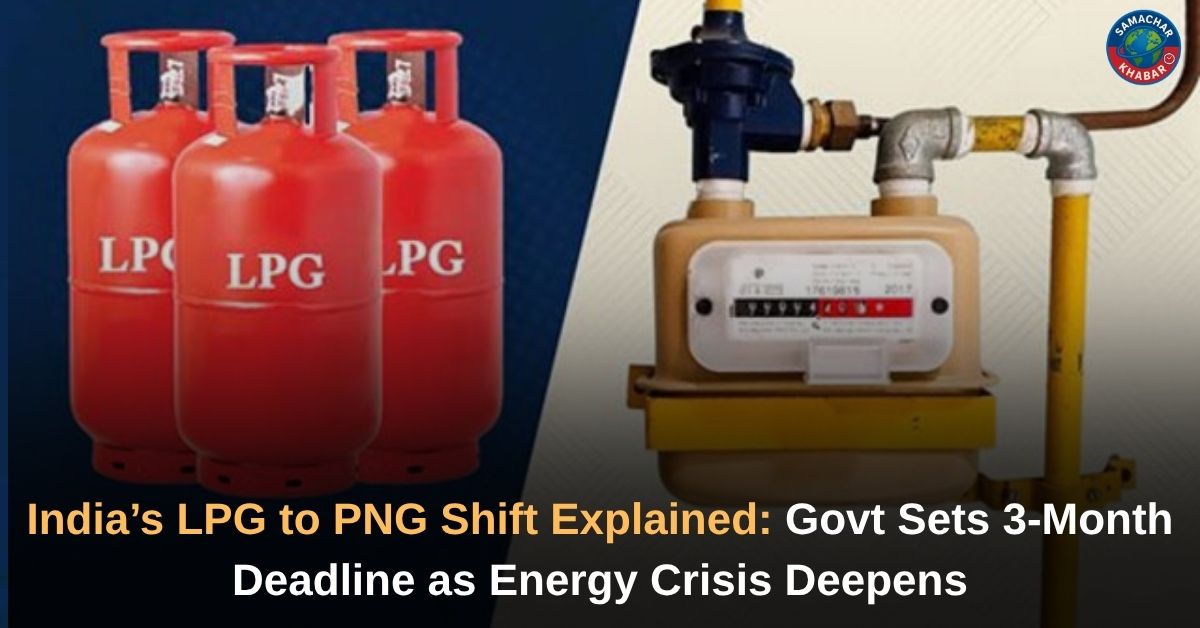
India is undergoing a major shift in how households access cooking fuel, as the government accelerates the transition from LPG cylinders to piped natural gas (PNG) in areas with existing pipeline connectivity. Triggered by global supply disruptions linked to the ongoing West Asia crisis, the move aims to strengthen energy security, reduce dependence on imports and ensure uninterrupted fuel supply.
Backed by a new legal framework, strict timelines and infrastructure reforms, the policy marks a structural change in India’s domestic energy distribution system, with direct implications for millions of households.
Key Takeaways: LPG to PNG Transition Policy in India
- PNG is mandatory in areas where pipeline connectivity exists
- LPG supply will cease after three months if consumers do not switch
- Exception allowed only if PNG is technically infeasible with NOC
- Policy driven by West Asia crisis and supply disruptions
- Government aims to reduce dependence on imported LPG
- Pipeline infrastructure expansion is being fast-tracked nationwide
- RWAs and housing societies must allow pipeline access within three days
- PNG is cheaper, safer and more environmentally friendly
- LPG freed from urban areas will be diverted to non-connected regions
- Incentives like free gas and reduced charges are being offered
Why India Is Pushing the Shift from LPG to PNG
The transition is rooted in growing concerns over energy security. India imports a significant portion of its LPG requirements, with a large share of shipments passing through the Strait of Hormuz, a critical global energy chokepoint.
The ongoing conflict in West Asia has disrupted supply routes and damaged key liquefaction facilities, reducing the availability of gas for export. This has exposed the vulnerability of India’s dependence on imported LPG and prompted the government to accelerate the development of a more resilient gas distribution system.
What the New Gas Pipeline Order Says
The government has notified the Natural Gas and Petroleum Products Distribution (Through Laying, Building, Operation and Expansion of Pipelines and Other Facilities) Order, 2026 under the Essential Commodities Act, 1955.
Under this order, households in areas where PNG connectivity is available must switch within three months of being notified. If they fail to do so, LPG supply to that address shall cease after the deadline.
However, LPG supply will continue in cases where it is technically infeasible to provide PNG, provided a no-objection certificate is issued by the authorised entity.
Strict Rules for Housing Societies and RWAs
The order introduces strict provisions for residential complexes and access-controlling entities.
Housing societies and RWAs are required to grant permission for pipeline installation within three working days. Applications for PNG connectivity cannot be rejected in such areas.
If access is denied or delayed, authorities can intervene, and LPG supply to households in those premises may be discontinued after three months.
Fast-Tracking Pipeline Infrastructure Across India
To accelerate rollout, the government has introduced a time-bound and uniform approval system.
Permissions for smaller city gas distribution networks must be granted within 10 days, while large transmission pipelines have a timeline of up to 60 working days. If authorities fail to act within these timelines, approvals will be treated as deemed clearances.
Authorised entities must begin pipeline work within four months of receiving approval, failing which penalties, including possible loss of exclusivity, may apply.
Once permissions and access are granted, last-mile PNG connections are to be provided within 48 hours.
Land Access, Compensation and Dispute Resolution
The policy also addresses long-standing issues related to land access.
Pipeline developers must first seek agreement with landowners. If no agreement is reached and no alternative route exists, the designated district authority can grant right of way after hearing objections.
Compensation is determined through a standardised formula linked to the circle rate of land, reducing disputes and ensuring uniformity.
Designated officers have been given powers similar to a civil court to resolve disputes efficiently.
How the Policy Strengthens Energy Security
The shift to PNG is part of a broader strategy to diversify energy sources and reduce reliance on a single supply chain.
Pipeline networks can be fed through multiple sources, including domestic gas fields and LNG imports from various countries. This reduces the risks associated with disruptions in specific regions and ensures more stable supply.
The move also supports long-term goals of reducing fiscal burden from LPG subsidies and promoting cleaner fuel usage.
PNG vs LPG: Key Differences Explained
| Feature | PNG | LPG |
| Supply | Continuous pipeline | Cylinder-based |
| Cost | Lower monthly expense | Higher due to logistics |
| Safety | Disperses quickly | Can accumulate and pose risks |
| Convenience | No refill required | Requires booking and delivery |
| Composition | Methane | Propane and Butane |
PNG burns more cleanly and does not require storage, making it both environmentally friendly and convenient.
Step-by-Step Process to Get a PNG Connection
Consumers can apply for a PNG connection through City Gas Distribution companies via online portals, email, call centres or physical applications.
The process includes submitting identity, address and ownership proof, along with KYC verification and payment of applicable charges. Tenants must also provide a no-objection certificate from the landlord.
After approval, a Business Partner (BP) number is assigned, which serves as a unique identifier for the consumer. The service provider then installs the pipeline, gas meter, valves and regulator at the household.
The process may take up to three months to become operational. The total cost typically does not exceed ₹6,000 for standard connections and may go up to ₹9,000 for smart meter installations.
Can You Keep Both LPG and PNG?
Policy direction indicates a gradual transition away from LPG in areas where PNG is available. Households switching to PNG are generally expected to rely on pipeline-based supply.
However, some reports indicate that limited dual usage may exist in certain cases, though the overall objective remains to reduce dependence on LPG in pipeline-connected areas.
Incentives Offered to Promote PNG Adoption
To accelerate adoption, gas companies are offering various incentives.
These include free gas worth up to ₹500, reduced security deposits and waived registration or meter fees. Some regions have also seen policy support such as waiver of road restoration charges and permission for round-the-clock pipeline work.
These measures are aimed at making the transition easier and more attractive for consumers.
What Happens If You Do Not Switch
The consequences are clearly defined in the government order.
If a household does not apply for a PNG connection despite being notified, LPG supply to that address shall cease after three months. Similarly, if housing societies block pipeline access, LPG supply to residents may also be discontinued after the notice period.
Also Read: LPG e-KYC Mandatory as Supply Disruptions Hit India
In cases where PNG is not technically feasible, LPG supply will continue, provided a valid no-objection certificate is issued.
Additional Measures and Ground Developments
The government has taken several steps to manage the situation during the transition.
Authorities have conducted raids to curb black marketing and hoarding of LPG cylinders. Data indicates that LPG refill bookings, which had surged during the crisis, have now stabilised.
Online bookings account for a majority of LPG refills, reflecting improved distribution systems. Additionally, alternative fuel allocations, including kerosene in certain regions, have been made to ensure continuity of supply.
Around 2.2 lakh consumers have already shifted to PNG, and approximately 2.5 lakh new connections have been added in a short span, indicating rapid adoption.
Government Clarification on LPG Supply
The government has clarified that there is no shortage of LPG in the country and urged consumers not to panic.
Officials have stated that supply remains stable and existing refill booking rules have not been changed. Reports suggesting revisions in booking timelines have been termed misleading.
Consumers have been advised to avoid unnecessary bookings and rely on official information.
Spiritual Perspective: Beyond Material Security — Teachings of Saint Rampal Ji Maharaj
As India strengthens its energy systems, the shift from LPG to PNG highlights an important reality—material resources and systems can change or face disruption at any time. According to Saint Rampal Ji Maharaj Ji, true and lasting security does not come from physical arrangements alone, but from spiritual understanding.
His teachings emphasise that while human efforts can improve comfort and stability, real peace comes from connecting with the Supreme Power through true devotion based on authentic scriptures. In a world affected by uncertainty, such knowledge guides individuals to rise above fear, reduce dependence on temporary systems, and move towards a more stable, purposeful, and peaceful life.
A Defining Shift in India’s Household Energy Landscape
India’s transition from LPG to PNG represents a significant structural reform driven by global realities and domestic priorities. By accelerating pipeline infrastructure, simplifying approvals and encouraging fuel diversification, the government is building a more resilient energy system.
While LPG will continue to serve areas without pipeline connectivity, the shift towards PNG signals a long-term move toward cleaner, more reliable and cost-effective fuel for urban households. As the transition gathers pace, it is set to redefine how millions of homes access cooking energy in the years ahead.
FAQs on India’s LPG to PNG Shift Policy
1. Will LPG supply stop if I don’t switch to PNG?
Yes. If PNG is available and you don’t switch within three months of notification, LPG supply to your household may be discontinued.
2. What if a PNG connection is not available in my area?
LPG supply will continue if PNG is technically infeasible, provided the authorised entity issues a valid no-objection certificate (NOC).
3. Why is the government pushing LPG users to switch to PNG?
The shift aims to reduce import dependence, improve energy security, diversify fuel sources, and address supply disruptions caused by the West Asia crisis.
4. How long does it take to get a PNG connection?
The process can take up to three months, including application, verification, installation, and activation of the piped gas supply.
5. Is PNG cheaper and safer than LPG?
Yes. PNG is generally cheaper, provides continuous supply, and is safer as it disperses quickly, reducing risks compared to LPG cylinders.