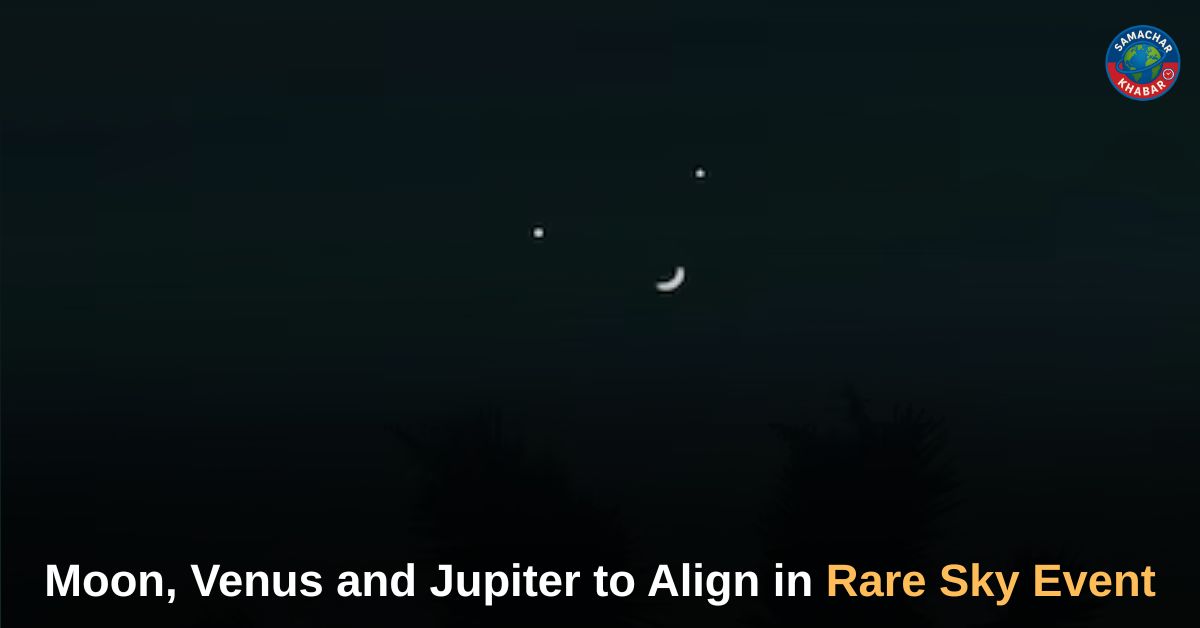
A rare celestial conjunction involving the crescent Moon, Venus and Jupiter is drawing attention from skywatchers across India and several parts of the world during the week beginning May 18, 2026. The astronomical event, visible shortly after sunset, features the thin waxing Moon moving close to the two brightest planets visible from Earth. Social media users have widely referred to the formation as a “sky smile,” while astronomy experts describe it as one of the most visually striking naked-eye sky events of the month.
Key Takeaways on Moon, Venus and Jupiter Conjunction 2026
- The conjunction is visible between May 18 and May 20, 2026
- The crescent Moon appears close to Venus first, then Jupiter
- The event is visible shortly after sunset in the western sky
- Venus appears as the brightest object, with Jupiter higher above
- Experts say the phenomenon can be viewed with the naked eye
- Social media users are calling the formation a “sky smile”
- The Moon will continue waxing until the Blue Moon on May 31, 2026
Rare Celestial Alignment Visible Across India and Worldwide
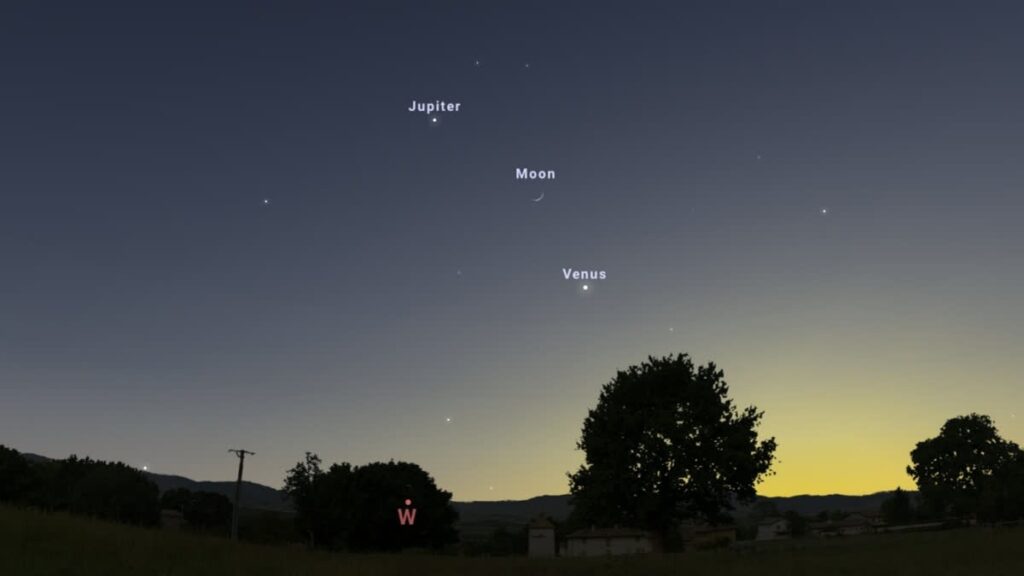
Skywatchers are witnessing a rare astronomical alignment this week as the crescent Moon appears close to Venus and Jupiter in the early evening sky. According to multiple astronomy reports and observational updates, the event is visible from India as well as several regions across the globe.
The conjunction became noticeable beginning May 18, when the thin crescent Moon appeared near Venus low on the western horizon shortly after sunset. On May 19, the Moon positioned itself between Venus and Jupiter, creating a striking triangular formation in the sky.
Astronomy experts noted that the event does not involve the planets physically moving close together in space. Instead, the alignment appears close from Earth’s perspective.
According to Dr Sanjukta Sattar, Head of Department Geography at the University of Mumbai, a conjunction occurs when planets, stars or the Moon appear close together in the sky when viewed from Earth, despite being separated by millions of kilometres.
Why the Moon Changes Position Each Evening
Unlike Venus and Jupiter, which appear nearly fixed in position from one night to the next, the Moon moves eastward across the sky every evening due to its orbit around Earth.
This movement is the reason the Moon appears beside Venus on one evening and closer to Jupiter on the next.
Also Read: ब्रह्मांड के रहस्य: शुरुआत, विस्तार और हमारी समझ
Astronomy observations during the week describe the sequence as follows:
| Date | Sky Position |
| May 18 | Crescent Moon appeared to the right of Venus |
| May 19 | Moon positioned between Venus and Jupiter |
| May 20 | Moon moved above and left of Jupiter |
| May 21 | Moon appeared higher and farther east |
Reports from astronomy observers also noted that the Moon forms a visual line with Castor and Pollux, the twin stars of Gemini, during the later phase of the conjunction.
Best Time and Direction to Watch the Conjunction
Experts stated that the event is best viewed approximately 30 to 60 minutes after sunset.
Observers are advised to look toward the western or west-northwestern horizon under clear sky conditions. A flat and unobstructed western horizon improves visibility, particularly because Venus remains relatively low after sunset.
In India, the conjunction is visible after sunset at approximately:
- Mumbai, Pune and Nashik: after 7:10 PM
- Delhi: after 7:00 PM
- Kolkata: after 6:20 PM
- Bengaluru and Chennai: after 6:40 PM
Astronomy publications and skywatching guides also recommend moving away from bright city lights for clearer viewing conditions.
Venus Appears Brightest in the Evening Sky
Astronomers describe Venus as the brightest planet visible from Earth during the current evening cycle. The planet appears as a bright white point of light and is often visible even during twilight.
Jupiter appears slightly dimmer because of its greater distance from Earth, despite being the Solar System’s largest planet.
According to Dr Sattar, the placement of the crescent Moon between Venus and Jupiter creates a visually captivating celestial scene.
Several astronomy reports also stated that Venus and Jupiter are gradually moving closer together ahead of a larger conjunction expected in June 2026.
Can the Event Be Seen Without a Telescope?
Experts confirmed that the conjunction can be viewed easily with the naked eye.
However, binoculars or a small telescope may provide a clearer view of the lunar crescent and could also reveal some of Jupiter’s moons.
Astronomy observers additionally recommended using mobile phones or DSLR cameras in Night Mode to photograph the alignment.
Also Read: World Earth Day 2026: Theme, History, Significance And Global Observance Explained
A safety warning was also issued for viewers. Observers should only begin looking toward the western sky after the Sun has completely set, as accidental viewing of the Sun may damage eyesight.
‘Sky Smile’ Trend Spreads Across Social Media
Photos and videos of the conjunction have spread widely across Instagram, Facebook and X, where users have referred to the arrangement as a “sky smile.”
However, astronomy experts clarified that the smile-like appearance is largely an optical effect that varies depending on viewing angle, observer location and timing.
Several social media users encouraged people to participate in stargazing during the event, especially because the conjunction is visible without specialised equipment.
Reports also stated that the Moon will continue waxing in the coming days until it reaches full Moon on May 31, 2026. That full Moon will be the second full Moon of the month, making it a “monthly blue Moon.”
A Rare Week for Evening Sky Observers
The conjunction of the crescent Moon, Venus and Jupiter has become one of the most widely discussed astronomy events of May 2026 due to its visibility, simplicity and striking appearance. The event combines three of the brightest celestial objects visible from Earth and allows even casual observers to participate without advanced equipment.
Astronomy experts and skywatching reports continue advising viewers to observe the western sky shortly after sunset while weather conditions remain favourable. As the Moon continues its eastward movement and waxing phase, the conjunction gradually concludes, leaving behind one of the most notable evening sky displays of the month.
Reflection Beyond The Night Sky
Astronomical events such as the conjunction of the Moon, Venus and Jupiter often inspire curiosity about the universe and humanity’s place within it. Many people view such celestial alignments not only as scientific phenomena but also as moments for reflection and inner awareness.
Tatvdarshi Sant Rampal Ji Maharaj explains that the universe operates under fixed natural laws and that understanding true Spiritual Knowledge helps individuals recognise the deeper purpose of human life while remaining connected to peace, balance and wisdom.
For more information visit our
Website: www.jagatgururampalji.org
YouTube: Sant Rampal Ji Maharaj
Facebook: Spiritual Leader Saint Rampal Ji
‘X’ handle: @SaintRampalJiM
FAQs on Moon, Venus and Jupiter Conjunction 2026
1. What planet is next to the Moon tonight?
Venus and Jupiter appear close to the crescent Moon during the May 18–20, 2026 conjunction.
2. What is a conjunction in astronomy?
A conjunction occurs when celestial objects appear close together in the sky from Earth’s perspective.
3. When is the Moon-Venus-Jupiter conjunction visible?
The conjunction is visible shortly after sunset between May 18 and May 20, 2026.
4. Can the conjunction be seen without a telescope?
Yes, the event is clearly visible with the naked eye under clear western skies.
5. Why are people calling it a “sky smile”?
The arrangement resembles a smiling face from certain viewing angles, though experts describe it as an optical effect.