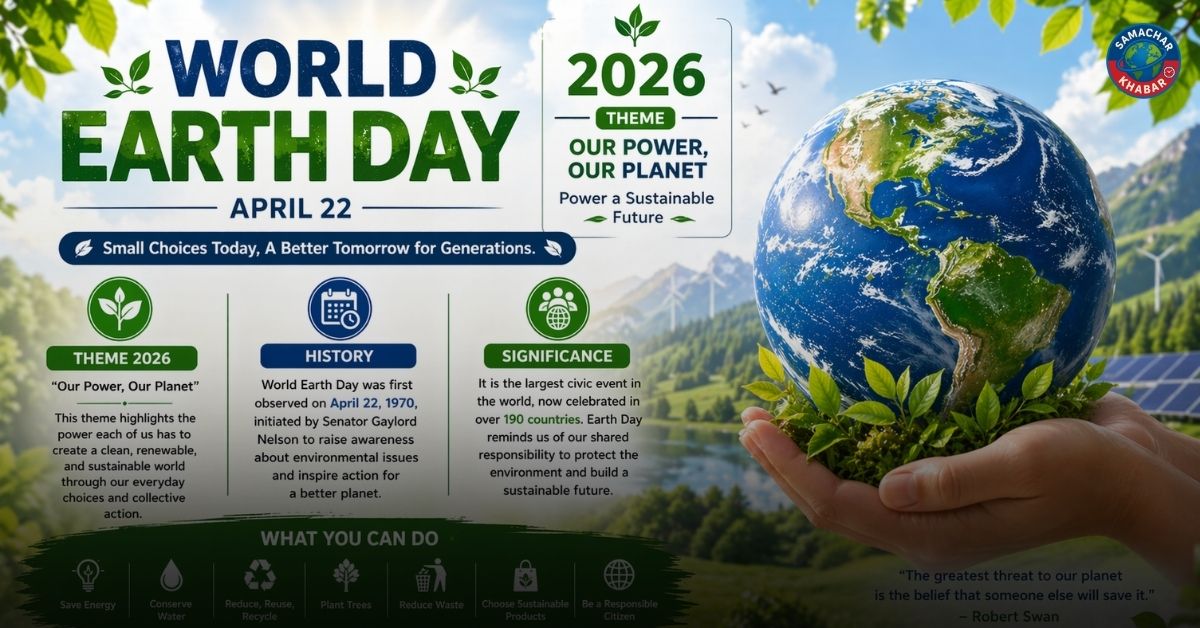
World Earth Day 2026, observed annually on April 22, continues to unite around a billion people across more than 190 countries in support of environmental protection, conservation, and sustainability. What began in 1970 as a grassroots initiative in the United States has evolved into the world’s largest civic environmental movement. The 2026 theme, “Our Power, Our Planet,” highlights collective responsibility, civic engagement, and environmental literacy while addressing urgent global challenges such as climate change, pollution, and biodiversity loss.
Key Takeaways on World Earth Day 2026
- Observed globally on April 22 every year
- Theme for 2026: “Our Power, Our Planet”
- Mobilises around 1 billion people worldwide
- Originated in 1970 in the United States
- Initiated by Gaylord Nelson after the 1969 Santa Barbara oil spill
- First Earth Day saw participation of around 20 million Americans
- Expanded globally in 1990 with over 140 countries involved
- Now observed in over 190 countries
- Focus areas: climate change, biodiversity, pollution, sustainability
- Coordinated globally by EARTHDAY.ORG
What Is World Earth Day And Why It Is Celebrated
World Earth Day is an international day devoted to raising awareness about environmental protection, conservation, and sustainability. Observed each year on April 22, it encourages individuals, communities, and governments to take meaningful action to protect natural systems.
The day highlights the interconnectedness of ecosystems and human well-being. Forests, oceans, freshwater systems, soils, and biodiversity support food production, human health, economic resilience, and livelihoods. Healthy ecosystems absorb carbon, reduce disaster risks, and help communities adapt to a changing world.
Earth Day serves as a platform for awareness, education, and activism, promoting behavioural change and collective responsibility in addressing environmental degradation and the climate crisis.
Also Read: How ‘microlightning’ in water droplets may have sparked life on Earth | Explained News
Theme of World Earth Day 2026: “Our Power, Our Planet”
The theme for 2026, “Our Power, Our Planet,” emphasizes human agency and collective action. It builds on earlier calls for clean energy and highlights the role of communities in driving local solutions, even as broader policy responses continue to evolve.
Campaigns this year focus on:
- Civic mobilization
- Environmental literacy
- Democratic participation
Activities such as voter registration drives, teach-ins, and town halls are being promoted to strengthen public engagement in environmental decision-making.
History of Earth Day: From Local Protest to Global Movement
Earth Day began on April 22, 1970, in the United States at a time when environmental concerns were gaining attention but lacked a unified platform. The movement was spearheaded by Gaylord Nelson, who was inspired to act after witnessing the devastating impact of the 1969 Santa Barbara oil spill.
On the first Earth Day, around 20 million Americans—including students, activists, and citizens—participated in demonstrations across cities such as New York and Boston. These protests highlighted concerns over pollution, industrial damage, and environmental neglect.
The momentum from this movement contributed to:
- The creation of the Environmental Protection Agency
- Landmark laws such as the Clean Air Act and Clean Water Act
By 1990, Earth Day expanded globally, mobilising around 200 million people in more than 140 countries. Today, it is coordinated by EARTHDAY.ORG and observed in over 190 countries, making it the largest civic observance in the world.
Significance of Earth Day in Addressing Climate Change
Earth Day plays a critical role in mobilizing global action against climate change. It promotes awareness, advocacy, and participation in addressing environmental challenges that are becoming increasingly urgent.
Scientific observations indicate:
- Rising global temperatures
- Recent years among the warmest on record
- Risks of severe warming without major energy transitions
Environmental risks continue to dominate global concerns. Natural ecosystems remain essential in absorbing carbon emissions, but biodiversity loss and human-driven pressures threaten their stability.
The day reinforces the importance of:
- Conservation of natural resources
- Sustainable practices
- Collective global action
Global Participation And Activities
Participation in Earth Day ranges from individual efforts to large-scale global initiatives. Communities, organisations, and institutions take part in activities aimed at environmental protection and awareness.
Common Earth Day Activities
- Tree planting and reforestation
- Clean-up campaigns and litter removal
- Climate marches and protests
- Educational seminars and “teach-ins”
- Eco-friendly corporate and community initiatives
Digital and Advocacy Initiatives
- Webinars and online campaigns
- Social media awareness drives
- Signing petitions for global environmental policies
- Support for renewable energy and plastic reduction
Initiatives coordinated by EARTHDAY.ORG include:
- Great Global Cleanup
- Reforestation programmes
- Environmental education campaigns
- Advocacy for a Global Plastics Treaty
Institutional Celebrations in India
In India, the National Science Centre, under the Ministry of Culture, is commemorating World Earth Day on April 22 with educational and interactive programmes.
Event Highlights
| Time | Programme Description |
| 10:00 AM | Science lecture: “Exploring Antarctica: A Journey to the White Continent” |
| 11:00 AM | Open House Quiz Contest on environmental science and biodiversity |
The lecture is being delivered by Dr. Amitava Sen Gupta, Distinguished Professor at the Department of Space, Indian Space Research Organisation. The session is expected to provide insights into Antarctica’s scientific importance and challenges.
Officials stated that the initiative reflects ongoing efforts to promote science education and connect students with experts, encouraging awareness about the role of science in protecting the planet.
Quotes That Reflect Earth Day’s Message
Several influential voices highlight the importance of environmental responsibility:
- “The Earth has enough resources for our needs, but not enough for our greed.” – Mahatma Gandhi
- “The Earth does not belong to us: we belong to the Earth.” – Marlee Matlin
- “We do not inherit the Earth from our ancestors; we borrow it from our children.” – Native American Proverb
- “The future will either be green or not at all.” – Bob Brown
- “Save the Earth to save life, save life to save the Earth.” – Vandana Shiva
- “The Earth is what we all have in common.” – Wendell Berry
- “He that plants trees loves others besides himself.” – Thomas Fuller
- “Look deep into nature, and then you will understand everything better.” – Albert Einstein
A Global Moment For Responsibility And Action
World Earth Day 2026 continues to serve as a global reminder of the urgency of protecting natural resources for future generations. While environmental challenges such as climate change, pollution, and biodiversity loss remain significant, the day also carries a sense of hope.
By bringing together individuals, communities, and governments, Earth Day reinforces the importance of collective action, awareness, and responsibility in safeguarding the planet and ensuring a sustainable future.
Spiritual Perspective On Collective Responsibility
World Earth Day also reflects a deeper understanding of responsibility towards nature and future generations. The idea of preserving the Earth aligns with the principle that natural resources are not owned but entrusted to humanity.
Teachings shared by Tatvdarshi Saint Rampal Ji Maharaj emphasise that true awareness begins with right knowledge and responsible actions. He explains that human life carries the duty to protect nature and maintain balance. This perspective supports the broader message of Earth Day, where individual responsibility and collective action are essential for sustaining the planet.
For more information visit our
- Website: www.jagatgururampalji.org
- YouTube: Sant Rampal Ji Maharaj
- Facebook: Spiritual Leader Saint Rampal Ji
- X (Twitter): @SaintRampalJiM
FAQs on World Earth Day 2026
1. When is World Earth Day 2026 observed?
World Earth Day 2026 is observed on April 22 worldwide every year.
2. What is the theme of Earth Day 2026?
The theme is “Our Power, Our Planet,” focusing on collective action and environmental responsibility.
3. Who started Earth Day?
Earth Day was started in 1970 in the United States by Gaylord Nelson.
4. How many people participate in Earth Day globally?
Around one billion people participate globally across more than 190 countries.
5. Why is Earth Day important?
It raises awareness about climate change, sustainability, and the need to protect natural ecosystems.