
For decades, society has conditioned us to believe that the early bird catches the worm, often labeling late risers as undisciplined or unmotivated. However, a growing body of sleep research reveals that our preferred sleep-wake schedules are deeply biological. Known as chronotypes, these natural internal clocks are governed by genetics, brain structures, and hormonal shifts, suggesting that night owls are following biological patterns that differ from those of many other people.
News Highlights
- Genetic Blueprint: Your chronotype is heavily influenced by specific genetic variations, meaning late-night tendencies are inheritable traits.
- The Master Clock: Internal timing is dictated by the suprachiasmatic nucleus (SCN), a cluster of cells in the brain that responds to environmental light cues.
- Social Jetlag: Forcing a natural night owl into a strict 9-to-5 schedule creates a chronic mismatch between biological and social clocks, leading to elevated fatigue and stress.
- Evolutionary Roots: Researchers hypothesize that varied sleep schedules developed as an ancient survival mechanism to ensure human tribes were never entirely defenseless at night.
Written in the DNA: Why Being a Night Owl Is a Biological Identity, Not a Choice
The modern world is unmistakably biased toward early risers. Schools start at dawn, corporate offices demand early attendance, and self-help gurus routinely preach the virtues of the 5:00 AM wakeup call. Yet, for a significant portion of the global population, waking up early feels less like a healthy habit and more like a direct violation of their biology.
These individuals are not lazy; they are night owls, and science increasingly demonstrates that chronotype is strongly influenced by genetics and begins to emerge early in life.
Understanding the Chronotype
A person’s chronotype is the underlying biological propensity to sleep and wake at a specific time. While sleep hygiene and lifestyle factors play a role, chronotype appears to be substantially influenced by genetics and tends to remain relatively stable throughout life. It dictates not only when you feel tired, but also your peak body temperature, hormone production, and cognitive performance throughout a 24-hour cycle.
To visualize how this works within our anatomy, it helps to look at how our brains process external signals to keep time:
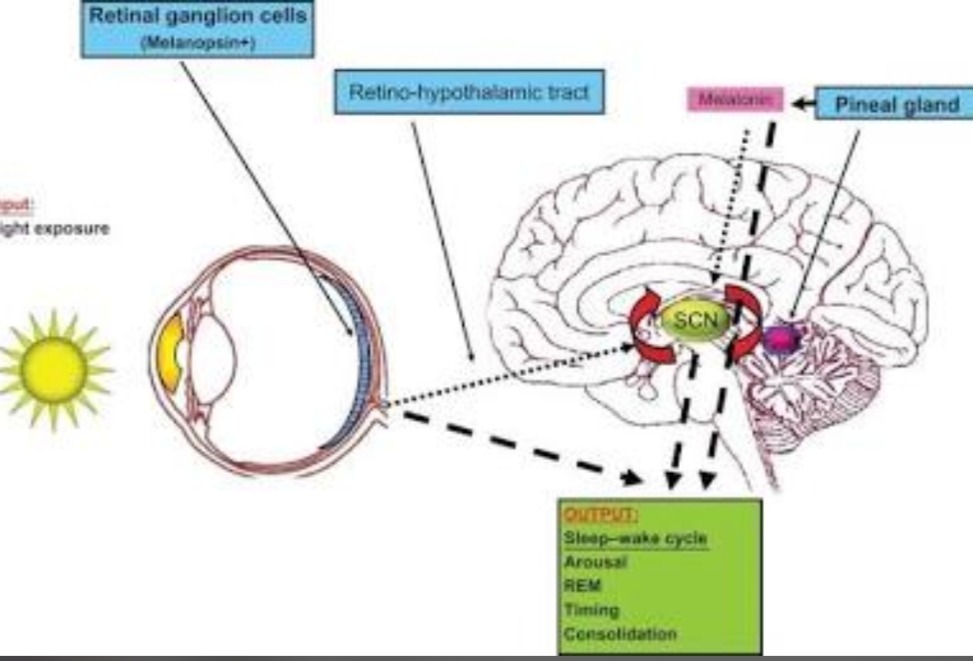
As shown above, environmental light enters the eye and stimulates retinal ganglion cells. This signal travels along the retino-hypothalamic tract directly to the suprachiasmatic nucleus (SCN)—the master clock located in the brain’s hypothalamus. The SCN coordinates the master timeline, signaling the pineal gland to suppress or release melatonin (the hormone responsible for sleepiness).
In night owls, this entire chemical feedback loop is naturally delayed. Melatonin production kicks in hours later than it does in a morning lark, making it physically difficult to fall asleep before midnight.
The DNA Connection
The variance in our internal master clocks is not an accident; it is written into our genetic code. Researchers have identified several specific “clock genes”—such as PER3, CLOCK, and CRY1—that dictate how fast or slow our cell-level circadian machinery runs.
Certain variants of the CRY1 gene have been associated with Delayed Sleep Phase Disorder (DSPD), although many genetic and environmental factors also contribute. This is a condition common among extreme night owls where the biological clock is pushed back significantly. If your parents preferred staying up until the early hours of the morning, there is a strong statistical probability that you will too.
The Evolutionary Purpose of the Night Watchman
Why would nature allow such drastic differences in human sleep schedules? Anthropologists believe the answer lies in our evolutionary history.
In ancestral hunter-gatherer communities, a tribe that all slept at the exact same time would be highly vulnerable to predators or rival groups during the night. By having a diverse mix of morning larks and night owls, researchers have proposed that varied sleep schedules may have increased the likelihood that at least some members of a group remained alert during the night, to guard the perimeter. Some researchers hypothesize that individuals with later chronotypes may have served as informal “night watchmen” in ancestral communities.
The Cost of Social Jetlag
The primary conflict for modern night owls is what sleep researchers term social jetlag. This occurs when an individual’s internal biological clock clashes violently with the social clock demanded by work, school, or family obligations.
When a night owl is forced to wake up at 6:00 AM every day, they don’t magically fall asleep earlier the night before; instead, they simply cut their sleep cycle short. Over time, this chronic sleep deprivation can lead to:
- Impaired metabolic health and increased risk of cardiovascular issues.
- Higher susceptibility to anxiety, clinical depression, and chronic stress.
- Pronounced cognitive deficits during early morning hours.
Working With Your Body, Not Against It
As corporate environments embrace flexible, asynchronous working schedules, the stigma surrounding night owls is slowly dissolving. Studies show that when night owls are permitted to work during their peak biological hours—often between 6:00 PM and midnight—their creativity, problem-solving abilities, and lateral thinking may improve significantly.
Ultimately, trying to cure a night owl of their late-night habits is as futile as trying to change their height or eye color. True wellness comes from recognizing your biological identity and building a life that honors it.
FAQs
What is a chronotype?
A chronotype is your body’s natural, genetically predetermined inclination to sleep and wake at certain times. It also influences the times of day you experience peak mental and physical energy.
Can I train myself to change my chronotype?
While genetics place constraints on chronotype, sleep schedules can often be shifted to some extent through light exposure, behavioral changes, and other interventions. If you stop actively managing the shift, your body will naturally default back to its genetic baseline.
Are night owls less productive than morning larks?
Not at all. Night owls simply reach their peak productivity much later in the day. Research suggests that while morning larks start the day strong, night owls often maintain focus and cognitive stamina longer into their waking hours than early birds do.
What are the main chronotype categories?
A popular but non-clinical framework developed by Dr. Michael Breus categorizes people as Bears (follow the sun, most common), Lions (early mornings), Wolves (night owls), and Dolphins (insomniacs/light sleepers). However, scientific chronobiology more commonly classifies individuals along a continuum ranging from morningness to eveningness.