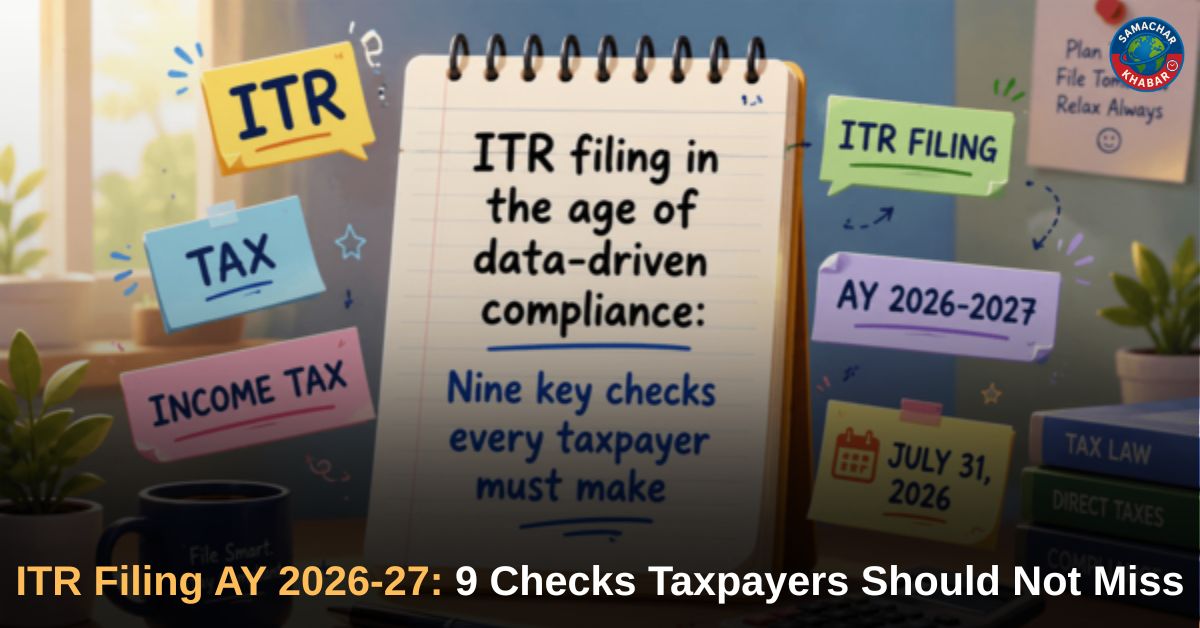
ITR Filing AY 2026-27: As the Income Tax Return (ITR) filing season for Assessment Year (AY) 2026-27 gets underway, tax experts are advising taxpayers to pay closer attention to the accuracy and completeness of their returns. India’s tax administration has become increasingly data-driven, with information from Tax Deducted at Source (TDS), Tax Collected at Source (TCS), Statement of Financial Transactions (SFT), Annual Information Statement (AIS), Form 26AS and other reporting mechanisms being used to validate taxpayer disclosures.
Alongside understanding how to claim a TDS refund, taxpayers are being urged to follow nine important checks that can help avoid refund delays, compliance alerts, tax demands and notices.
Key Takeaways: ITR Filing AY 2026-27
- TDS refund can be claimed when tax deducted exceeds actual tax liability.
- Form 26AS should be checked before filing a return.
- Correct ITR form selection is essential to avoid defective returns.
- AIS, Form 26AS, Form 16 and pre-filled data should be reconciled.
- All taxable and exempt income should be reported appropriately.
- Only eligible exemptions and deductions should be claimed.
- Refund bank account details should be validated and updated.
- Returns should be reviewed carefully before submission.
- Filing and verification must be completed within prescribed timelines.
Understanding TDS Refund In ITR Filing
Tax Deducted at Source (TDS) is a mechanism through which tax is collected in advance by deducting a specified amount from certain payments. The deductor deposits this tax with the government on behalf of the recipient.
A TDS refund becomes applicable when the total tax deducted during a financial year exceeds the taxpayer’s actual tax liability. Taxpayers whose total taxable income falls below the basic exemption limit and who ultimately have no tax liability may also be eligible to claim a refund of TDS already deducted.
TDS is commonly deducted from:
- Salary
- Dividend income
- Bank interest
- Professional fees
- Consultancy charges
- Contract payments
- Commission
- Brokerage
- Lottery winnings
- Online gaming income
In such situations, the excess tax paid can be recovered by filing an Income Tax Return.
How To Claim A TDS Refund
Taxpayers seeking a TDS refund are required to follow a structured process.
Step 1: Check Form 26AS
Form 26AS, linked to the taxpayer’s PAN and available through the Income Tax portal, contains details of TDS deducted and deposited against the PAN. It also reflects advance tax and self-assessment tax payments.
Step 2: File The ITR
While filing the return, taxpayers should accurately disclose all income and ensure that TDS details match the information available in Form 26AS. If the TDS amount exceeds the actual tax liability, the excess amount is automatically reflected as a refund.
Step 3: Verify The Return
After filing the ITR, taxpayers must complete e-verification through Aadhaar OTP or other prescribed methods. Once verification is completed and accepted, the refund is credited directly to the linked bank account.
Also Read: Income Tax Department Launches AI-Powered ‘Kar Saathi’ as New Income Tax Act 2025 Comes Into Effect
How To Check Income Tax Refund Status
Refund processing begins only after successful e-verification of the return. Refunds are generally credited within four to five weeks, depending on processing timelines.
To check refund status:
- Log in to the Income Tax e-Filing portal.
- Navigate to “e-File”.
- Select “Income Tax Returns”.
- Click on “View Filed Returns”.
- Choose AY 2026-27.
- Click “View Details”.
Taxpayers can view refund processing updates, including:
- Refund issued
- Refund partially adjusted
- Full refund adjusted against outstanding demand
- Refund failed
Refund failures may occur due to:
- Inoperative PAN not linked with Aadhaar
- Non-validated bank account
- Incorrect bank details
- Incorrect IFSC code
- Closed bank account mentioned in the return
Nine Important Checks Before Filing ITR
1. Select The Correct ITR Form
The filing process starts with choosing the appropriate ITR form. Eligibility depends on factors such as taxpayer category, income level, income source, residential status and loss carry-forward requirements.
For example, ITR-1 can now be used for income from up to two house properties. However, taxpayers intending to carry forward house property losses cannot use ITR-1.
Using the wrong form may result in a defective return and could ultimately render the return invalid if not corrected within the prescribed period.
2. Reconcile AIS And Pre-Filled Data
Taxpayers should reconcile:
| Document | Purpose |
| AIS | Comprehensive transaction reporting |
| Form 26AS | TDS and tax payment details |
| Form 16 | Salary and tax details |
| Form 16A | Non-salary TDS details |
| Pre-filled ITR Data | Information available with the department |
Discrepancies may arise due to reporting errors, duplicate entries, timing differences or incorrect PAN reporting.
3. Report All Income Under Correct Heads
Taxpayers should not rely solely on pre-filled information. All taxable income must be reported under the appropriate income head under the Income-Tax Act, 1961.
Where TDS has been deducted, the corresponding TDS credit should be linked with the relevant income disclosed in the return. This helps establish a clear relationship between income reported and TDS claimed.
4. Report Exempt Income
Although exempt income may not be taxable, it often remains reportable.
An example highlighted involves an individual retiring during FY 2025-26 who received exempt retirement benefits such as gratuity, leave encashment and commuted pension totaling Rs 1.60 crore, while taxable salary and pension income amounted to Rs 15 lakh.
If such exempt receipts are not disclosed, subsequent investments may appear disproportionate to reported income and could trigger compliance queries regarding the source of funds.
5. Claim Only Eligible Exemptions And Deductions
ITR forms now require detailed disclosures relating to:
- Chapter VI-A deductions
- Housing loan interest
- Capital gains exemptions
- Exemptions under Section 10
Taxpayers should ensure all claims are legally admissible and supported by documentation. Incorrect claims may lead to additional tax, interest and penalty proceedings. In some circumstances, penalties may extend up to 200% of the tax payable on the incorrect claim.
6. Validate Refund Bank Account Details
Before filing, taxpayers should verify that the bank account intended for receiving refunds is:
- Validated on the Income Tax portal
- Active and operational
- Updated with correct account details
Failure to do so may delay refund processing.
7. Review The Return Carefully
Before submission, taxpayers should verify:
- Personal details
- Address, mobile number and email ID
- Bank account information
- Nature of employment
- Income under each head
- TDS credits and tax payments
- Exemptions and deductions
- Loss carry-forward details
- Final tax or refund computation
Careful review can help prevent processing delays and compliance issues.
8. File Within The Due Date
Timely filing remains important for taxpayers wishing to opt out of the default new tax regime and choose the old tax regime, where permitted under applicable provisions.
Delayed filing may also result in:
- Late filing fees
- Interest liability
- Loss of certain tax benefits
9. Complete Verification Within Prescribed Time
Filing alone does not complete the compliance process. The return must also be verified within the prescribed timeline.
The article notes that an unverified return is treated as invalid and, legally, it is considered as though no return was filed. Verification can be completed through:
- Aadhaar OTP
- Net banking
- Electronic Verification Code (EVC)
- Digital signature
- Other prescribed methods
Why Accurate Filing Has Become More Important
The Income Tax Department now receives information from employers, banks, financial institutions, registrars, stock exchanges, mutual funds and other reporting entities. The integration of this information enables authorities to identify omissions, mismatches and inconsistencies with increasing accuracy.
As a result, tax compliance is no longer measured simply by whether a return has been filed. Greater emphasis is now placed on whether the return is complete, accurate, internally consistent and aligned with information available across the broader tax ecosystem.
Stronger Compliance Starts With Correct Filing
The concept of tax reflects an important principle of accountability. In daily life, whenever individuals use public services, infrastructure, or facilities, they are required to pay taxes as part of their responsibility within that system. In a similar spiritual context, many traditions teach that every action performed in life carries consequences, and individuals remain accountable for their deeds.
According to the spiritual teachings shared by Tatvdarshi Sant Rampal Ji Maharaj, human beings continue to experience the results of their actions and remain bound within the cycle of birth and death until this spiritual debt is resolved. He explains that true spiritual Knowledge and the method of worship provided by a Tatvadarshi Saint help seekers understand this accountability and guide them towards liberation. Through the mantras given by Him, a devotee strives to overcome karmic bondage and progress towards the eternal abode of the Supreme God, which is described as the soul’s original and everlasting home.
For more information visit our:
Website: www.jagatgururampalji.org
YouTube: Sant Rampal Ji Maharaj
Facebook: Spiritual Leader Saint Rampal Ji
X (Twitter): @SaintRampalJiM
FAQs on ITR Filing AY 2026-27
1. When can a taxpayer claim a TDS refund?
A refund can be claimed when total TDS deducted exceeds the taxpayer’s actual tax liability.
2. Which document should be checked before claiming a TDS refund?
Taxpayers should verify TDS details through Form 26AS before filing their return.
3. Can exempt income be reported in the ITR?
Yes. Exempt income may still require disclosure even though it is not taxable.
4. What happens if an ITR is not verified?
An unverified return is treated as invalid and considered as though no return was filed.
5. Why is AIS reconciliation important?
It helps identify reporting errors, omissions, duplicates and mismatches before filing the return.