The Economic Survey 2026, tabled in Parliament ahead of the Union Budget 2026–27, presents a detailed and data-backed assessment of India’s economic position in a volatile global environment. Projecting real GDP growth of 6.8% to 7.2% in FY27, the Survey highlights India’s resilience driven by domestic demand, public investment and anchored inflation, even as external uncertainties persist.
It evaluates growth trends, fiscal consolidation, inflation management, employment conditions and global risks, while also capturing market reactions, currency pressures and trade challenges. The document sets the economic framework against which Budget 2026 will be interpreted.
Key Takeaways from Economic Survey 2026 on India’s Economy and FY27 Growth
- FY27 real GDP growth projected at 6.8%–7.2%, with medium-term potential growth near 7%
- FY26 growth estimated at 7.4%, with 8% expansion in the first half
- India remains the fastest-growing major economy, despite global headwinds
- Inflation remains contained and anchored, supporting consumption and investment
- External risks persist due to US tariffs, trade fragmentation and volatile capital flows
- India–US trade negotiations expected to conclude during the year
- Fiscal consolidation continues alongside high public capital expenditure
- Equity markets and the rupee react cautiously ahead of Budget 2026
What Is the Economic Survey and Why It Matters
Prepared by the Department of Economic Affairs under the Ministry of Finance, under the guidance of Chief Economic Adviser V. Anantha Nageswaran, the Economic Survey is the government’s annual economic report card. Released every year ahead of the Union Budget, it provides a comprehensive review of economic performance and an outlook for the coming fiscal year.
The Survey is divided into two parts:
- Part A reviews macroeconomic developments and overall economic conditions.
- Part B focuses on thematic and sector-specific socio-economic issues.
First presented in 1950–51 as part of the Budget documents, the Survey was separated in 1964 to allow Parliament and the public to examine economic conditions independently before budgetary decisions.
Economic Survey 2026: Structure, Chapters and Thematic Focus
The Economic Survey 2025–26 is structured into 16 chapters, with the final chapter presented in two substantive parts. The document blends macroeconomic analysis with sectoral deep dives covering agriculture, industry, services, labour markets, MSMEs, infrastructure, digitalisation, climate change, artificial intelligence and strategic resilience.
The opening chapter, “State of the Economy: Pushing the Growth Frontier”, positions India as one of the fastest-growing large economies, supported by macroeconomic stability, reform-led growth and rising purchasing power.
Growth Outlook: FY27 Projections and Recent Performance
At the heart of the Survey is the projection that India’s real GDP will grow between 6.8% and 7.2% in FY27. This estimate is higher than projections by the International Monetary Fund (6.4%) and the World Bank (6.5%), reinforcing India’s status as the world’s fastest-growing major economy.
For FY26, first advance estimates place growth at 7.4%, compared with 6.5% in FY25. Growth accelerated to a six-quarter high of 8.2% in Q2 FY26, following 7.8% growth in Q1, taking first-half expansion to 8%.
On a calendar-year basis, growth is projected at 6.3% in 2026 and 6.5% in 2027.
Domestic Demand, Investment and Sectoral Drivers
The Survey underscores domestic demand as the primary anchor of growth. Rural consumption strengthened due to agricultural growth, while urban consumption improved following tax rationalisation that boosted disposable incomes.
Investment emerged as a key growth engine, expanding 7.8% in FY26, compared with 7.1% in the previous year. Manufacturing activity gained momentum, supported by sustained public capital expenditure that continued to crowd in private investment.
The services sector remained the economy’s strongest pillar, driven by financial services expansion, digital transformation and global outsourcing trends.
Inflation, Monetary Policy and Financial Stability
Inflation remained low and anchored, with subdued core inflation reflecting improved supply-side conditions. This allowed the central bank to cut policy rates by 1.25% in 2025, helping revive credit growth and support demand.
The Survey notes that a healthier banking sector, improving asset quality and stable credit growth have strengthened the economy’s financial foundations as India enters FY27.
Market Reaction: Sensex, Nifty, Fed Pause and Rupee at Record Low
Equity markets traded lower on the day the Economic Survey was tabled, as investors turned cautious ahead of Budget 2026 and global cues.
The Sensex fell 576.99 points to 81,767.69, while the Nifty declined 139.25 points to 25,203.50. Market breadth was weak, with over 2,300 stocks declining and 116 stocks hitting 52-week lows.
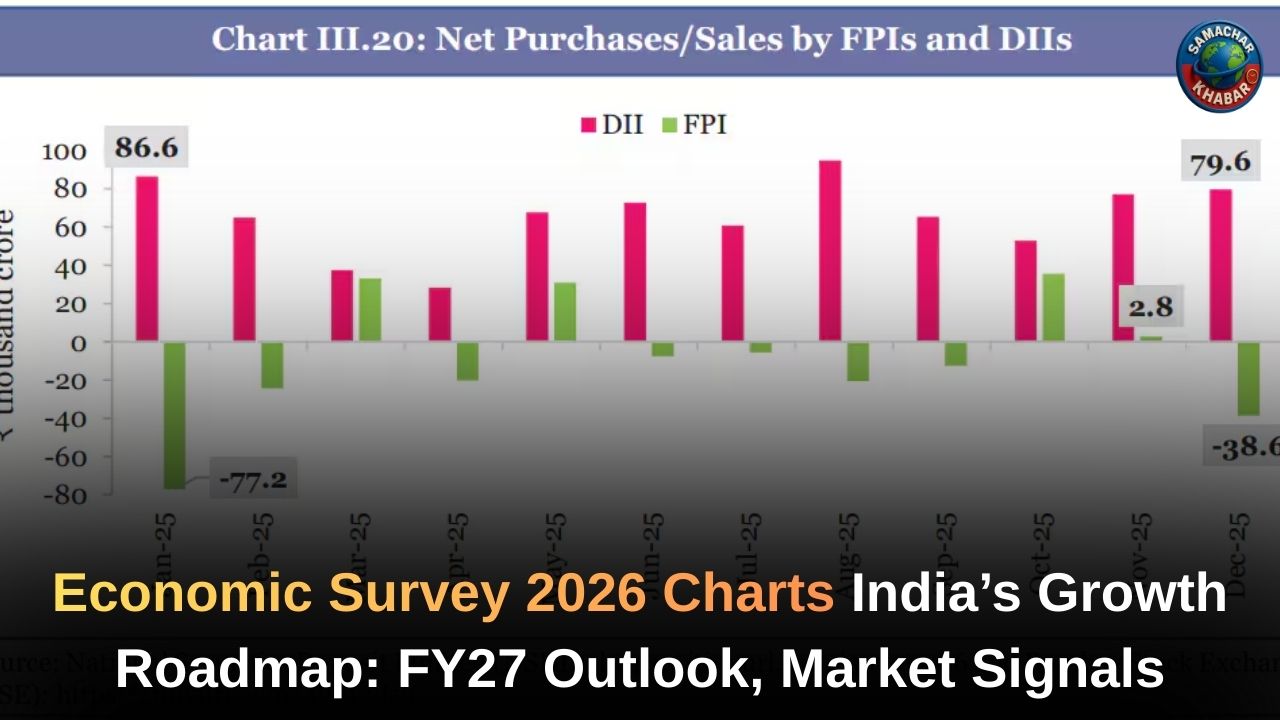
Sentiment was weighed down by the US Federal Reserve’s decision to keep interest rates unchanged at 3.5–3.75%, and by the rupee slipping to a record low of 92 per dollar, marking a 2.25% decline so far this year.
External Sector: US Tariffs, Trade Talks and Global Risks
The Survey highlights that global conditions translate into external uncertainty rather than immediate macroeconomic stress for India. Slower growth in key trading partners, tariff-induced disruptions and volatile capital flows could intermittently weigh on exports and investor sentiment.
India continues to face the impact of 50% US tariffs on Indian goods, imposed following disagreements linked to trade and India’s purchase of Russian crude oil. The US accounts for nearly 18% of India’s exports, affecting labour-intensive sectors such as textiles, gems and jewellery, and leather.
However, the Survey notes that ongoing India–US trade negotiations, underway since March last year with six rounds completed, are expected to conclude during the year, potentially reducing external uncertainty.
Global Risk Scenarios Highlighted in Economic Survey 2026
The Survey outlines three global scenarios for 2026:
- Managed global disorder (40–45%)
- Disorderly multipolar breakdown (40–45%)
- Low-probability but high-impact systemic shock (10–20%), potentially more severe than the 2008 crisis
Risks from prolonged trade conflicts and leveraged artificial intelligence investments remain elevated.
Fiscal Consolidation and Budget Signals
Fiscal discipline remains central to the Survey’s narrative. The FY25 fiscal deficit stood at 4.8% of GDP, better than budgeted, with a 4.4% target for FY26. Economists expect a further glide path towards around 4.2% in FY27, while maintaining high capital expenditure.
The Survey also flags concerns over state-level fiscal populism, rising revenue deficits and unconditional cash transfers crowding out capital spending.
Union Budget 2026 Timeline
- 28 January: Budget Session begins with the President’s address
- 29 January: Economic Survey tabled in Parliament
- 1 February: Union Budget 2026 presented at 11 am
- 13 February: First half of Budget Session ends
- 9 March: Second half begins
- 2 April: Budget Session concludes
How Economic Survey Cover Colours Signal Broader Themes
In recent years, the Survey’s cover design has reflected its broader narrative:
- Pink (2018): Focus on women’s empowerment
- Lavender (2020): Blend of tradition and technology
- Blue (2021): Tribute to healthcare workers during the pandemic
Spiritual Perspective on Economic Stability Through the Unique Knowledge of Saint Rampal Ji Maharaj Ji
Beyond policy frameworks and economic projections, the Economic Survey 2026 also invites reflection on deeper foundations of stability and prosperity. The unique spiritual knowledge of Saint Rampal Ji Maharaj emphasizes that sustainable progress is not driven by material growth alone, but by ethical living, social harmony and inner discipline. According to his teachings, true national strength emerges when economic activity is guided by values such as honesty, restraint, compassion and collective welfare.
In times of global uncertainty and financial volatility, this perspective underlines the importance of balanced development—where spiritual awareness complements economic planning, helping society move toward lasting peace, equity and resilience rather than short-term material gain alone.
India’s Growth Outlook in a Fragile Global Economy
Overall, the Economic Survey 2026 presents a narrative of resilient but cautious growth. While global uncertainties persist, India’s strong domestic demand, anchored inflation, external buffers and reform momentum place the economy on a firmer footing.
As Budget 2026 approaches, the Survey provides the essential economic backdrop for policy decisions that will shape growth, investment, employment and financial stability in the year ahead.
FAQs on Economic Survey 2026 and India’s FY27 Economic Outlook
Q1. What growth rate does the Economic Survey 2026 project for FY27?
The Economic Survey 2026 projects India’s real GDP growth between 6.8% and 7.2% for FY27, reflecting resilient domestic demand amid global uncertainties.
Q2. Why is the Economic Survey 2026 important before the Union Budget?
The Economic Survey provides a data-backed assessment of growth, inflation, fiscal health and risks, setting the economic context for policy decisions in Union Budget 2026.
Q3. How did markets react to the Economic Survey 2026?
Equity markets turned cautious, with Sensex and Nifty falling, as investors assessed global risks, rupee weakness, US Fed policy signals and Budget-related uncertainty.
Q4. What does the Economic Survey 2026 say about India–US trade talks?
The Survey states that ongoing India–US trade negotiations, underway since last year, are expected to conclude during the year, potentially reducing external uncertainty.
Q5. What major global risks are highlighted in the Economic Survey 2026?
The Survey flags risks from trade fragmentation, geopolitical tensions, volatile capital flows and leveraged AI investments, outlining scenarios including potential high-impact global shocks.