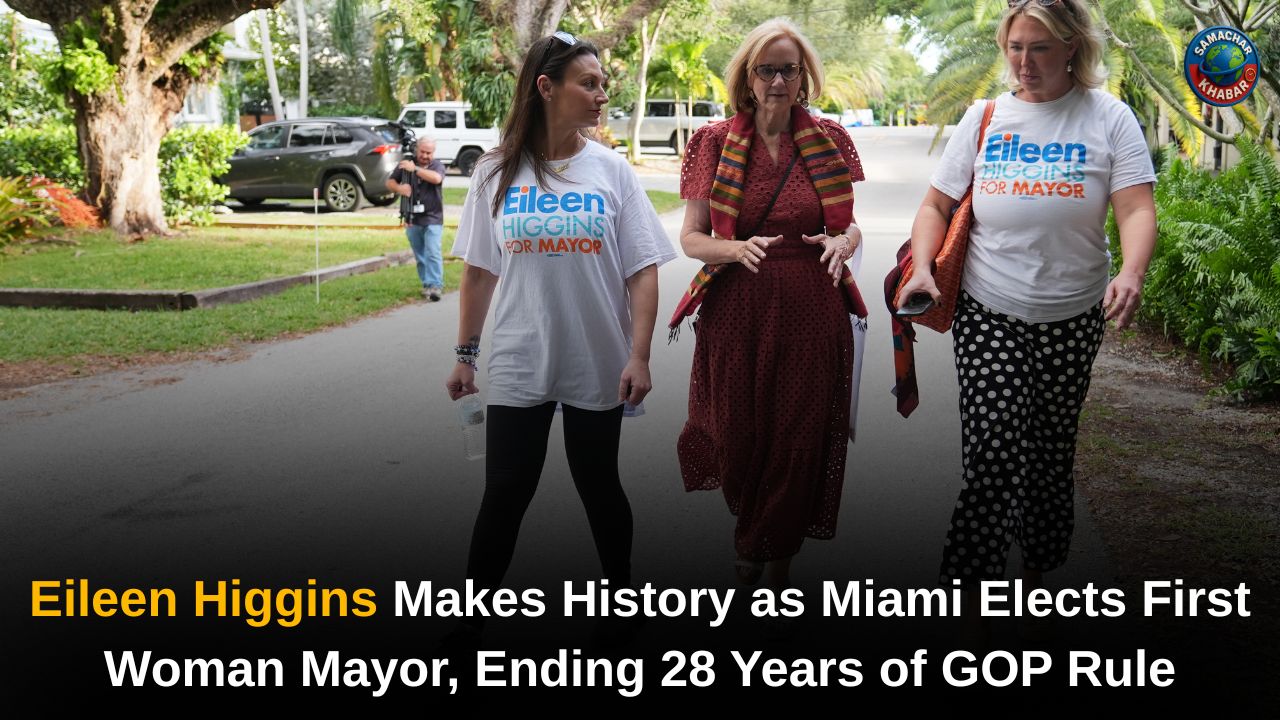
Miami has entered a new political era. In a landmark victory that has captured national attention, Democrat Eileen Higgins defeated Republican Emilio González in Tuesday’s runoff election, becoming the city’s first female mayor and the first Democrat to hold the office in nearly three decades. Her win breaks the GOP’s long-standing control of Miami politics and signals a significant shift in a state that has increasingly leaned Republican under Donald Trump’s influence.
Higgins, 60, a former Miami-Dade County commissioner, mechanical engineer, Peace Corps director in Belize, and former U.S. diplomat, ran a campaign centered on competence, accountability, and the lived realities of Miami residents. Her victory comes despite strong endorsements for González from Trump and Florida Governor Ron DeSantis, and amid a broader national debate on immigration, affordability, and political polarization.
Her message of ethical governance, affordable housing, humane immigration policies, and transparent leadership resonated with voters across Miami’s diverse neighborhoods — including the city’s large Hispanic and immigrant population.
Key Takeaways: Eileen Higgins’ Historic Win and Miami’s Political Turning Point
- Higgins becomes Miami’s first woman mayor and first Democrat in nearly 30 years, securing about 59–60% of the runoff vote.
- Defeats Emilio González, a Trump-endorsed Republican and former city manager.
- Miami voters reject decades of GOP rule, signaling a potential shift in Florida politics ahead of the 2026 midterms.
- Immigration, affordability, and corruption shaped the race, with voters responding strongly to Higgins’ calls for humane policies and ethical leadership.
- National Democrats heavily invested in the race, viewing Miami as a bellwether after a run of off-cycle election successes.
- Higgins promises a full-time, accountable mayoralty, vowing to rebuild trust, improve city services, and prioritize affordable housing.
A Race That Captivated the Nation
Although Miami’s elections are officially nonpartisan, the mayoral contest quickly became a symbolic political showdown. Republicans sought to retain their decades-long control, rallying behind González, who received vocal support from Donald Trump — including repeated social media endorsements. Prominent GOP figures underscored the importance of keeping Miami aligned with Trump-era immigration and public safety policies.
Democrats, meanwhile, saw a rare opening in Florida’s GOP-dominated landscape. The Democratic National Committee invested significant resources, sending volunteers, organizers, and nationally known leaders — including Rahm Emanuel, Sen. Ruben Gallego, and multiple gubernatorial candidates — to campaign alongside Higgins. Former Transportation Secretary Pete Buttigieg also publicly endorsed her.
With Miami poised to host FIFA World Cup matches and neighboring Doral preparing for the 2026 G-20 summit, the stakes for the city’s governance have grown. Higgins’ victory represents not only a local shift but a symbolic win for national Democrats looking for momentum ahead of the midterms.
A Campaign Built on Trust, Transparency, and Affordability
From the start, Higgins positioned herself as a problem-solver who understood Miami’s challenges firsthand.
Her core issues included:
- Affordable Housing: Higgins highlighted the city’s deepening housing crisis. She championed using city-owned land for affordable housing and criticized state leaders for spending resources on new immigrant detention centers — including the controversial “Alligator Alcatraz.”
- Ethical Governance: She pledged to root out corruption, referencing years of public frustration over scandals and dynastic politics in Miami.
- Government Efficiency: Higgins vowed to streamline permitting, reduce bureaucracy, and improve responsiveness, insisting Miami deserved a government that “finally works for the people.”
- Immigration and Public Safety: In a city where more than half the residents are foreign-born, Higgins frequently spoke about the impact of harsh immigration crackdowns. She criticized ICE raids, overcrowded detention centers, and DeSantis-backed policies that had eroded trust between immigrant communities and law enforcement.
Her message resonated deeply in Miami’s heavily Hispanic neighborhoods. She often interacted with Spanish-speaking voters and openly embraced the nickname “La Gringa” to connect culturally and personally with the community.
An Opponent with Strong Republican Credentials
Emilio González brought significant experience to the race — and significant Republican backing. A retired Air Force colonel, former director of U.S. Citizenship and Immigration Services, and ex–Miami International Airport CEO, González positioned himself as a strong proponent of law enforcement and economic development.
He supported allowing federal authorities to increase detentions of undocumented immigrants and backed a property tax elimination plan championed by DeSantis.
Also Read: HSBC Stuns Markets by Appointing Brendan Nelson as Group Chair After Turbulent Global Search
Despite Trump’s involvement, Republican leaders attempted to downplay Higgins’ chances before the runoff, calling Miami a Democratic-leaning city. After his defeat, González conceded gracefully and broke plates in Greek tradition at his watch party, calling the moment cathartic. He publicly pledged to support Higgins’ administration.
Voter Backlash Against Fear and Division
Immigration emerged as one of the most emotionally charged issues in the race. Higgins repeatedly spoke about meeting residents whose family members had been detained or moved without explanation.
“This is the first year ever where residents have told me they’re afraid,” she said. “Families are being torn apart.”
Her stance contrasted sharply with Trump-aligned messaging around “secure borders” and “migrant crime.” Miami, home to the Krome detention center, has been at the center of national debates over detention conditions and enforcement strategies.
Voters also responded to skyrocketing housing costs, corruption investigations, rising insurance premiums, and increasing costs of living — issues Democrats tied directly to Republican leadership.
A Wider Political Shift Beneath the Surface
Higgins’ win comes at a time when Democrats are outperforming expectations nationally.
In recent off-year elections in New Jersey and Virginia, Democratic candidates saw strong support from non-white and immigrant voters — a trend that echoed in Miami.
Although Miami-Dade County flipped red in 2024 for the first time since 1988, the city of Miami narrowly leaned Democratic. Higgins built her strategy on vigorous organizing, neighborhood-level outreach, and a coalition of voters across party lines.
Polls showed early that she held leads in all five commission districts, and she ultimately dominated the runoff, winning 36% in the first round and surging to nearly 60% in the final vote.
A Defining Moment for Miami’s Future
Eileen Higgins’ election marks a turning point in Miami’s political history — one that echoes far beyond city limits.
Her victory signals a voter rejection of aggressive immigration policies, entrenched political dynasties, and years of governance controversies. It elevates a leader who promises collaboration, transparency, and solutions grounded in everyday realities.
As Miami’s first woman mayor, first Democrat in nearly 30 years, and a figure with deep experience in engineering, diplomacy, and public service, Higgins enters office with both symbolic weight and high expectations.
Her next steps — particularly on affordability, immigration, and restoring public trust — will help determine whether Miami’s political shift is a momentary break or the beginning of a longer transformation in Florida’s political landscape.
FAQs on Eileen Higgins’ Historic Win as Miami’s First Woman Mayor
1. Who is Eileen Higgins, Miami’s newly elected mayor?
Eileen Higgins is a former Miami-Dade commissioner, engineer, and ex-diplomat who became Miami’s first woman mayor and first Democrat in nearly 30 years.
2. How did Eileen Higgins win the Miami mayoral election?
Higgins won the runoff with nearly 60% of the vote, defeating Trump-endorsed Republican Emilio González after leading the first round.
3. Why is Eileen Higgins’ victory historically significant?
Her win ends almost three decades of Republican control and marks Miami’s first female and first non-Hispanic mayor since the 1990s.
4. What were the key issues in the Miami mayoral race?
Major issues included affordable housing, corruption concerns, immigration policies, government efficiency, and public trust in city leadership.
5. How did national politics influence the Miami mayoral election?
Trump and DeSantis backed González, while national Democrats campaigned for Higgins, turning the local race into a symbol of broader political momentum.