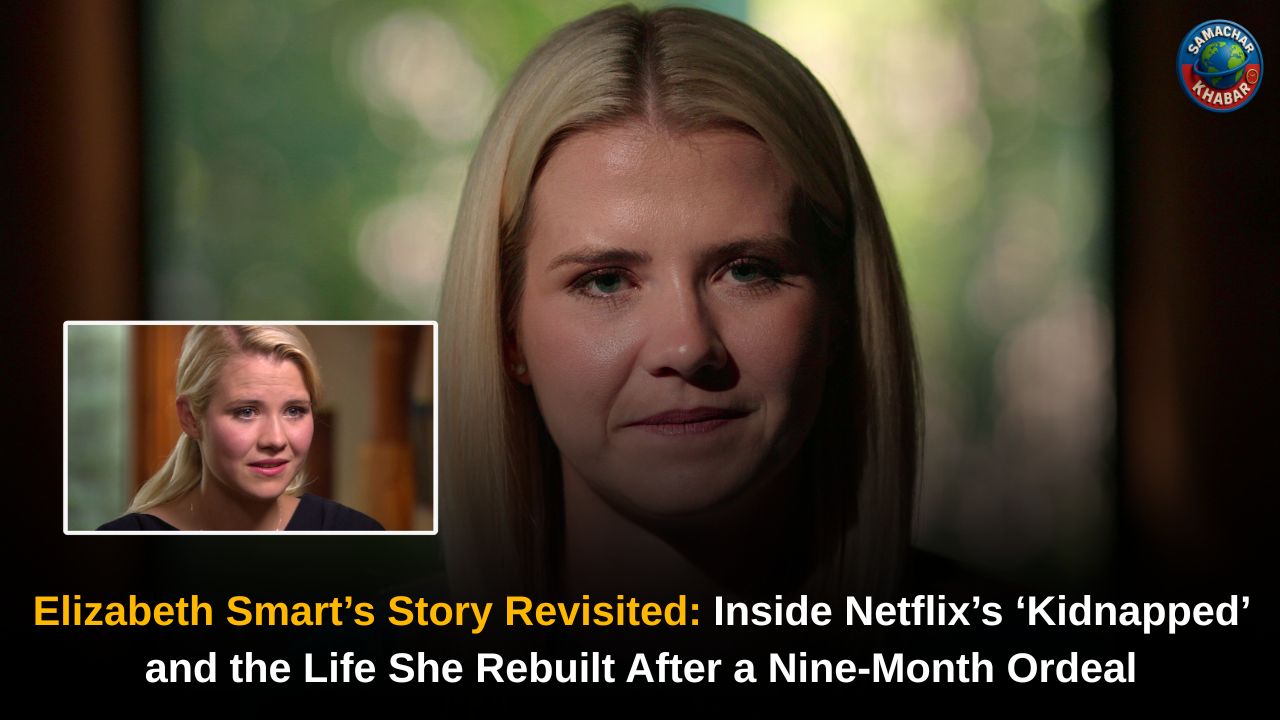
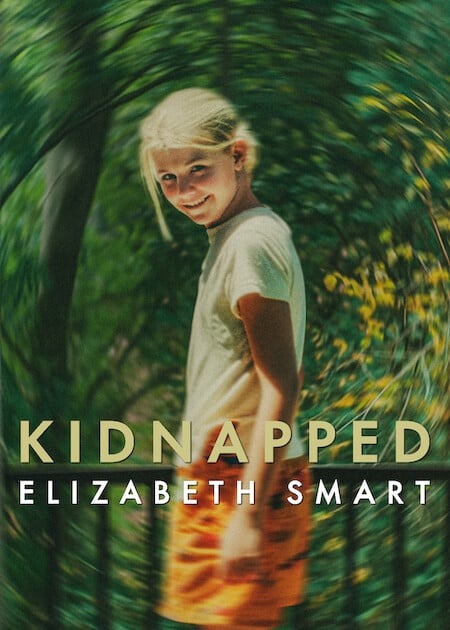
More than two decades after one of America’s most harrowing kidnapping cases, Elizabeth Smart is reclaiming her story in Netflix’s documentary Kidnapped: Elizabeth Smart. Abducted at knifepoint from her Salt Lake City home in 2002, Smart endured nine months of captivity before being rescued in March 2003. Now 38, she reflects with rare honesty on trauma, shame, survival, and healing.
The documentary not only revisits the investigation and rescue that gripped the nation but also sheds light on Smart’s present life as a wife, mother, and leading advocate for survivors of abuse.
Key Highlights from Netflix’s Kidnapped: Elizabeth Smart and Her Life After Survival
- Elizabeth Smart recounts her 2002 kidnapping and nine-month captivity in her own words
- The documentary explores the emotional and investigative challenges faced by her family
- Smart speaks openly about sexual abuse, shame, and long-term psychological impact
- Her sister Mary Katherine’s role emerges as a decisive turning point in the case
- The film traces Smart’s journey from survivor to activist, wife, and mother of three
- The case’s legal aftermath and convictions are revisited with clarity and context
The Night That Changed Everything
Among the most disturbing moments in Kidnapped: Elizabeth Smart are the details of the night Elizabeth was taken from her bedroom in Salt Lake City on June 5, 2002. At just 14 years old, she was abducted at knifepoint by Brian David Mitchell while her nine-year-old sister, Mary Katherine, lay beside her, frozen in fear and pretending to be asleep.
Elizabeth recalls waking to a knife at her neck and fearing for her life, hoping her parents would wake up. Mary Katherine later gathered the courage to alert her parents, who initially believed she had experienced a nightmare, until they discovered a broken screen and realized their daughter had been taken.
Life in Captivity and the Use of Fear
The documentary details the months Elizabeth spent held captive at a remote campsite in the mountains outside Salt Lake City. She describes being repeatedly sexually assaulted by Mitchell, who justified his actions through distorted religious beliefs. According to Elizabeth, abuse occurred multiple times a day, followed by long prayer rituals.
She also recounts daily humiliation, starvation, physical restraint, and psychological manipulation. Mitchell controlled her movements, withheld food as punishment, and used threats of violence to suppress any attempt at escape. His wife, Wanda Barzee, remained present throughout much of the abuse.
Elizabeth speaks candidly about how religion was weaponized against her, saying Mitchell used God to rationalize his actions while exerting complete power and control.
A Family Under Scrutiny and a Search That Stalled
As the nation watched, Elizabeth’s family faced immense pressure. Her parents, Ed and Lois Smart, made constant media appeals to keep the case alive. However, the investigation soon turned inward, with authorities examining family members as potential suspects, a development that further strained already devastated parents.
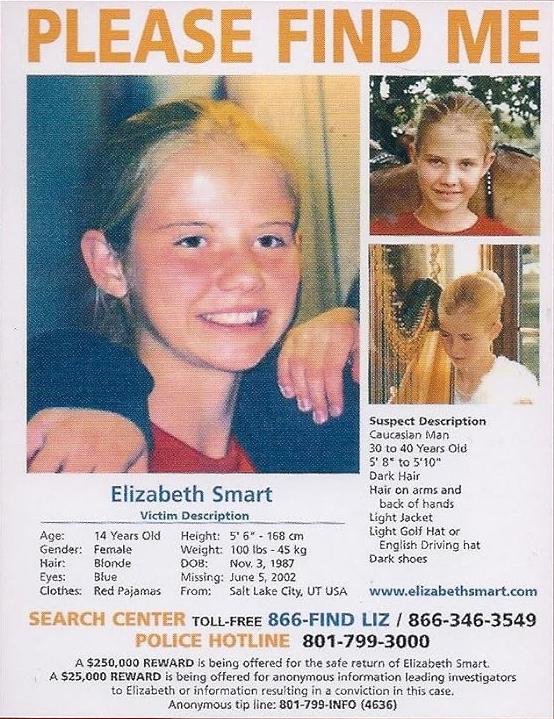
The documentary shows how leads stalled despite widespread public attention, and how the family grew increasingly frustrated with what they perceived as a lack of urgency in following up on critical clues.
Mary Katherine Smart: The Breakthrough Witness
A defining moment in the case came months after the kidnapping, when Mary Katherine suddenly remembered where she had heard the kidnapper’s voice before. She recalled a man known as “Immanuel” who had previously done work at their home.
This realization proved pivotal. Against police advice, the Smart family publicly released a sketch and name of the suspect. That decision led to a crucial tip from Mitchell’s brother-in-law, who identified him as Brian David Mitchell, a self-styled preacher living in the mountains.
Elizabeth later referred to her younger sister as her “hero,” crediting her memory and bravery with saving her life.
The Rescue That Ended the Ordeal
On March 12, 2003, a 911 call reported a group walking along a highway in Sandy, Utah, dressed in long white robes. Police arrived and recognized the scene from images broadcast on America’s Most Wanted.
An officer separated the youngest girl from the group and asked her if she was Elizabeth Smart, showing her a flyer. She replied, “Thou sayeth.” Elizabeth had been rescued just miles from her home, ending nine months of captivity.
Mitchell was later convicted of kidnapping and transporting a minor across state lines for sexual activity and sentenced to life in prison. Wanda Barzee pleaded guilty and was sentenced to 15 years, later released in 2018.
Speaking About Shame, Survival, and Strength
One of the documentary’s most striking aspects is Elizabeth Smart’s refusal to avoid difficult language. She openly uses words like “rape” and “shame,” explaining how her religious upbringing intensified her feelings of guilt after the abuse.
She describes how it took years to unlearn self-blame and rebuild her inner voice. Rather than questioning what she should have done differently, she now focuses on resilience and self-compassion.
Her frankness, she explains, is intentional. By speaking openly, she hopes other survivors understand that responsibility lies solely with the perpetrator.
Life After Trauma: Family, Advocacy, and Purpose
Following her rescue, Elizabeth returned to school, completed her education at Brigham Young University, and gradually rebuilt her life. She later married Matthew Gilmour, whom she met during a Mormon mission trip to Paris. The couple married in 2012 and now share three children.
Also Read: UK Government Drops Mandatory Digital ID Plan for Workers in Policy U-Turn
Today, Elizabeth Smart is the founder of the Elizabeth Smart Foundation, which focuses on child safety, survivor advocacy, and abuse prevention. She has authored multiple books, testified before Congress, and continues to speak publicly to support other survivors.
While some family members chose not to participate in the documentary, Elizabeth emphasizes respect for their wishes, noting that sharing her story is a personal choice driven by purpose, not obligation.
Why This Documentary Still Matters
Kidnapped: Elizabeth Smart is not presented as a sensational retelling of a crime, but as a survivor-led account of trauma, justice, and recovery. It revisits a case many remember while reframing it through Elizabeth’s voice, agency, and lived experience.
The documentary underscores the long road survivors face even after rescue and highlights the importance of listening, believing, and supporting those who have endured unimaginable harm.
A Story That Refuses to Be Defined by Trauma
Elizabeth Smart’s journey, as captured in Netflix’s Kidnapped, is not only about what was taken from her, but about what she rebuilt. Through honesty, resilience, and unwavering purpose, she transformed a childhood tragedy into a lifelong mission to protect others. By revisiting her past on her own terms, Smart reinforces a powerful truth: survival is not the end of the story. Healing, advocacy, and a meaningful life can follow.
Her voice, steady and unflinching, ensures that her experience serves not as a spectacle, but as a source of understanding and hope.
FAQs on Kidnapped: Elizabeth Smart Netflix Documentary
1. What is Netflix’s Kidnapped: Elizabeth Smart documentary about?
It chronicles Elizabeth Smart’s 2002 kidnapping, nine-month captivity, rescue, and her life today, told in her own words as a survivor and advocate.
2. When did Kidnapped: Elizabeth Smart premiere on Netflix?
The documentary premiered on Netflix on January 21, 2026, bringing renewed focus to one of America’s most high-profile abduction cases.
3. How was Elizabeth Smart rescued after her kidnapping?
Elizabeth Smart was rescued on March 12, 2003, in Sandy, Utah, after a public sighting linked to images shown on America’s Most Wanted.
4. Who played a key role in identifying Elizabeth Smart’s kidnapper?
Her younger sister, Mary Katherine Smart, identified the kidnapper’s voice, leading to the release of a sketch and the eventual arrest of Brian David Mitchell.
5. What is Elizabeth Smart doing today?
Elizabeth Smart is a wife, mother of three, and founder of the Elizabeth Smart Foundation, advocating for child safety, survivor support, and abuse prevention.