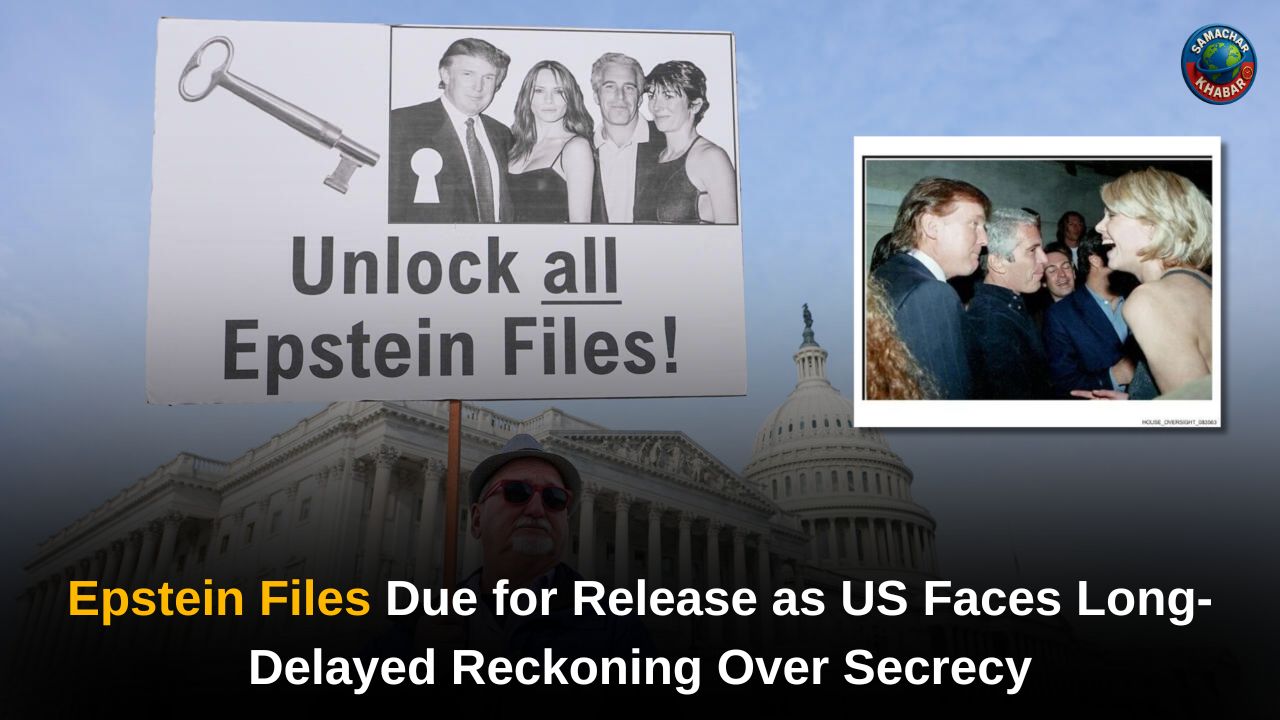
Epstein Files: The United States is set to release long-suppressed records linked to convicted sex offender Jeffrey Epstein, as mandated by the Epstein Files Transparency Act signed by President Donald Trump. The disclosure comes amid mounting political pressure, survivor demands, and renewed scrutiny over Epstein’s vast network of powerful associates.
House Democrats have already released 68 photographs from Epstein’s estate, drawn from a larger cache of 95,000 images seized before his death. Lawmakers stress that appearances in photographs do not imply criminal wrongdoing, but say the materials highlight Epstein’s influence and raise questions about years of institutional secrecy surrounding his alleged sex trafficking operation.
Key Takeaways: Epstein Files Case Update
- The Justice Department is required to release Epstein and Ghislaine Maxwell-related files by Friday under federal law.
- House Democrats have released 68 photographs from Epstein’s estate for transparency purposes.
- The images come from a collection of 95,000 photos seized before Epstein’s death in 2019.
- The photographs show Epstein with numerous influential figures across politics, business, academia and media.
- Democrats stress that appearing in the images does not indicate criminal activity.
- Survivors remain cautious, anticipating heavy redactions in the released files.
Justice Department Faces Deadline Under Transparency Law
The United States is poised to release one of its most closely guarded case files as the Justice Department prepares to make public long-sealed records tied to Jeffrey Epstein. The disclosure is mandated by the Epstein Files Transparency Act, signed into law by President Donald Trump, requiring the department to release unclassified records related to Epstein and his longtime associate Ghislaine Maxwell by Friday.
House Democratic Minority Leader Hakeem Jeffries said lawmakers expected compliance with the law, warning of bipartisan consequences if the department failed to act. “We do expect compliance,” Jeffries told reporters, adding that failure to follow federal law would trigger strong bipartisan pushback.
The release is seen as the clearest opportunity yet for the public and survivors to gain insight into how Epstein operated, who assisted him, and whether institutional restraint shielded influential individuals from accountability.
House Democrats Release 68 Epstein Estate Photographs
Ahead of the Justice Department disclosure, Democrats on the House Oversight Committee released 68 photographs obtained from Epstein’s estate. The images were part of a larger archive of approximately 95,000 photos seized before Epstein’s death in 2019 and provided to the committee as part of its investigation.
The undated images show Epstein in various social settings with a range of prominent individuals, including Microsoft co-founder Bill Gates, Google co-founder Sergey Brin, filmmaker Woody Allen, philosopher Noam Chomsky, former Trump adviser Steve Bannon, and New York Times columnist David Brooks. Previous photo releases also showed former U.S. presidents Donald Trump and Bill Clinton, as well as Britain’s Prince Andrew.

Democrats emphasized that the release was aimed at transparency, not accusation. The committee stated that none of the photographs demonstrate criminal activity by Epstein’s known associates and that appearance in the images should not be construed as evidence of wrongdoing.
Clarifications From Media and Political Figures
Following the release of the photographs, The New York Times issued a statement regarding columnist David Brooks, noting that he attended a widely held dinner in 2011 for reporting purposes and had no contact with Epstein before or after the event.
Representatives for several individuals appearing in the images did not immediately respond. President Trump previously commented that Epstein had photographs with many people and said this alone was not significant.
The White House later said that the release of the images did not change the administration’s position, maintaining that Trump had consistently supported transparency regarding the Epstein files.
Disturbing Materials Found in Epstein’s Possession
Among the released materials were images and documents described by lawmakers as deeply troubling. Some photographs show excerpts from Vladimir Nabokov’s novel Lolita written on a woman’s body, including blurred images where lines appear across different body parts. Faces were obscured to protect potential victims.
Other materials included passports, visas, and identification documents linked to multiple countries, including Russia, Ukraine, South Africa, Lithuania, Morocco, Italy, and the Czech Republic. The names on these documents were concealed, but the countries were visible.
The release also included screenshots of late-night text messages discussing the sending of girls and referencing payments of $1,000 per girl. One message included details about an 18-year-old Russian girl, though it remains unclear who sent or received the messages.
Also Read: Dan Bongino to Step Down as FBI Deputy Director After Less Than a Year
Additional recovered items included architectural blueprints, a bottle of phenazopyridine medication, and numerous photographs of women.
Political Sensitivity and Anticipated Redactions
Advocates and survivors have welcomed the impending file release but remain guarded. The law requires the unsealing of internal correspondence, investigative files, and court documents that were previously sealed or inaccessible. However, it allows prosecutors to redact information that could identify victims, compromise ongoing investigations, or affect national security.
The Justice Department has said that no definitive “client list” exists, tempering expectations that the files will provide a comprehensive roster of Epstein’s alleged associates. While the law explicitly prohibits withholding records due to embarrassment or political sensitivity, observers anticipate significant redactions.
Robert Garcia, the top Democrat on the House Oversight Committee, said the approaching deadline raises questions about what information the Justice Department possesses. Posting on X, Garcia said the department had an opportunity to act transparently and urged it to do so.
Epstein’s Background and Unresolved Questions
Jeffrey Epstein was a wealthy American financier known for cultivating relationships with powerful figures across politics, business, academia, and entertainment. In 2005, he was accused of sexually abusing a minor. In 2008, he was convicted of soliciting sex from underage girls and served 13 months in jail following a plea deal that later drew widespread criticism.
In 2019, Epstein was arrested again on federal charges of sex trafficking involving minors. Before his trial could begin, he was found dead in a New York jail. His death was officially ruled a suicide.
Epstein’s longtime associate Ghislaine Maxwell was convicted in 2021 of helping recruit and abuse underage girls. She was sentenced to 20 years in prison and is currently serving her sentence.
A Test of Transparency and Accountability
As the United States prepares for the release of the Epstein files, the case continues to sit at the intersection of immense wealth, political power, and unresolved accountability. Lawmakers argue that years of secrecy fueled public distrust and protected institutions rather than victims.
While the forthcoming records may not answer every question, they represent a critical moment in a scandal that has shaped debates about justice, influence, and transparency. Whether the disclosures meet public expectations remains uncertain, but the pressure on federal authorities to comply with the law has never been higher.
Spiritual Accountability Beyond Worldly Power
Beyond legal scrutiny and public disclosures, the Epstein case has reopened a broader reflection on moral accountability. History repeatedly shows that wealth, influence, or high office do not automatically reflect ethical conduct; actions are shaped by values, guidance, and conscience.
Spiritual traditions emphasise that without a true Guru, human beings are prone to repeated mistakes, especially while living in a world governed by material temptations.
Tatvdarshi Sant Rampal Ji Maharaj explains, based on sacred scriptures, that true devotion and righteous conduct are rooted in correct spiritual guidance. He teaches that genuine worship of the Supreme God helps individuals avoid wrongdoing, accumulate virtuous deeds, and work towards liberation. According to this knowledge, inner discipline, ethical living, and devotion, not status or power, determine one’s spiritual progress and ultimate destiny, as described in the scriptures that speak of attaining Satlok through true devotion.
- For more information visit our
- Website:www.jagatgururampalji.org
- YouTube: Sant Rampal Ji Maharaj
- Facebook: Spiritual Leader Saint Rampal Ji
- X (Twitter): @SaintRampalJiM
FAQs on Epstein Files Case Update
1. What are the Epstein files?
They are Justice Department records related to Jeffrey Epstein and Ghislaine Maxwell, including investigative and court documents.
2. Why are the files being released now?
Their release is mandated by the Epstein Files Transparency Act signed into law by President Donald Trump.
3. Do the released photos prove criminal wrongdoing?
No. Lawmakers state that appearing in photographs does not indicate criminal activity.
4. Will all information be made public?
No. The law allows redactions to protect victims, investigations, and national security.
5. What is the significance of this release?
It represents the most substantial disclosure yet in a case long criticized for secrecy and institutional failure.