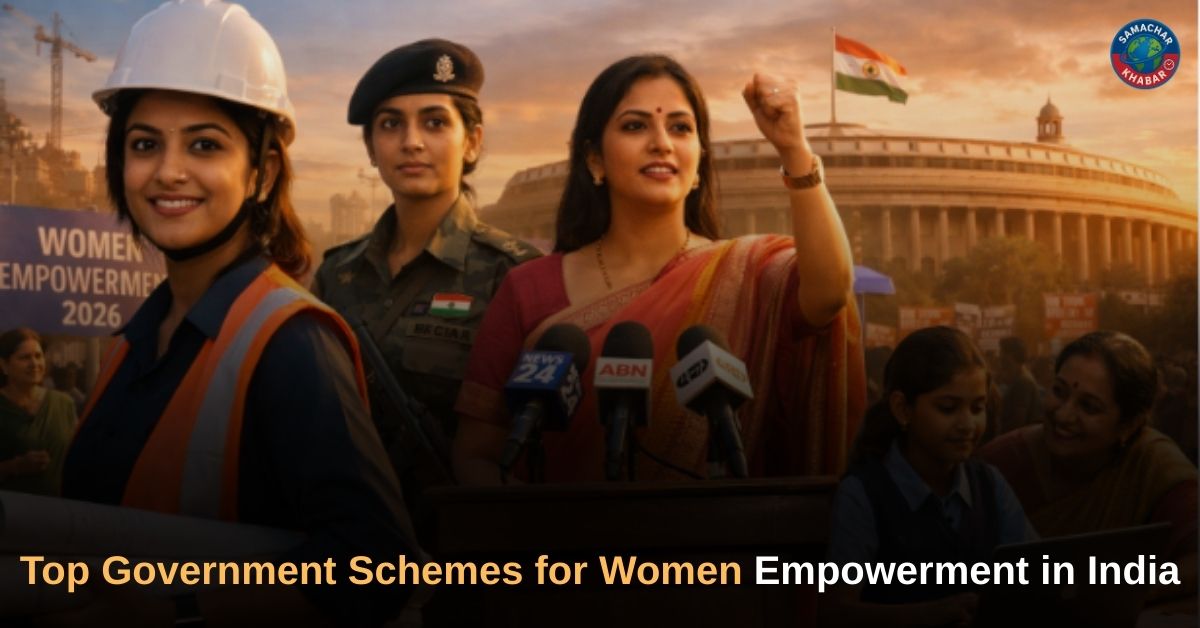
Top Government Schemes for Women Empowerment in India (2026): Women empowerment is central to India’s inclusive development vision. Over the years, the Government of India has launched multiple schemes to ensure women’s access to education, healthcare, financial independence, entrepreneurship, and social security. Programs such as Beti Bachao Beti Padhao, Stand-Up India, PM Mudra Yojana, and Pradhan Mantri Matru Vandana Yojana aim to uplift women socially and economically.
In 2026, increased budget allocation and focused policy interventions have further strengthened women-centric initiatives, especially in entrepreneurship, skill development, and livelihood generation. This article explores the top government schemes for women empowerment in India in 2026, their benefits, eligibility criteria, and application process.
Why Women Empowerment Matters in India
Women empowerment refers to enabling women with equal access to opportunities, resources, and decision-making power – economically, socially, and politically. Empowered women contribute directly to family welfare, community development, and national economic growth. Policies that strengthen women’s participation ensure inclusive and sustainable progress for India.
Top Government Schemes for Women Empowerment in India (2026)
| Scheme Name | Core Objective | Key Benefits | Eligibility Criteria | How to Apply |
| Beti Bachao Beti Padhao (BBBP) | Preventing gender bias & promoting education. | Improved gender ratio; linkage with savings schemes like SSY. | Parents/guardians of girl children (under 10). | Ministry of Women & Child Development or District Offices. |
| Sukanya Samriddhi Yojana (SSY) | Long-term savings for a girl’s future. | High interest (~8.2%); Tax benefits (Sec 80C); Secure funds for marriage/education. | Girl child under 10; operated by parent/guardian. | Post offices or authorized banks with Aadhaar & ID. |
| PM Matru Vandana Yojana (PMMVY) | Maternity benefits for health and nutrition. | Cash incentives for pregnancy and post-delivery care. | Pregnant/lactating women (first living child). | PMMVY online portal with Aadhaar & bank details. |
| Stand-Up India Scheme | Entrepreneurship for women and SC/ST. | Loans from ₹10 lakh to ₹1 crore; support for new (greenfield) businesses. | Women 18+ with 51% or more business ownership. | Stand-Up Mitra portal or designated bank branches. |
| PM Mudra Yojana (PMMY) | Collateral-free business loans. | Loans up to ₹20 lakh; easy credit for small enterprises. | Women entrepreneurs with a viable business plan. | Banks, NBFCs, or the PMMY online portal. |
| Mahila Coir Yojana | Skill development in the coir industry. | Up to 75% machinery subsidy; rural employment. | Women from coir-producing or rural regions. | Coir Board offices or government nodal agencies. |
| PM Ujjwala Yojana (PMUY) | Clean cooking fuel for BPL households. | Free LPG connection; smoke-free cooking and improved health. | Women belonging to BPL (Below Poverty Line) households. | Official PMUY portal with Aadhaar and BPL documents. |
Also Read: 7 Women-led Success Stories in Agriculture You Should Know
State-Specific & New-Age Empowerment Schemes
While national schemes provide the foundation, state-level initiatives and recent budget mandates have shifted the focus toward high-value financial independence.
| Scheme / Initiative | Regional Scope | Primary Benefit | Strategic Impact |
| Subhadra Yojana | Odisha | ₹50,000 financial assistance disbursed over 5 years. | Enhances liquid assets for rural and semi-urban women. |
| Lakhpati Didi 2.0 | National | Target to help SHG members earn ₹1 lakh+ annually. | Moves women from subsistence farming to micro-entrepreneurship. |
| SHE-Marts | National (New) | Dedicated marketplaces for women-led SHG products. | Eliminates middlemen; provides direct market access for rural crafts. |
| State Stipend Programs | Various (e.g., MP, MH, TN) | Monthly cash transfers (₹1,000–₹1,500) and education grants. | Provides immediate social security and reduces dropout rates. |
Budget 2026–27: Women Empowerment Focus
The Union Budget 2026–27 marked a historic shift by moving beyond “Women’s Development” to “Women-Led Development.” Key highlights include:
- DAY-NRLM Surge: A 20% increase in allocation for the Deendayal Antyodaya Yojana-National Rural Livelihoods Mission, aimed at digitizing 10 million Self-Help Groups (SHGs).
- Credit Guarantee Schemes: Enhanced collateral-free credit limits specifically for women-led startups in the “Greenfield” and “Tech” sectors.
- Infrastructure for Care: Increased funding for Working Women Hostels and Creche facilities to boost the Female Labour Force Participation Rate (FLFPR).
Women Empowerment as a Moral Responsibility
While government schemes provide essential financial frameworks, true empowerment is rooted in compassion and basic human security. Sant Rampal Ji Maharaj Ji is leading a profound social revolution through his Annapurna Muhim, ensuring that no woman or needy person is left behind. By providing free food, shelter, clothing, medical care, and education, He offers a tangible refuge that goes beyond mere policy.
His teachings strike at the root of inequality, emphasizing that men and women are equal souls with the same right to salvation. By establishing Dowry-Free Marriages (Ramaini) and erasing gender discrimination, He is constructing a society where a woman is respected not just for her economic potential, but for her spiritual identity. To see a truly empowered India, we must embrace this path of true worship, where physical sustenance meets spiritual liberation, creating a safe and dignified world for every daughter.
FAQ: Top Government Schemes for Women Empowerment in India (2026)
Q1. What are the top government schemes for women empowerment in India in 2026?
Key schemes include Beti Bachao Beti Padhao, PMMVY, Stand-Up India, Mudra Yojana, PMUY, and various state-specific programs.
Q2. How can women apply for government schemes online?
Women can apply through official government portals of each scheme using Aadhaar, bank details, and required documents.
Q3. Who is eligible for Stand-Up India loans?
Women entrepreneurs aged 18+ with a greenfield project and 51% ownership can apply for loans between ₹10 lakh and ₹1 crore.
Q4. What are the benefits of Sukanya Samriddhi Yojana?
It offers high interest savings, tax benefits, and long-term financial security for a girl child’s education and marriage.
Q5. Are unmarried women and homemakers eligible for these schemes?
Yes. Schemes like PMUY, MSSC, and several state programs are available irrespective of marital status, subject to eligibility criteria.