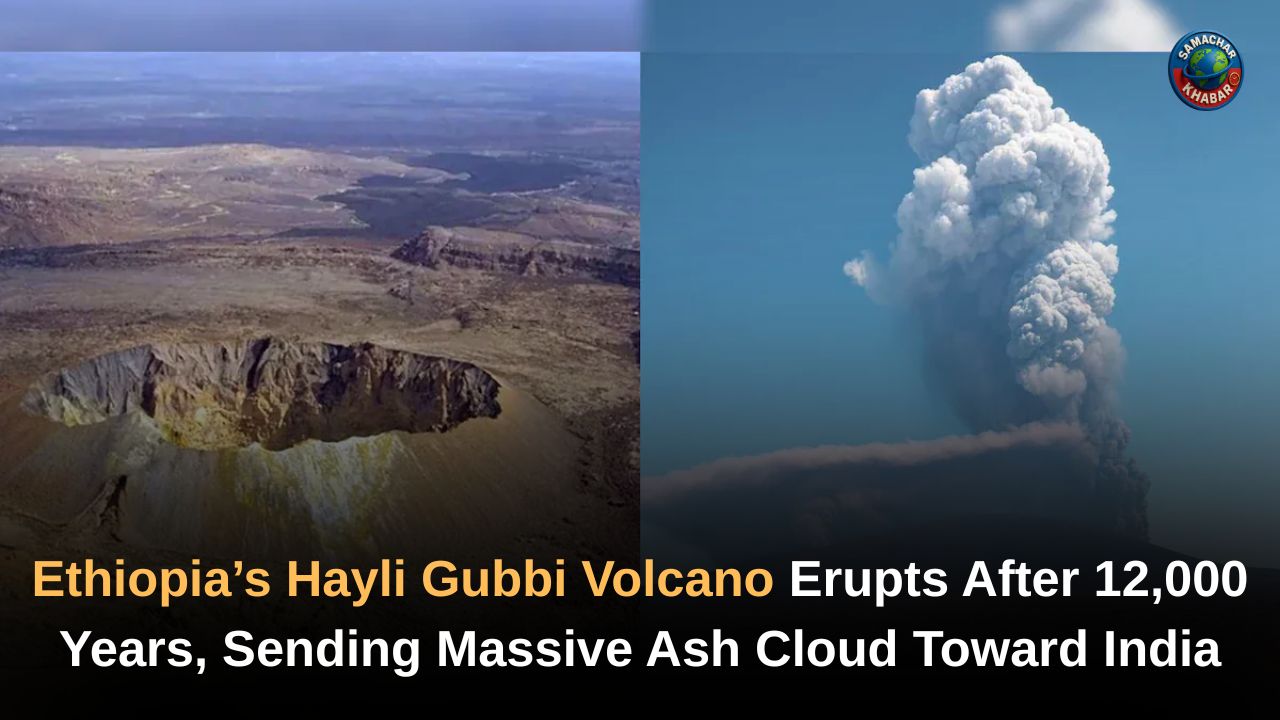
The world witnessed a rare geological event this week as Ethiopia’s long-silent Hayli Gubbi volcano erupted after nearly 10,000–12,000 years of inactivity, sending a massive ash plume across the Red Sea and toward India, Pakistan, Yemen and Oman. The drifting ash cloud disrupted flight operations across West Asia and India, prompted emergency aviation advisories, and left Ethiopian villages blanketed in dust.
Indian weather agencies confirmed the plume’s movement over Gujarat, Rajasthan, Delhi, Haryana, Punjab and northwest Maharashtra, creating concerns for aviation safety as the ash travelled at high altitudes and high speeds.
Key Takeaways on Ethiopia’s Hayli Gubbi Volcanic Eruption and Its Impact on India
• First eruption in 12,000 years: Hayli Gubbi volcano in Ethiopia’s Afar region erupted after millennia of dormancy.
• Ash cloud moving toward India: Ash plume entered Gujarat and drifted over Rajasthan, Delhi, Haryana, Punjab and NW Maharashtra.
• Severe aviation disruptions: IndiGo, Akasa Air, KLM and others diverted or cancelled flights; DGCA issued strict directives.
• Ash plume altitude: Cloud travelled between 15,000–25,000 feet, rising up to 45,000 feet and moving at 100–120 km/h.
• No casualties reported in Ethiopia: Local villages like Afdera covered in ash, livestock grazing impacted.
• VAAC confirms major eruption: Toulouse VAAC tracked plume after an explosive burst reaching nearly 14 km into the atmosphere.
A Rare Geological Event: What Triggered the Hayli Gubbi Volcano After 12,000 Years?
The Hayli Gubbi volcano, located in Ethiopia’s Afar region near the Eritrean border and about 800 km from Addis Ababa, erupted on Sunday morning after being dormant for at least 10,000–12,000 years.
Locals described hearing a loud blast followed by a powerful shock wave, with ash spreading across Afdera and surrounding villages. Ethiopia’s Afar region frequently experiences tectonic activity, and this eruption sent a towering ash column across the Red Sea, reaching the Arabian Peninsula before shifting toward India.
The Toulouse Volcanic Ash Advisory Centre (VAAC) confirmed the eruption through satellite imagery, reporting ash columns rising up to 14 km into the atmosphere. The Smithsonian Institution also noted that Hayli Gubbi had no recorded activity during the Holocene era.
Local officials reported no casualties but expressed concern over livestock survival, as the ash cover reduced available grazing.
How the Ash Cloud Reached India: Route, Speed and Atmospheric Impact
IndiaMetSky Weather and other meteorological agencies reported that the ash cloud entered Gujarat late on Monday night before drifting toward Rajasthan, northwest Maharashtra, and further into Delhi, Haryana and Punjab.
Composition and Altitude of the Ash Cloud
The ash plume consisted of:
• Volcanic ash
• Sulphur dioxide
• Fine particles of glass and rock
It travelled at 100–120 km/h, primarily between 15,000–25,000 feet and even rising to 45,000 feet, posing a major threat to aircraft engines operating at those altitudes.
Also Read: UK Major Snowfall Forecast: Latest Updates on Storms, Arctic Climate Shift and Nationwide Impact
Although experts stated the plume would not significantly worsen India’s Air Quality Index, they cautioned that sulphur dioxide levels could rise in areas of Nepal’s Himalayan belt and adjoining regions of Uttar Pradesh.
Visibility and Sky Conditions
The ash cloud was expected to cause:
• Darker skies
• Hazy visibility
• Possible delays in aviation routes
• Low probability of ashfall on Indian soil
Major Flight Disruptions Across India and West Asia
The eruption heavily affected aviation across the region. Airlines immediately activated safety protocols due to the risk volcanic ash poses to turbine engines.
Indian Airlines Affected
- IndiGo:
• Flight 6E 1433 from Kannur to Abu Dhabi diverted to Ahmedabad.
• Several flights reported delays between 60–120 minutes.
• The airline issued public statements assuring continuous monitoring. - Akasa Air:
• Cancelled flights to Jeddah, Kuwait and Abu Dhabi on November 24–25.
• Offered full refunds or free rebooking within seven days.
• Confirmed active coordination with international aviation bodies. - SpiceJet:
• Warned passengers of potential delays on Dubai routes.
• Issued advisories to monitor flight status. - KLM and Other Carriers:
• Cancelled or rerouted flights due to the expanding ash plume.
DGCA’s Detailed Advisory
India’s aviation regulator instructed airlines to:
• Strictly avoid volcanic ash-affected regions and altitudes
• Adjust fuel planning and routing
• Report any encounter with ash, including unusual engine performance
• Inspect runways, taxiways and aprons for ash contamination
A Mumbai airport official also noted that some flights were being rerouted through Pakistan airspace. However, because Pakistan airspace remains closed for Indian carriers, additional complications were expected for Indian airlines.
Local Impact in Ethiopia: Villages Covered in Ash
While Ethiopia avoided human casualties, many villages around Afdera were coated in grey volcanic dust.
• Livestock grazing was severely affected.
• Tourists heading to the Danakil desert were stranded.
• Residents described the blast as sounding like an explosion filled with smoke and ash.
Authorities shared photographs showing a massive column of ash rising from the volcano, painting an eerie picture of the rare eruption.
Monitoring the Plume: What’s Next for India and the Region
The Toulouse VAAC confirmed that the active eruption phase has now stopped, but the large ash plume continues to drift with upper-level winds.
IMD stated the cloud is expected to exit Indian skies by Tuesday 7:30 pm local time as it moves towards China.
Airlines and authorities worldwide remain on alert, tracking shifts in the plume’s altitude and density to ensure aviation safety.
Spiritual Insight: Saint Rampal Ji Maharaj Ji’s Guidance on Nature’s Balance and Human Conduct
In moments when nature displays its unimaginable power, spiritual teachings offer clarity beyond scientific explanation. Saint Rampal Ji Maharaj emphasizes that the universe operates under strict divine law, where every natural event reflects the deeper workings of creation.
His teachings highlight that true safety and stability arise not from human control, but from understanding the Supreme God’s system, following the path of righteousness, and practising compassion.
According to the knowledge revealed by Saint Rampal Ji Maharaj, only the correct way of worship prescribed in the scriptures can protect humans from unseen calamities and bring lasting peace.
A Rare Eruption That Reshaped Global Aviation for Days
The eruption of Ethiopia’s Hayli Gubbi volcano after more than 12,000 years created a chain of events that rippled across continents—from villages in Afar struggling with ash-covered fields to major flight disruptions in India and West Asia.
As aviation authorities continue to track the ash plume’s movement, the incident serves as a powerful reminder of how a single geological event can alter global air traffic, local livelihoods and atmospheric conditions within hours.
FAQs on Ethiopia’s Hayli Gubbi Volcano Eruption and India’s Flight Disruptions
1. What caused the Hayli Gubbi volcano in Ethiopia to erupt after 12,000 years?
The eruption occurred in Ethiopia’s tectonically active Afar region, sending ash nearly 14 km high after over 10,000–12,000 years of dormancy.
2. How is the volcanic ash cloud from Ethiopia affecting India?
The ash plume entered Gujarat and drifted over Rajasthan, Delhi, Haryana, Punjab and northwest Maharashtra, prompting aviation advisories and flight disruptions.
3. Which flights and airlines were impacted by the volcanic ash?
IndiGo, Akasa Air, KLM and SpiceJet diverted or cancelled several routes to West Asia as DGCA instructed airlines to avoid ash-affected altitudes.
4. Why is volcanic ash dangerous for aircraft?
Volcanic ash contains glass-like particles that melt inside engines, potentially blocking cooling passages, damaging turbines and causing severe engine failure.
5. Will the ash cloud impact air quality or cause ashfall in India?
Experts say no significant ashfall is expected in India, though skies may appear hazy. Minor sulphur dioxide rise is possible near Himalayan regions.