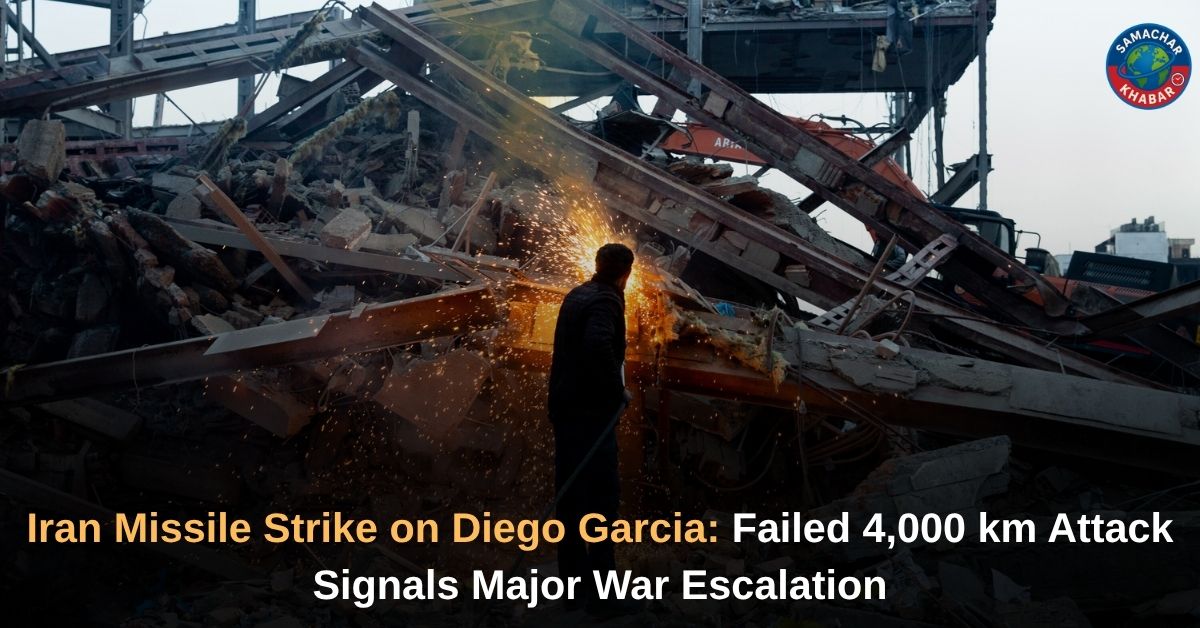
In a major escalation of the ongoing Iran–US conflict, Tehran reportedly launched two intermediate-range ballistic missiles toward the strategically vital Diego Garcia base in the Indian Ocean. Although neither missile hit the target, the attempt has raised serious global concerns. The strike indicates that Iran’s missile capabilities may extend far beyond previously acknowledged limits and signals a widening of the conflict beyond the Middle East.
At the same time, statements from Donald Trump about potentially winding down military operations have added complexity to an already volatile geopolitical situation.
Key Highlights of Iran Missile Strike on Diego Garcia and Global Escalation
- Iran fired two intermediate-range ballistic missiles (IRBMs) toward Diego Garcia, approximately 3,800–4,000 km away.
- Neither missile struck the base—one failed mid-flight, while the other was targeted by a US Navy SM-3 interceptor.
- The strike suggests Iran’s missile range may be far greater than its publicly stated 2,000 km limit.
- Marks a significant expansion of the conflict into the Indian Ocean.
- Diego Garcia remains a critical US-UK military hub supporting global operations.
- The United States has deployed additional warships and Marines to the region.
- Iran has issued warnings targeting tourist and recreational sites worldwide.
- Rising tensions in the Strait of Hormuz are disrupting global oil supply chains.
Iran’s Missile Strike Attempt: What Happened
According to reports citing US officials, Iran launched two intermediate-range ballistic missiles toward Diego Garcia. One missile failed during flight, while the second was engaged by an SM-3 interceptor launched from a US warship. However, it remains unclear whether the interception successfully neutralised the missile.
The SM-3 system is designed to destroy incoming ballistic missiles using a “hit-to-kill” method, relying on direct impact rather than explosive warheads.
The attempted strike is significant because of the distance involved. Diego Garcia lies nearly 4,000 kilometres from Iran, making it a target previously considered beyond the range of Tehran’s known missile systems.
Missile Range Debate: Capabilities Beyond Known Limits
The strike has intensified scrutiny of Iran’s missile capabilities. Iran had earlier indicated that its missile range was limited to around 2,000 kilometres, as stated by Foreign Minister Abbas Araghchi.
However, existing assessments show:
| Missile System | Estimated Range |
| Khorramshahr | 2,000–3,000 km |
| Emad | ~1,800 km |
| Ghadr | 1,600–2,000 km |
| Shahab-3 | ~1,300 km |
| Rezvan | ~1,400 km |
The targeting of a location nearly 4,000 km away suggests that Iran may possess longer-range capabilities not previously disclosed, raising fresh concerns among global security analysts.
Why Diego Garcia Holds Strategic Importance
Diego Garcia is one of the most critical overseas military bases operated by the United States and the United Kingdom. Located in the central Indian Ocean, it plays a key role in global military operations.
Strategic Functions of the Base:
- Launch site for long-range bomber missions
- Support hub for naval deployments and submarines
- Critical base for surveillance and logistics operations
- Previously used in US campaigns in Afghanistan and Iraq
The base, along with RAF Fairford in the United Kingdom, has been made available for US operations related to Iran.
War Expands Beyond the Middle East
The attempted strike on Diego Garcia marks a clear expansion of the conflict’s geographic scope. What began as a regional confrontation has now extended into the Indian Ocean, signalling a broader and more complex phase of the war.
Earlier in the conflict, a US submarine reportedly sank the Iranian warship IRIS Dena south of Sri Lanka, resulting in significant casualties. This incident highlighted that hostilities had already begun spreading beyond traditional conflict zones.
US Military Build-Up in Response
The United States has strengthened its military presence in the region amid escalating tensions. Reports indicate:
- Deployment of three additional warships
- Movement of approximately 2,500 Marines
- Total US troop presence in the region reaching around 50,000
These reinforcements are aimed at enhancing readiness and maintaining control over strategic areas, particularly around critical maritime routes.
Trump’s Strategy: Pressure with Possible Exit
Donald Trump has taken a firm stance on continuing military pressure while also संकेत देते हुए that the United States may soon scale down operations.
He stated that the US is “very close” to achieving its objectives, which include:
- Destroying Iran’s missile capabilities
- Eliminating its naval and air power
- Preventing nuclear advancement
- Protecting regional allies
Despite this, Trump has clearly rejected the idea of a ceasefire.
This dual approach reflects a complex strategy combining continued pressure with potential de-escalation.
Iran’s Retaliation and Global Threat Warnings
Iran has expanded its response beyond direct military targets. Senior military spokesperson Abolfazl Shekarchi warned that tourist sites, parks, and recreational areas worldwide could be targeted.
Also Read: Crude Oil Surge After Israel–Iran Strikes: Will Indian Stock Market Face Fresh Volatility This Week?
Additional developments include:
- Drone strikes on Kuwait’s Mina Al-Ahmadi refinery, triggering a fire
- Warnings issued to the United Arab Emirates, particularly Ras al-Khaimah
- Continued attacks on energy infrastructure across Gulf countries
These actions have raised concerns about potential attacks beyond traditional war zones, increasing global security risks.
Strait of Hormuz Tensions and Economic Impact
The conflict has disrupted activity in the Strait of Hormuz, a vital global oil route through which nearly one-fifth of the world’s oil supply passes.
Key Impacts:
- Disruption in shipping routes
- Rising oil prices
- Increase in fuel and food costs globally
- Pressure on financial markets
Iran has, however, indicated limited flexibility by allowing certain vessels, including Japanese-linked ships, to pass through the route.
Leadership Losses Inside Iran
The ongoing conflict has also resulted in significant losses within Iran’s leadership and military structure. Reports indicate that several senior figures have been killed, including:
- Ali Larijani
- Gholamreza Soleimani
- Ali Mohammad Naini
These developments represent a major setback for Iran’s command structure during a critical phase of the conflict.
UK’s Role and Diplomatic Fallout
The United Kingdom has allowed the United States to use key bases, including Diego Garcia and RAF Fairford, for operations linked to Iran.
Prime Minister Keir Starmer initially showed reluctance but later approved the move following attacks on allied interests.
Iran has criticised the decision, stating that such actions would be considered direct participation in aggression, further escalating diplomatic tensions.
Spiritual Perspective: Understanding True Peace Through the Unique Knowledge of Saint Rampal Ji Maharaj Ji
Amid rising global conflicts, fear, and destruction, the deeper question remains—can lasting peace ever be achieved through war? According to the teachings of Saint Rampal Ji Maharaj, true peace is not established through weapons or power, but through spiritual knowledge and righteous living.
He explains that wars and violence are consequences of ignorance about the true way of living as described in holy scriptures. When humans act against divine laws, suffering and unrest become inevitable. The current global tensions reflect a larger spiritual imbalance where material power is prioritised over inner wisdom.
Saint Rampal Ji Maharaj emphasises that only by understanding the true spiritual path, following Satbhakti (true worship), and living with compassion and truth can humanity move towards real peace. His teachings guide individuals to rise above hatred, ego, and conflict, offering a path that leads not only to personal salvation but also to global harmony.
In a world increasingly shaped by conflict, this spiritual knowledge provides a meaningful direction—one that shifts focus from destruction to lasting peace and unity.
A Conflict Entering a More Uncertain Phase
The attempted missile strike on Diego Garcia, despite failing, highlights a critical turning point in the ongoing conflict. It underscores the possibility that Iran’s military capabilities may be more advanced than previously believed and demonstrates its willingness to target strategic locations far beyond the Middle East.
At the same time, the United States continues to reinforce its military presence while संकेत देते हुए a possible reduction in operations. With rising tensions, threats extending beyond traditional battlefields, and increasing pressure on global energy routes, the situation remains highly uncertain. The coming weeks will be crucial in determining whether the conflict escalates further or moves toward de-escalation.
FAQs on Iran Missile Strike on Diego Garcia and Global War Escalation
1. Did Iran successfully hit the Diego Garcia military base?
No, Iran’s two missiles failed to hit Diego Garcia. One failed mid-flight, while the second was intercepted or engaged by a US SM-3 missile defense system.
2. How far is Diego Garcia from Iran and why is it significant?
Diego Garcia is around 3,800–4,000 km from Iran, making the strike attempt significant as it suggests Iran may have longer-range missile capabilities than previously declared.
3. What type of missiles did Iran use in the attack?
Iran reportedly used intermediate-range ballistic missiles (IRBMs), marking a potential first operational use at such long distances beyond its earlier claimed limits.
4. Why is Diego Garcia important for the US and UK?
Diego Garcia is a strategic military base used for bomber missions, naval operations, and logistics, playing a key role in US operations in Asia, the Middle East, and Africa.
5. How has the Iran missile strike impacted global security and economy?
The strike has increased global tensions, raised fears of wider conflict, disrupted oil supply routes like the Strait of Hormuz, and contributed to rising fuel and economic instability.