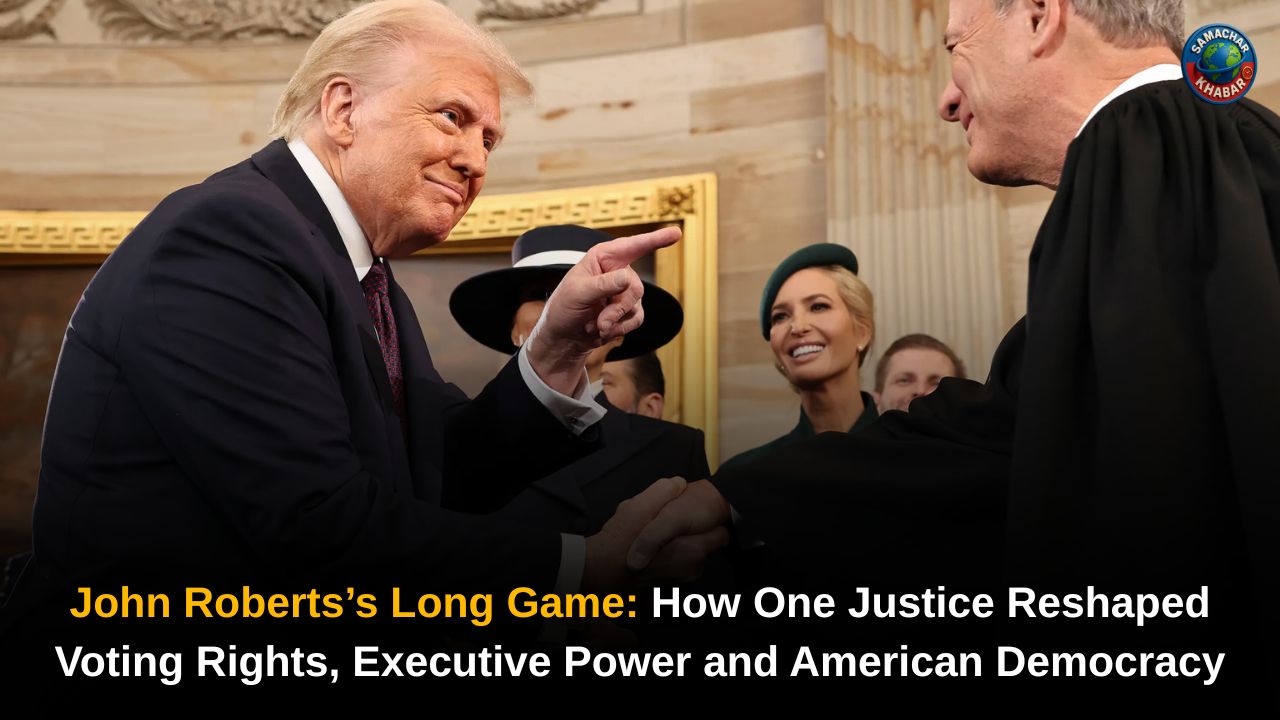
For more than four decades, Chief Justice John Roberts. has been at the center of a quiet but far-reaching transformation of American law. From his early work in the Reagan Justice Department to his current leadership of the Supreme Court’s conservative supermajority, Roberts has pursued a consistent vision: limiting federal oversight of elections, weakening key protections of the Voting Rights Act, and strengthening presidential authority over the executive branch.
As the Court moves toward deciding historic cases like Louisiana v. Callais, and as emergency rulings increasingly favor presidential power, Roberts’s long-term strategy is shaping the very structure of American democracy.
Key Takeaways on John Roberts’s Long Campaign to Reshape U.S. Power Structures
Roberts opposed the Voting Rights Act’s protections from the start
In the 1980s, he argued fiercely against the “effects test” in Section 2, insisting that discriminatory impact should not be grounds for legal action unless discriminatory intent was proven.
His Supreme Court rulings significantly weakened oversight of voting laws
Decisions like Shelby County v. Holder and Rucho v. Common Cause reduced federal power to stop discriminatory voting rules and banned federal review of partisan gerrymandering.
Roberts advanced the unitary executive theory for decades
He helped shape the Reagan-era argument for stronger presidential control and later incorporated those ideas into rulings that expand executive authority.
Louisiana v. Callais could dismantle Section 2 protections
The Court appears ready to forbid the use of race data in redistricting, a move that could dilute minority representation across the South.
Emergency rulings under Roberts increasingly protect presidential decisions
His rapid stay of a 4th Circuit ruling on immigration judges exemplifies how the Court shields executive-branch personnel power from judicial oversight.
A Strategic Beginning: Roberts in the Reagan Justice Department
John Roberts’s long campaign began in 1981, when he joined the Reagan Justice Department and was quickly assigned the Voting Rights Act portfolio. At the time, Congress was preparing to reauthorize the VRA, with civil-rights groups pushing to restore Section 2 by adding an effects test — a response to the Supreme Court’s Mobile v. Bolden decision, which had made discriminatory intent the legal threshold.
Roberts argued vigorously against the change. His memos warned that adopting an effects standard would trigger widespread litigation, impose what he characterized as racial quota systems, and permit unprecedented federal intervention in state and local elections. These arguments shaped President Reagan’s public statements, demonstrating how deeply Roberts influenced administration strategy.
Although Congress ultimately rejected his position, Roberts’s writings became the intellectual seeds of legal arguments he would revive decades later from the Supreme Court bench.
A Shift to Judicial Power: Turning Defeat Into Opportunity
After Congress strengthened the Voting Rights Act in 1982, the conservative movement — with scholars like Robert Bork and Antonin Scalia — concluded that legal change would have to come through the judiciary, not legislation. Roberts joined this judicial pipeline, eventually becoming Chief Justice in 2005.
Also Read: Healthy Man Suffers Stroke After Excessive Energy Drink Use
Once positioned at the helm of the Court, Roberts presided over rulings that re-opened the very debates he lost as a DOJ attorney. In 2013, Shelby County v. Holder disabled Section 5 preclearance by striking down the formula that determined which states required oversight. States with long histories of discriminatory practices could now change voting laws without federal review, setting off a wave of voter restrictions across the country.
In 2019, Rucho v. Common Cause barred federal courts from adjudicating partisan gerrymandering claims, a decision that sharply limited judicial checks on redistricting abuses. Although Roberts assured that courts could still intervene in racial discrimination cases, the Court’s 2025 posture in Louisiana v. Callais suggests that protection is now in jeopardy.
The 2025 Redistricting Showdown: An Echo of the 1980s Debate
The central question in Louisiana v. Callais — whether race data may be used in redistricting — is strikingly similar to the debate Roberts helped shape in the early 1980s. During oral arguments, several conservative justices appeared prepared to rule that considering race in map-drawing may itself violate the Constitution.
If the Court restricts or nullifies Section 2’s effects standard, states across the South could redraw districts held by Black lawmakers into white-majority, more conservative seats. Analysts note this could shift up to 19 congressional seats toward Republicans in 2026, profoundly altering national political representation.
Roberts’s decades-old memos anticipated this shift: limit the use of race in voting law, limit the federal role in overseeing discriminatory systems, and narrow the scope of civil-rights protections.
Roberts and the Expansion of Presidential Authority
Roberts’s long-term influence extends beyond voting rights. He has consistently supported a stronger presidency. Early in his career, he worked on legal theories asserting that presidents should have broad authority over the executive branch, including the removal of agency officials whom Congress attempted to shield from political pressure.
Today, the Court’s conservative bloc appears ready to allow President Trump sweeping removal power over independent agencies, including the Federal Trade Commission. Critics argue this would collapse long-standing checks on presidential influence, consolidating control over regulatory bodies.
The Court’s recent decisions and signals align with broader conservative efforts, including aspects of Project 2025, to remake the federal bureaucracy under stronger presidential leadership.
A Recent Example: Roberts Blocks a Challenge to Trump’s Personnel Authority
A fresh illustration of Roberts’s approach came when the 4th U.S. Circuit Court of Appeals ruled that immigration judges could bypass the Merit Systems Protection Board (MSPB) because the board may not be functioning properly. The DOJ said this ruling created an unlawful workaround that undermined the Civil Service Reform Act.
Within hours of the request from Solicitor General D. John Sauer, Roberts issued a stay, halting the ruling and requiring further briefing. The move preserved executive authority and reaffirmed the Court’s skepticism toward judicial intervention in personnel matters Congress intended to channel through administrative review.
A Spiritual Insight: Guidance from Saint Rampal Ji Maharaj
At a time when institutions face deep scrutiny and public trust is strained, the teachings of Saint Rampal Ji Maharaj offer a reminder of moral clarity. He emphasizes truthfulness, accountability, and righteous conduct — values that remain essential for individuals and nations navigating turbulent political environments. His message underscores that genuine reform begins with ethical introspection and disciplined action.
The Moment Ahead: A Democracy at a Defining Crossroads
As the Supreme Court approaches major decisions on voting rights and presidential power, the full impact of Roberts’s long strategic vision is becoming visible. His decades of legal arguments — from DOJ memos to Supreme Court opinions — now converge at a critical point for American democracy. Whether the Voting Rights Act remains enforceable, whether presidential authority becomes virtually unchecked, and whether the public continues to trust the judiciary will shape the political landscape for generations.
FAQs on John Roberts’s Long Game and U.S. Democracy
1. What is John Roberts’s “long game” in reshaping U.S. democracy?
Roberts has spent four decades limiting voting-rights protections and expanding presidential authority through legal strategy, DOJ work, and landmark Supreme Court rulings.
2. How did Roberts influence the Voting Rights Act over time?
From the 1980s onward, he opposed the effects test in Section 2 and later authored rulings weakening federal oversight of discriminatory voting laws.
3. What is the significance of Louisiana v. Callais?
The case could bar race data in redistricting, undermining Section 2 and potentially reducing minority representation in several Southern congressional districts.
4. How has Roberts expanded presidential power?
His Court has increasingly supported broad removal authority, administrative control, and immunity for official acts, strengthening the unitary executive model.
5. Why did Roberts block the 4th Circuit ruling on immigration judges?
He stayed the ruling to preserve Congress’s requirement that personnel disputes go through the MSPB, preventing courts from bypassing established administrative processes.