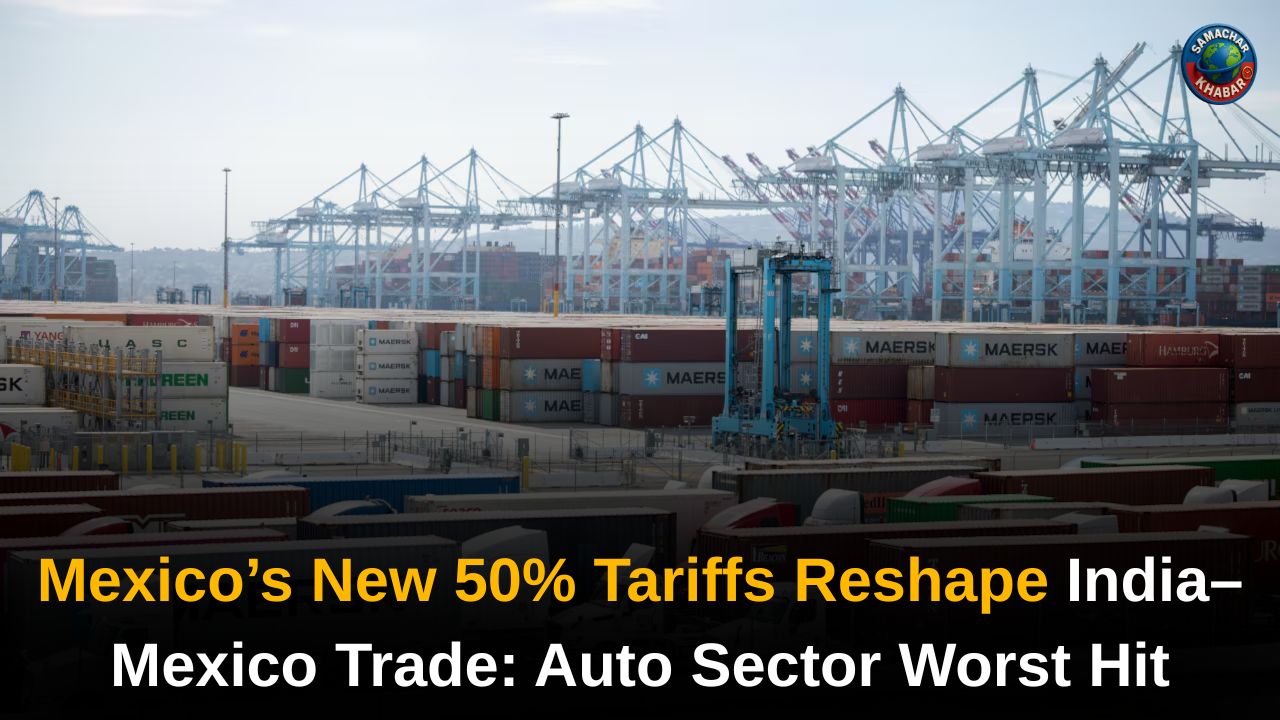
Mexico Tariffs India: India’s exporters are facing one of their most significant trade shocks in years after Mexico approved steep import tariffs of up to 50 percent on goods from countries with which it does not have a Free Trade Agreement (FTA). This sweeping overhaul, effective January 1, 2026, directly targets thousands of products from India, China, South Korea, Thailand and Indonesia.
For India—which has built Mexico into one of its fastest-growing export destinations—the new duties threaten more than a billion dollars in shipments, particularly in automobiles, engineering goods, chemicals, steel and consumer-focused manufacturing.
With the United States already imposing 50 percent tariffs on Indian imports, Mexico’s move intensifies pressure on New Delhi’s export engine and complicates an already-tense global trade landscape.
Key Takeaways: How Mexico’s 50% Tariffs Shake India–Mexico Trade Dynamics
- Mexico’s tariff regime of 5%–50% affects over 1,400 product lines, including autos, auto parts, textiles, steel, plastics, footwear, aluminium and machinery—categories crucial for Indian exports.
- India’s auto sector faces the worst blow, with nearly $1 billion worth of vehicles at risk as import duty rises from 20% to 50%.
- Mexico has become India’s largest passenger-vehicle export market, receiving up to 20% of output for some models.
- Trade ties valued at $11.7B in 2024 may weaken, despite India recording an $8.9B export high and a $6.1B trade surplus.
- Analysts link the move to US influence, as Mexico aligns ahead of the US-Mexico-Canada Agreement (USMCA) review while responding to concerns over Chinese inflows.
- Non-auto sectors such as steel, textiles, engineering goods, machinery, ceramics and aluminium also face steep duties up to 35%–50%.
Mexico’s Tariff Overhaul: What Changed and Why It Matters
Mexico—long known for its open-market orientation—has shifted sharply towards protectionism. The Senate approved a tariff framework raising duties to 35% for most goods and up to 50% for automobiles and select categories. The bill, passed with 76 votes in favour, reflects political consensus to safeguard domestic manufacturing amid a surge in cheaper Asian imports.
Mexican officials argue the duties are essential for protecting workers, stabilising industries, and reducing dependence on low-cost suppliers, especially China, with which Mexico has a widening trade imbalance. The Ministry of Finance estimates the new tariff structure could generate up to 52 billion pesos (approximately Rs 19,000 crore) next fiscal year, while Reuters analysis places the estimate at $3.76 billion.
Although President Claudia Sheinbaum insists the tariffs are not driven by US pressure, policy analysts see a clear geopolitical alignment. The United States—Mexico’s largest trading partner—has been urging North American economies to restrict Chinese access to regional supply chains. With growing scrutiny under the upcoming USMCA review, Mexico’s tariff configuration closely mirrors American trade actions taken earlier this year.
India’s Growing Reliance on Mexico: A Market Now Under Threat
Over the past decade, Mexico has emerged as a strategic export hub for Indian manufacturers. According to Embassy of India data, bilateral trade hit a record $11.7 billion in 2024, with India exporting $8.9 billion and enjoying a strong trade surplus for the eighth consecutive year.
India’s top exports include:
| Category | Export Value (2023-24) |
| Passenger Vehicles | $1.697B |
| Machinery & Mechanical Appliances | $521M |
| Electrical Machinery | $509M |
| Organic Chemicals | $337M |
| Aluminium Products | $302M |
| Iron & Steel | $236M |
| Pharmaceuticals | $212M |
More than 200 Indian companies operate in Mexico across IT services, pharmaceuticals, automobile assembly and engineering, reaffirming Mexico’s role as a gateway to North American supply chains.
But with heavy tariffs now looming, cost structures, pricing strategies and long-term planning for these firms may be significantly disrupted.
Automobile Industry Faces the Hardest Blow
The auto sector is the single biggest contributor to India’s exports to Mexico. In 2024 alone, India shipped nearly $1.9 billion worth of passenger vehicles, making Mexico its largest car export market.
Key manufacturers affected:
- Volkswagen / Skoda Auto – constituting nearly half of India’s total car shipments to Mexico
- Hyundai – exported around $200 million last year
- Nissan – roughly $140 million
- Maruti Suzuki – about $120 million
The import duty shock—from 20% to 50%—forces automakers to reassess production cycles and export allocation. For many brands, exports to Mexico are vital for maintaining plant utilisation, economies of scale and cushioning slower domestic sales.
Also Read: Russian President Vladimir Putin to Visit India from December 4–5 for High-Level Strategic Summit
The Society of Indian Automobile Manufacturers (SIAM) wrote to the Commerce Ministry urging diplomatic intervention, noting that Indian cars do not compete with Mexico’s high-end models and cater mainly to local demand with engines below one litre.
Two-wheeler manufacturers—including Royal Enfield, TVS, Bajaj and Honda—also face uncertainty, as higher duties could squeeze margins and reduce shipment volumes.
Non-Automotive Sectors Also in the Crossfire
Beyond automobiles, several high-value industries will feel the tariff heat:
Steel and Metals
- India exported $236M in steel and $302M in aluminium, both now facing duties up to 35%–50%.
- Mexico accounts for 20% of India’s flat-rolled stainless steel exports.
Textiles and Apparel
- Among the most vulnerable, as these largely fall under the steepest tariff slabs.
- Mexico previously relied on Asian suppliers for price-competitive garments and fabrics.
Engineering Goods & Machinery
- Over $521M worth of machinery exports now face higher landed costs.
- Could reduce competitiveness for Indian assembly-line suppliers.
Safety Bags & Industrial Components
- Mexico buys nearly one-third of India’s safety bag exports, a segment now at risk.
Ceramic & Tile Industry
- India shipped nearly $100M of ceramic tiles, holding more than half of Mexico’s market.
Aluminium Dominance
- India has 53% share of Mexico’s aluminium imports, making replacement difficult even with tariffs.
These strengths may soften the overall blow, but cannot counterbalance the scale of risk in automobiles and engineering goods.
Mexico’s Policy Shift: A Major Turning Point in Global Trade Relations
Mexico’s move represents one of the most substantial departures from its traditional trade policy in decades. Domestic groups, particularly in the automotive industry, argue that Chinese manufacturers—now holding nearly 20% of Mexico’s auto market—are expanding too quickly.
However, critics within Mexico, including members of the National Action Party (PAN), warn that the tariff package acts as a tax on consumers and may increase inflation by raising prices of imported goods.
The legislation also empowers Mexico’s Ministry of Economy to alter tariff rates without congressional approval, signalling that more frequent adjustments may follow as global trade tensions intensify.
A Defining Outlook for India’s Export Future
Mexico’s steep tariffs arrive at a moment when India is already grappling with US duties of 50 percent—creating a double-layered challenge for exporters. For India, the immediate risk is concentrated in automobiles, steel and intermediate goods, but the long-term implications are broader. If supply chains shift, Indian companies may need to diversify markets, push for bilateral trade agreements, or redesign export strategies entirely.
As nations tighten protectionist policies, India’s ability to navigate these disruptions—through diplomacy, strategic agreements and competitive manufacturing—will determine how effectively it sustains its global trade momentum.
FAQs on Mexico’s 50% Tariffs on Indian Exports
1. Why is Mexico imposing up to 50% tariffs on Indian goods?
Mexico aims to protect domestic industries, reduce dependence on Asian imports, correct trade imbalances and align strategically with US pressure before the USMCA review.
2. Which Indian sectors will be most affected by Mexico’s new tariffs?
Automobiles, auto parts, steel, textiles, plastics, engineering goods, aluminium, machinery, ceramics and safety bags face the steepest tariff impact.
3. How will Mexico’s 50% tariffs impact India’s automobile exports?
India’s $1 billion automobile exports face a duty hike from 20% to 50%, threatening shipments from Volkswagen, Hyundai, Nissan, Maruti Suzuki and two-wheeler brands.
4. How significant is India’s trade with Mexico before these tariff hikes?
India exported $8.9 billion to Mexico in 2024, making it one of India’s largest trade partners with a strong multi-year surplus.
5. Are Mexico’s tariffs linked to US geopolitical pressure?
Analysts say the tariffs align with US efforts to restrict Chinese supply-chain entry, influencing Mexico ahead of the USMCA review.