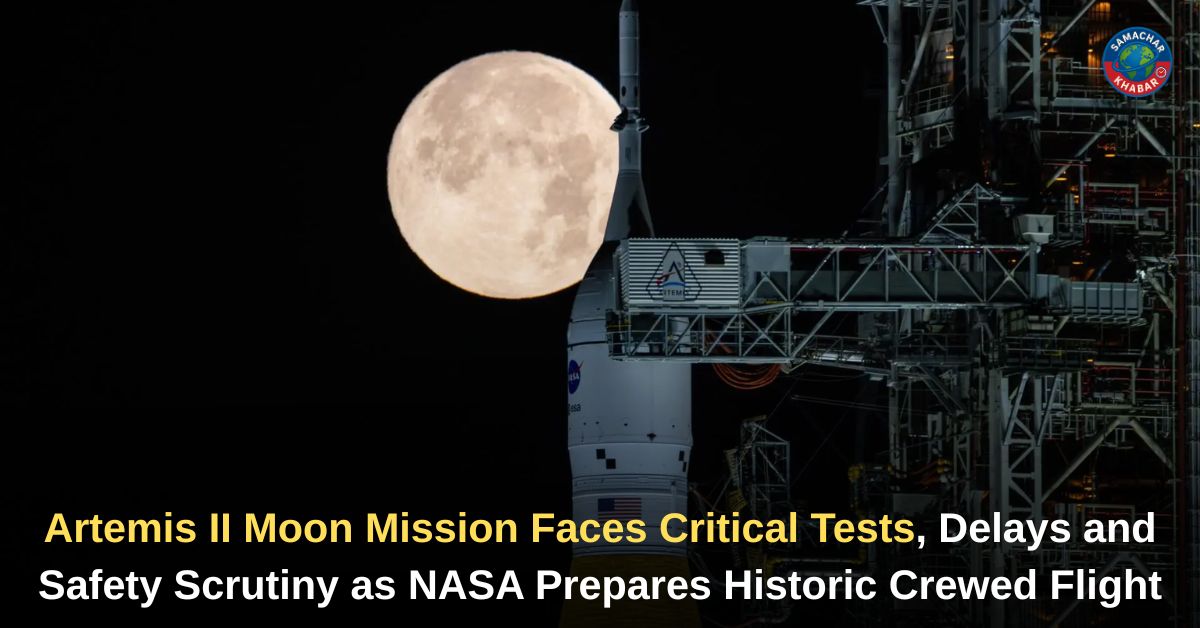
Artemis II Moon Mission: NASA is moving closer to launching Artemis II, its first crewed mission around the Moon in more than five decades, but the path forward remains complex and closely watched. As engineers carry out a crucial wet dress rehearsal of the Space Launch System rocket in Florida, weather delays, technical challenges, and renewed safety debates have come into sharp focus.
From hydrogen leaks during fueling tests to lingering questions about the Orion capsule’s heat shield, Artemis II represents both a major milestone and a demanding technical test. The mission’s success will shape the future of human lunar exploration and upcoming Moon landings.
Key Takeaways on NASA’s Artemis II Crewed Moon Mission and Launch Preparations
- Artemis II will be NASA’s first human mission to travel around the Moon since 1972
- The mission depends on a successful wet dress rehearsal, a full launch-day simulation without ignition
- Cold weather in Florida has already delayed critical testing
- Engineers detected a liquid hydrogen leak during fueling, echoing issues seen in Artemis I
- Four astronauts will fly on a 10-day lunar flyby mission, not a landing
- Experts continue to debate the safety of Orion’s heat shield following damage during Artemis I
- NASA has not announced an official launch date, but February to April windows are under review
What Is Artemis II and Why It Matters
Artemis II is the second mission in NASA’s Artemis program, an ambitious effort to return humans to the Moon and establish a sustained presence there. Unlike Artemis I, which launched in November 2022 without astronauts, Artemis II will carry a crew of four on a journey around the Moon and back to Earth.
The mission will send astronauts farther into space than any humans have ever traveled before. Over approximately 10 days, the crew will test life-support systems, navigation, communications, and manual flight operations in deep space. While no lunar landing is planned, Artemis II is considered a critical stepping stone toward Artemis III, which aims to land astronauts near the Moon’s south pole later in the decade.
Wet Dress Rehearsal: A Crucial Test Before Launch
Before NASA commits to a launch date, the agency must complete a preflight demonstration known as a wet dress rehearsal. This test simulates launch day procedures, including fueling the Space Launch System rocket with more than 700,000 gallons of liquid oxygen and liquid hydrogen.
The rehearsal began in early February at Kennedy Space Center in Florida. During the test, engineers power up the rocket’s core stage, charge the Orion capsule’s flight batteries, and run through a full countdown, stopping just short of engine ignition. The process allows teams to identify technical problems and verify that ground systems, software, and procedures work as expected.
NASA officials have emphasized that data from the wet dress rehearsal will heavily influence the launch schedule, as teams need time to review performance and address any anomalies.
Fueling Challenges and Hydrogen Leak Concerns
During the Artemis II wet dress rehearsal, NASA confirmed that teams detected a liquid hydrogen leak at the interface of the tail service mast umbilical. As a safety precaution, engineers temporarily stopped the flow of hydrogen after concentrations exceeded allowable limits.
Liquid oxygen continued flowing into the core stage, and hydrogen fueling to the upper stage was initially maintained. However, attempts to correct the leak were described as unsuccessful, leading NASA to pause hydrogen filling operations while teams assessed next steps.
Later updates indicated that fueling resumed, and the core stage was eventually filled and transitioned into topping mode. Engineers continued monitoring hydrogen concentration levels, reporting that they remained stable. Similar hydrogen leaks were detected during Artemis I in 2022, underscoring the complexity of handling cryogenic propellants at launch.
Launch Date Uncertainty and Weather Delays
NASA has not yet announced an official launch date for Artemis II. Cold weather in Florida caused at least a two-day delay to the wet dress rehearsal, pushing the timeline further into February.
Officials have said the earliest possible launch opportunity could be as soon as February 8, but windows extend into March and April depending on technical readiness and weather conditions. NASA’s launch criteria consider a wide range of factors, including temperature, wind, precipitation, lightning, cloud cover, and solar activity. Even light rain could force a launch scrub.
Because Artemis II is a crewed mission, NASA is taking a cautious approach, ensuring that all systems meet strict safety requirements before proceeding.
Who Will Fly on Artemis II
The Artemis II crew includes four astronauts:
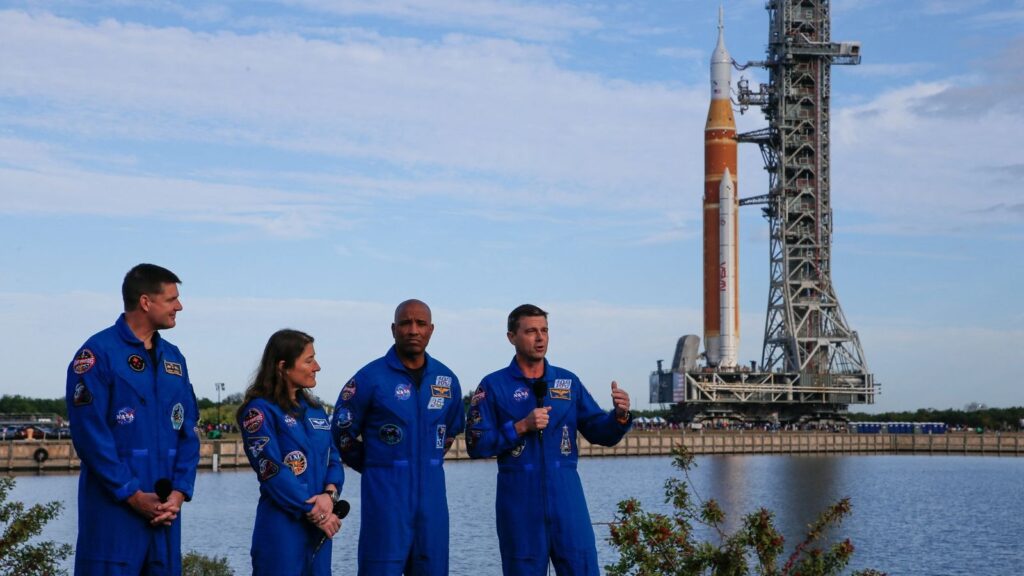
- Reid Wiseman, mission commander
- Victor Glover, pilot
- Christina Koch, mission specialist
- Jeremy Hansen, mission specialist from the Canadian Space Agency
The astronauts entered quarantine in January at the Johnson Space Center in Houston. This health stabilization period is standard protocol before crewed spaceflight, designed to reduce the risk of illness that could delay launch. The crew is expected to travel to Kennedy Space Center several days before liftoff.
Mission Profile: Around the Moon and Back
Artemis II will not land on the Moon. Instead, the Orion capsule will carry the crew on a lunar flyby, circling the Moon for several days. The spacecraft is expected to travel roughly 4,600 to 4,700 miles beyond the Moon’s far side before returning to Earth.
After completing its lunar loop, Orion will reenter Earth’s atmosphere and splash down in the Pacific Ocean. The mission will test critical systems needed for future landings, including guidance during high-speed reentry and crew operations far from Earth.
Heat Shield Safety Debate Raises Questions
Despite NASA’s confidence, some former astronauts and engineers have expressed concern about Orion’s heat shield. During Artemis I, the capsule sustained cracking and chipping after reentry due to gases becoming trapped inside the heat shield’s ablative material, known as Avcoat.
NASA has said it identified the root cause and opted to modify Artemis II’s reentry trajectory to reduce stress on the heat shield rather than redesign it. While agency leadership maintains that safety margins have been restored, critics argue that the issue was not fully resolved.
Others involved in the investigation believe Orion’s layered thermal protection system provides sufficient redundancy to protect the crew, even if cracking occurs again.
The Spiritual Perspective on Creation and the Cosmos According to Saint Rampal Ji Maharaj Ji
Beyond scientific exploration and technological achievement, questions about the universe, creation, and humanity’s true purpose have long been addressed through spiritual wisdom. Saint Rampal Ji Maharaj explains that while science explores the physical structure of the cosmos, true spiritual knowledge reveals who created the universe, why it was created, and what the ultimate goal of human life is.
According to the spiritual teachings of Saint Rampal Ji Maharaj, material discoveries—whether on Earth or in space—remain incomplete without understanding the Supreme Creator and the eternal laws governing creation. His unique knowledge, based on sacred scriptures, emphasizes that lasting peace and liberation are achieved not through technological advancement alone, but through true devotion, right spiritual practice, and self-realization.
Why Artemis II Is a Defining Moment for Lunar Exploration
Artemis II represents a turning point for NASA’s return to the Moon. The mission will determine whether the Space Launch System, Orion capsule, and ground operations are ready for sustained human exploration beyond Earth orbit.
Success would clear the way for Artemis III and future missions aimed at building a long-term human presence near the Moon’s south pole. Failure or major delays, however, could reshape timelines and raise new questions about the program’s direction.
As NASA works through final tests, Artemis II stands as both a bold step forward and a reminder of the technical challenges inherent in human spaceflight.
FAQs on NASA Artemis II Crewed Moon Mission
1. What is NASA’s Artemis II mission?
Artemis II is NASA’s first crewed Moon mission in over 50 years, sending four astronauts on a 10-day journey around the Moon and back to Earth.
2. When is the Artemis II rocket launch planned?
NASA has not confirmed a launch date yet, but the mission is targeting February to April, depending on wet dress rehearsal results, technical readiness, and weather conditions in Florida.
3. Why is the Artemis II launch facing delays?
Delays are due to cold weather in Florida and technical issues during the wet dress rehearsal, including a liquid hydrogen leak detected during fueling of the SLS rocket.
4. Who are the astronauts flying on Artemis II?
The Artemis II crew includes Reid Wiseman, Victor Glover, Christina Koch, and Canadian astronaut Jeremy Hansen, all currently under quarantine ahead of the planned launch.
5. Will Artemis II astronauts land on the Moon?
No. Artemis II is a lunar flyby mission designed to test spacecraft systems. A Moon landing is planned later under the Artemis III mission.