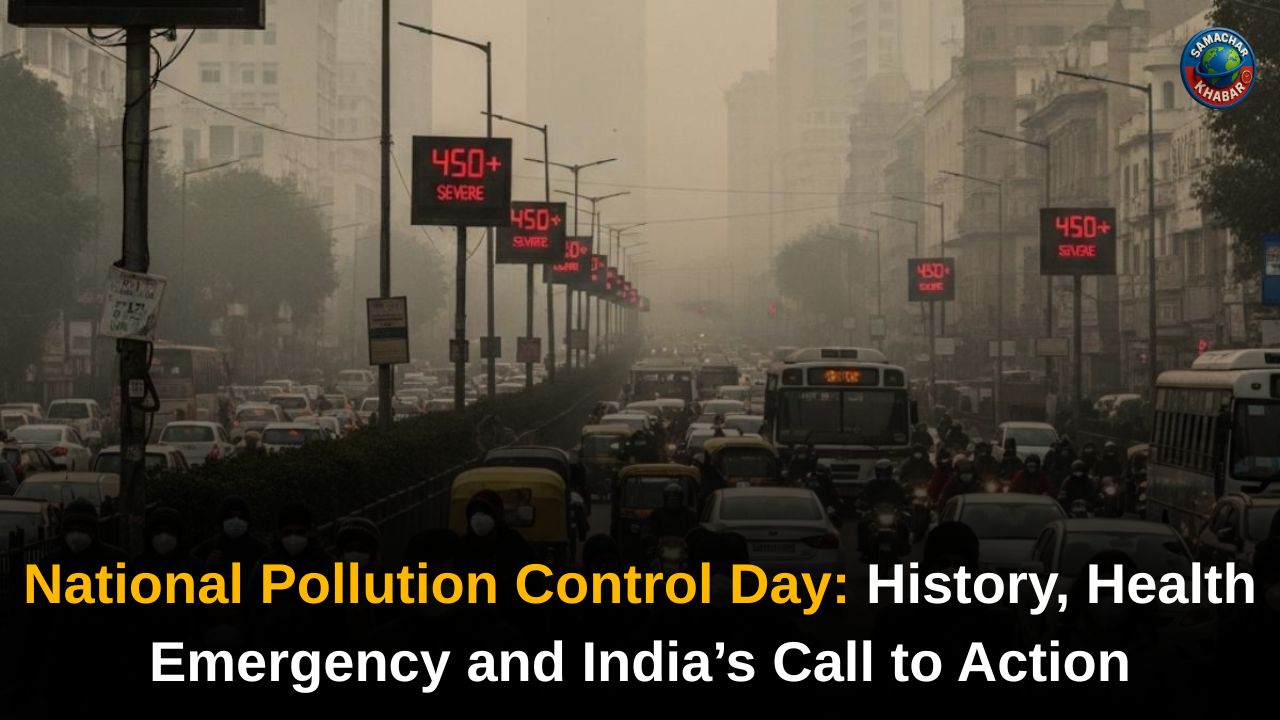
India observes National Pollution Control Day every year on December 2, not only to remember the victims of the 1984 Bhopal Gas Tragedy but also to confront the growing threats of pollution that now endanger millions across the country. As India battles some of its worst air-quality phases through 2024 and 2025, this day serves as a compelling reminder that environmental safety and public health are inseparable.
From toxic air and contaminated water to soil degradation and rising industrial risks, the nation faces an escalating environmental emergency that demands stronger policies, community participation and urgent lifestyle changes.
Key Takeaways: National Pollution Control Day 2025 and India’s Expanding Pollution Burden
- Observed annually on December 2, the day commemorates lives lost in the Bhopal Gas Tragedy (1984) and promotes pollution prevention nationwide.
- India recorded alarming spikes in PM2.5 and AQI levels in 2024–25, with several major cities reporting ‘severe’ to ‘hazardous’ conditions repeatedly.
- Pollution continues to drive rising cases of COPD, asthma, heart disease, stroke, neurological disorders and premature mortality, with children and the elderly most vulnerable.
- CPCB’s 2025 report listed the Top 10 cleanest Indian cities, demonstrating the impact of responsible governance, greenery and reduced emissions.
- India’s environmental laws, from the Air Act (1981) to the Environment Protection Act (1986), remain crucial to regulating industrial emissions and preventing disasters.
- National Pollution Control Day urges citizens, industries and administrations to adopt sustainable practices and reinforce India’s long-term environmental resilience.
The Legacy of Bhopal: A Disaster that Redefined Environmental Safety
The night of December 2–3, 1984 remains etched in global memory as one of the deadliest industrial disasters ever recorded. When methyl isocyanate (MIC) gas leaked from Union Carbide’s pesticide plant in Bhopal, more than 500,000 people were exposed within hours. Thousands died instantly, while many more suffered long-term respiratory diseases, impaired vision, neurological disorders, organ damage, genetic complications and lifelong disability.
The tragedy demonstrated with brutal clarity what industrial negligence can cost a nation. National Pollution Control Day is, therefore, not symbolic—it is an annual warning that without strict enforcement and accountability, history can repeat itself in even more devastating forms.
India’s Air-Pollution Emergency: What 2024–25 Data Signals
Recent assessments referenced in your provided material, including WHO updates and Lancet Countdown findings, outline India as one of the countries with exceptionally high PM2.5 exposure. Delhi, Mumbai, Kolkata, Lucknow and Gurgaon recorded multiple AQI readings exceeding 400–450, particularly during winter.
The Central Pollution Control Board (CPCB) indicated that Delhi’s early-winter 2025 PM2.5 concentration averaged seven times above safe limits. Such extreme pollution is closely tied to increasing cases of asthma, COPD, lung cancer, stroke, pregnancy complications and mental-health challenges like anxiety and cognitive decline.
Children under five, the elderly and people with chronic illnesses remain the most severely affected, as their immune and respiratory systems cannot withstand prolonged exposure.
Pollution Beyond Air: Water, Soil and Noise Contamination
Multiple rivers—including the Yamuna, Ganga and Sabarmati—continue to absorb untreated sewage, industrial effluents and agricultural runoff. Soil pollution from heavy metals and fertilizers threatens food safety and long-term agricultural productivity. Noise pollution from urban congestion and unregulated construction adds further stress, disrupting mental health, sleep cycles and overall quality of life.
These interconnected impacts underline that pollution is not a single-channel issue; it is a systemic crisis affecting health, economy and ecological balance.
Top 10 Indian Cities With the Cleanest Air in 2025 (CPCB Data)
Despite nationwide pollution challenges, several cities exhibited commendable air-quality consistency in 2025.
| Rank | City | State | Key Reasons for Clean Air |
| 1 | Aizawl | Mizoram | Green cover, low traffic, community awareness |
| 2 | Kohima | Nagaland | Controlled construction, protected natural zones |
| 3 | Shillong | Meghalaya | Dense forests, light vehicular load |
| 4 | Imphal | Manipur | Improved transport, reduced emissions |
| 5 | Gangtok | Sikkim | Strict plastic bans, strong waste disposal norms |
| 6 | Champhai | Mizoram | Low industrial activity, clean surroundings |
| 7 | Lunglei | Mizoram | Abundant greenery, minimal commercial pollution |
| 8 | Mandi | Himachal Pradesh | Cool climate, effective waste management |
| 9 | Kottayam | Kerala | High awareness, year-round greenery |
| 10 | Alappuzha | Kerala | Clean backwater ecosystem, coastal air quality |
These cities prove that focused governance, public participation and ecological stewardship can deliver measurable results.
Who Faces the Most Serious Health Risks?
Pollution impacts everyone, but some groups experience far greater harm:
- Children: Underdeveloped lungs and immune systems increase susceptibility.
- Elderly individuals: Higher risk of heart and respiratory issues.
- Pregnant women: Greater chances of preterm birth, low birth weight.
- People with chronic diseases: Pollutants worsen asthma, COPD and heart conditions.
- Low-income communities: Often live in high-exposure zones with limited healthcare access.
- Outdoor workers: Face long hours of pollutant inhalation.
Understanding these groups is essential for targeted interventions.
India’s Environmental Laws and Regulatory Framework
The materials you provided list several landmark laws guiding pollution control in India. These include:
- Water (Prevention & Control of Pollution) Act, 1974
- Water Cess Act, 1977
- Air (Prevention & Control of Pollution) Act, 1981
- Environment Protection Act & Rules, 1986
- Hazardous Waste (Management & Handling) Rules, 1989
- Noise Pollution (Regulation & Control) Rules, 2000
- Municipal Solid Waste Management Rules, 2000
- Ozone-Depleting Substances Regulation Rules, 2000
- Bio-Medical Waste Rules, 1998
- Batteries Management Rules, 2001
- Environment Impact Assessment Notification, 2006
- Maharashtra Bio-Degradable Garbage Ordinance, 2006
These laws are vital to preventing industrial disasters, regulating emissions and managing hazardous materials—but enforcement remains the true test.
What Individuals Can Do: Practical, Everyday Steps to Reduce Exposure
Based on your provided content, experts recommend:
- Use public transport, carpool or cycle; reduce dependency on private vehicles.
- Check AQI daily; avoid outdoor exercise when pollution peaks.
- Wear N95 masks during severe pollution periods.
- Improve indoor ventilation and install air purifiers.
- Plant trees, maintain green spaces and adopt reduce-reuse-recycle practices.
- Avoid burning waste or using firecrackers.
- Choose energy-efficient appliances and conserve resources.
- Add indoor plants like Peace Lily, Gerbera Daisy, English Ivy, Areca Palm and Snake Plant.
These actions, though simple, significantly reduce exposure and promote healthier surroundings.
Also Read: World AIDS Day: Theme, History, Early HIV Symptoms, Prevention Tips and Global HIV Response
Breathing Practices to Support Lung Health
While they cannot replace clean air, supportive breathing techniques can ease respiratory strain:
- Diaphragmatic breathing improves airflow efficiency.
- Box breathing helps regulate breathing and reduce stress.
- Alternate-nostril breathing enhances lung capacity and relaxation.
These exercises are supplementary aids—not alternatives to pollution control.
If Pollution Remains Unchecked: The Long-Term Reality
The consequences highlighted in your provided material include:
- Rising rates of respiratory and cardiovascular diseases
- Increased premature mortality
- Food insecurity due to soil degradation
- Water scarcity and contamination
- Higher economic burden on healthcare systems
- Climate-change acceleration
- Worsening mental-health and social well-being
- Deepening environmental inequality
This trajectory threatens future generations and undermines national development.
Spiritual Insight: Understanding Environmental Duty Through Saint Rampal Ji Maharaj Ji
As mentioned in your instructions, many people interpret the teachings of Saint Rampal Ji Maharaj as a call to protect nature with sincerity and responsibility. His emphasis on righteous conduct, compassion and accountability aligns with the principle that safeguarding the environment is essential for safeguarding humanity.
This spiritual perspective reinforces the message that pollution control begins with conscious actions, humility and commitment to collective welfare.
Towards a Safer, Cleaner Future: A Collective Responsibility
National Pollution Control Day 2025 stands as both a memorial and a warning. It reminds the nation that without consistent enforcement, scientific planning and public cooperation, pollution will continue to erode health, ecosystems and economic stability. The lessons of Bhopal, the rising pollution levels and the ongoing health impacts underline a simple truth: protecting the environment is protecting life itself.
A cleaner, safer and healthier India is possible—but only if governments, industries and citizens move forward together with sustained determination.
FAQs on National Pollution Control Day 2025
1. What is the purpose of National Pollution Control Day 2025?
It honors the victims of the 1984 Bhopal Gas Tragedy and raises awareness about controlling air, water, soil and industrial pollution to protect public health.
2. Why is pollution control important for India in 2025?
Rising air, water and soil pollution are causing severe respiratory, cardiovascular and neurological diseases, making pollution control essential for national health and environmental safety.
3. Which cities recorded the cleanest air in 2025?
According to CPCB data, Aizawl, Kohima, Shillong, Imphal, Gangtok, Champhai, Lunglei, Mandi, Kottayam and Alappuzha showed the best air-quality performance.
4. What steps can individuals take to reduce pollution exposure?
Use public transport, check AQI, wear N95 masks, avoid waste burning, adopt recycling, plant trees and improve indoor air quality with proper ventilation.
5. How does the Bhopal Gas Tragedy relate to Pollution Control Day?
The day commemorates the tragedy’s victims and highlights the need for strict environmental regulations to prevent industrial disasters and safeguard community health.