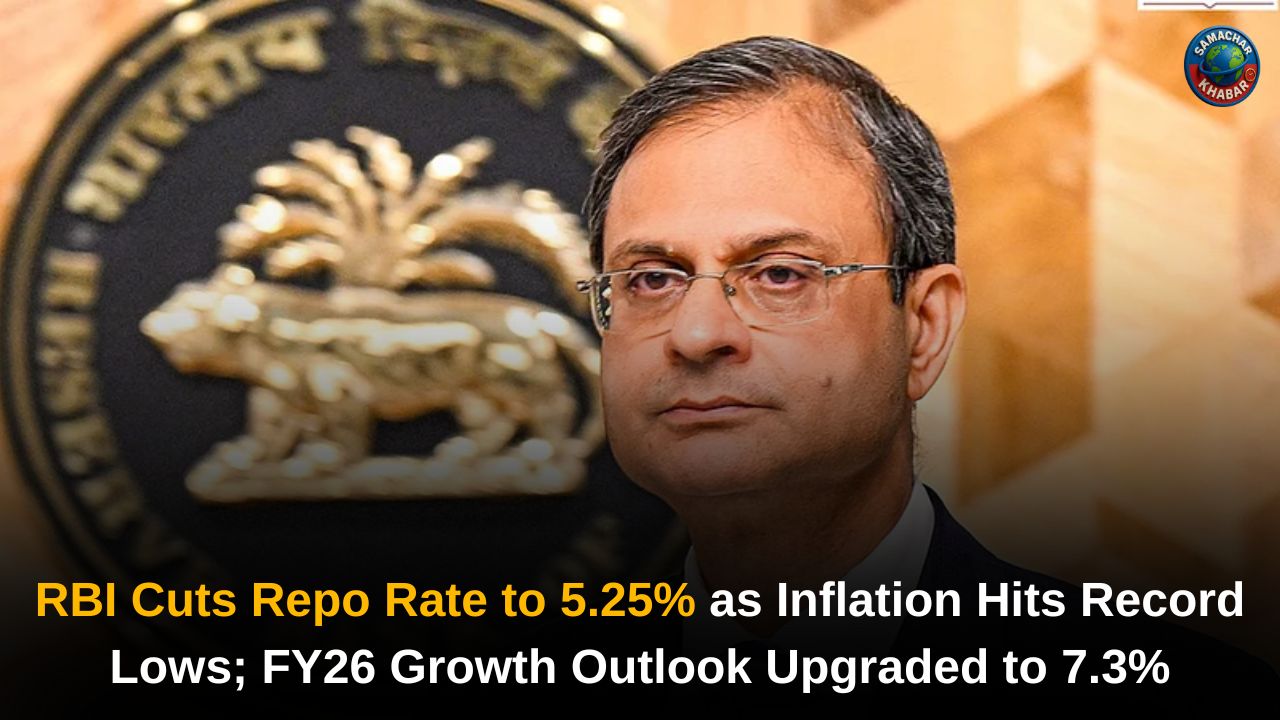
RBI Cuts Repo Rate to 5.25%: The Reserve Bank of India’s Monetary Policy Committee (MPC) has delivered a decisive 25 basis-point repo rate cut to 5.25%, signalling a strong growth-supportive stance as inflation softens sharply and economic momentum remains robust. The latest move, approved unanimously, is the fourth rate reduction in 2025, taking the total easing for the year to 125 basis points.
Alongside the cut, the RBI has also sharply upgraded its FY26 growth forecast to 7.3% and reduced its inflation projection to 2%, marking one of the most optimistic macroeconomic assessments in recent years.
Key Takeaways from RBI’s FY26 Monetary Policy: Repo Rate Cut, Growth Outlook & Inflation Signals
- MPC cuts repo rate by 25 bps to 5.25%, continuing a growth-supportive stance.
- Total rate cuts in 2025 stand at 125 bps, after three reductions earlier this year.
- GDP growth forecast for FY26 raised to 7.3%, up from 6.8%.
- Inflation outlook revised down to 2%, driven by record-low CPI and improved food supply conditions.
- SDF set at 5%, while MSF and Bank Rate fixed at 5.5%.
- RBI to conduct ₹1 lakh crore OMO purchases and a $5 billion, 3-year USD/INR buy-sell swap to support liquidity.
- Real estate leaders say the rate cut may spur housing demand and ease EMIs, while developers caution about cost pressures from a weaker rupee.
- RBI calls current conditions a “rare Goldilocks period” with strong growth and controlled inflation.
RBI’s Fourth Rate Cut of 2025: Why the Central Bank Moved Again
After keeping rates unchanged for the past two policy meetings, the RBI has resumed easing, reducing the repo rate from 5.50% to 5.25% with immediate effect. Governor Sanjay Malhotra highlighted that the decision was enabled by a dramatic cooling in inflation, which touched an all-time low of 0.25% in October 2025.
He noted that the Indian economy has shown “remarkable resilience” despite global uncertainty, and the inflation headroom allows the MPC to focus on supporting growth.
The SDF rate has now been lowered to 5%, while the MSF and the Bank Rate have been aligned at 5.5%. The MPC also confirmed that it will continue with a neutral policy stance.
Growth Outlook Strengthens: RBI Projects 7.3% Expansion in FY26
In a significant revision, the RBI has raised its GDP growth projection for FY26 from 6.8% to 7.3%, citing resilient domestic demand, supportive policy environment, and improving global trade prospects.
Revised Quarterly Growth Estimates
| Quarter | Growth Forecast |
| Q3 FY26 | 7.0% |
| Q4 FY26 | 6.5% |
| Q1 FY27 | 6.7% |
| Q2 FY27 | 6.8% |
Governor Malhotra acknowledged that global risks remain substantial, but said the successful conclusion of ongoing trade and investment negotiations could create additional upside potential for India’s economic expansion.
Inflation Falls Sharply: RBI Cuts FY26 CPI Projection to 2%
The RBI has sharply reduced the inflation forecast for FY26 to 2%, down from 2.6%, noting several favourable domestic and global factors.
What Is Driving Softer Inflation?
- Better kharif output
- Healthy rabi sowing
- Adequate reservoir storage
- Improved soil moisture
- Moderation in most international commodity prices
Revised Quarterly Inflation Estimates
| Quarter | Inflation Forecast |
| Q3 FY26 | 0.6% |
| Q4 FY26 | 2.9% |
| Q1 FY27 | 3.9% |
| Q2 FY27 | 4.0% |
The central bank expects inflation to remain at or below 4% for the first half of FY27, creating room for continued policy support if needed.
Liquidity Boost: RBI Announces OMO Purchases and Dollar Swap
To ensure smooth financial conditions and support credit flow, the RBI will implement two major liquidity operations:
- Open Market Purchases (OMO) of ₹1 lakh crore in government securities
- USD/INR buy-sell swap worth $5 billion for a 3-year tenor
These actions aim to inject durable liquidity into the system at a time when global financial conditions remain volatile.
Impact on Homebuyers: Will EMIs Come Down Now?
With the repo rate now at 5.25%, borrowers—especially homebuyers—are watching for how quickly banks transmit the benefit.
Also Read: RBI Holds Repo Rate at 5.5% as Growth Outlook Shines, Inflation Slips to Record Low
Most home loans are now linked to external benchmark lending rates (EBLRs), meaning EMIs should reduce as soon as banks revise their benchmarks.
Industry experts are optimistic:
- ANAROCK Chairman Anuj Puri said the rate cut “sweetens the value proposition” for homebuyers, particularly in the affordable and mid-income segments.
- Rising property prices—up around 10% across major cities in 2025—make this relief timely.
- Demand momentum is expected to carry into Q1 2026 if transmission is swift.
Developers in markets like MMR, NCR and Pune say the policy will improve buyer confidence and ease affordability challenges.
However, there are concerns too.
As Dharmendra Raichura of Ashar Group pointed out, the depreciating rupee has pushed up the cost of imported construction materials, squeezing developer margins.
At the same time, the weaker rupee has made Indian real estate more attractive to NRI buyers, offering a demand cushion.
Sector leaders agree that the combination of lower borrowing costs and a supportive macro environment should sustain the real estate sector’s growth trajectory.
Economy Enters a Balanced Phase: RBI Calls It a “Rare Goldilocks Period”
Governor Malhotra described the current macroeconomic setting as a rare balance of strong growth and easing inflation, allowing the RBI to adopt a more supportive stance without risking price instability.
Headline and core inflation are expected to remain contained, while growth remains firmly above 7%, placing India among the fastest-expanding major economies.
The next meeting of the MPC is scheduled for February 4–6, 2026.
India’s Policy Path Ahead: A Defining Moment for Growth & Stability
The latest monetary policy announcement marks a critical point where easing inflation and resilient economic fundamentals have aligned to give India a unique window of opportunity. The 25 bps repo rate cut, combined with upgraded GDP projections and targeted liquidity support, places the economy on a stronger footing for FY26.
With inflation projected to remain well within the comfort zone and growth entering a higher trajectory, the RBI’s stance reinforces confidence across markets, consumers, and investors. The coming months will determine how effectively banks transmit the rate cuts and how domestic and global conditions shape India’s economic momentum.
FAQs on RBI Repo Rate Cut to 5.25% and FY26 Growth Outlook
1. Why did the RBI cut the repo rate to 5.25%?
RBI cut the repo rate by 25 bps due to record-low inflation, strong economic resilience, and enough policy space to support growth without risking price stability.
2. How will the 5.25% repo rate affect home loan EMIs?
Home loan EMIs may reduce once banks update external benchmark lending rates, as most floating-rate loans directly reflect changes in the repo rate.
3. What is the RBI’s revised GDP growth forecast for FY26?
The RBI increased the FY26 GDP growth projection to 7.3%, supported by strong domestic demand, policy measures, and improving trade and investment prospects.
4. What are the RBI’s new inflation projections for FY26?
RBI cut FY26 CPI inflation forecast to 2%, driven by improved food supply, favourable agricultural conditions, and moderating global commodity prices.
5. What liquidity measures did the RBI announce in this policy?
RBI announced ₹1 lakh crore OMO purchases and a $5 billion USD/INR buy-sell swap to ensure ample liquidity and stable financial conditions.