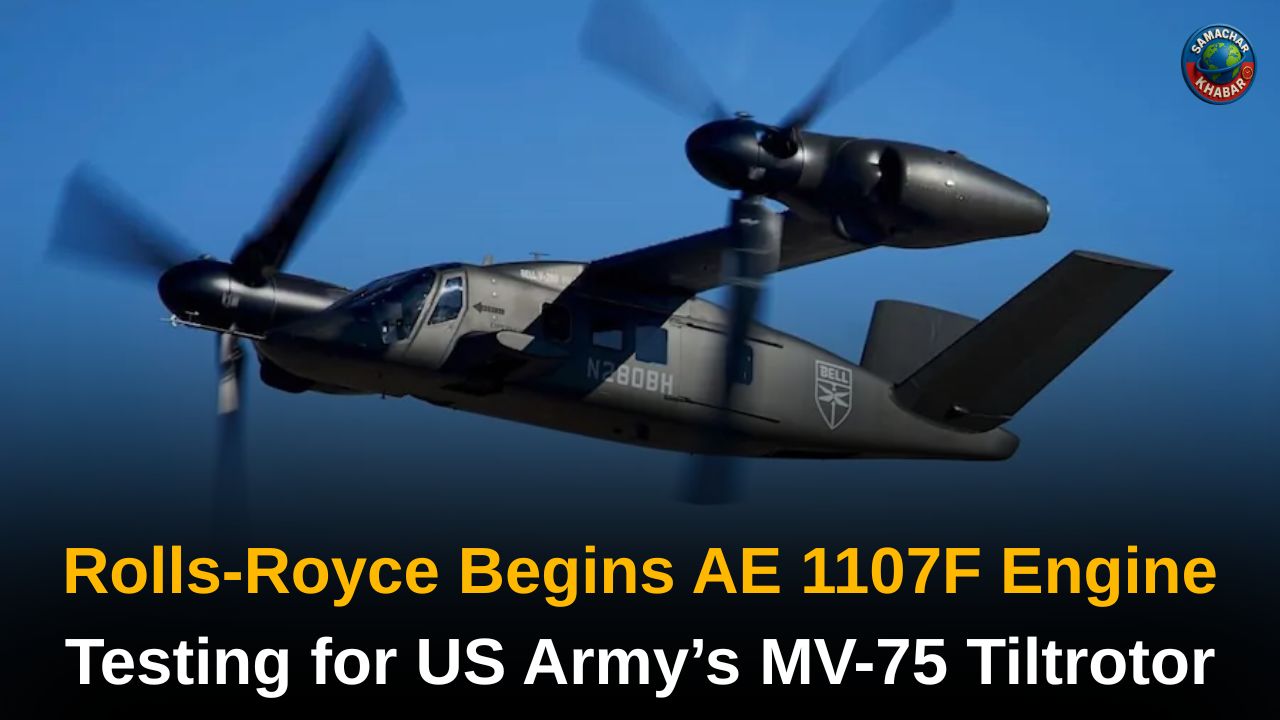
Rolls-Royce has begun ground testing the AE 1107F turboshaft engine that will power the US Army’s new MV-75 tiltrotor aircraft under the Future Long-Range Assault Aircraft (FLRAA) program. Testing is taking place at the company’s Indianapolis campus, its largest site in the United States.

Source: Bell
The AE 1107F is a derivative of the long-serving AE 1107 engine family and will equip Bell’s MV-75 tiltrotor, which was selected in 2022 to replace the UH-60 Black Hawk. Each MV-75 will be powered by two AE 1107F engines as the Army moves toward accelerated fielding of its first operational tiltrotor.
Key Takeaways: Rolls-Royce AE 1107F Engine and MV-75 FLRAA Program
- Rolls-Royce has begun testing the AE 1107F turboshaft engine for the MV-75 tiltrotor
- Testing is underway at Rolls-Royce’s Indianapolis facility
- The AE 1107F is derived from the AE 1107 engine family used on the V-22 Osprey
- Each MV-75 will be powered by two AE 1107F engines
- The MV-75 was selected to replace the UH-60 Black Hawk under the FLRAA program
- Initial delivery of MV-75 prototypes is expected in 2027
- The US Army aims to field the MV-75 by 2030
Rolls-Royce Begins Ground Testing of AE 1107F Engine
Rolls-Royce has begun ground testing the AE 1107F turboshaft engine that will power the US Army’s developmental MV-75 tiltrotor aircraft. The engine testing represents a major milestone in the Future Long-Range Assault Aircraft (FLRAA) program, which is designed to deliver significantly greater speed and range than legacy helicopters while retaining vertical takeoff and landing capability.

Source : Rolls-Royce
Testing is being conducted at the Rolls-Royce campus in Indianapolis, which serves as the company’s main US manufacturing and test site. Rolls-Royce describes the AE 1107F as an evolution of its established AE 1107 engine family, offering a low-risk propulsion solution based on decades of operational experience.
Also Read: Rafale-Marine Fighter Jets: भारत-फ्रांस सौदे से समुद्री सुरक्षा में बड़ा बदलाव
“We continue working closely with the US Army and our industry partners to deliver an ultra-modern propulsion solution with proven, low-risk AE 1107F engines,” said Candice Bineyard, Director of US Business Development & Future Programs for Rolls-Royce Defense. She added that engine testing represents a critical milestone in bringing the capability to service members.
Engine Heritage and Design Lineage
The AE 1107F traces its lineage to the Rolls-Royce T406 engine, which powers the US Marine Corps’ MV-22 Osprey tiltrotor. The AE 1107 engine family has accumulated more than one million flight hours across over 1,000 AE 1107C engines delivered for the V-22 program.
More than 400 V-22 Ospreys are currently in active service with the US Marine Corps, US Navy, and US Air Force, along with a smaller fleet operated by Japan. Rolls-Royce states that this extensive operational history provides a mature and proven baseline for the FLRAA propulsion system.
Also Read: Triumph Tracker 400 Unveiled in UK, India Launch Unlikely
The AE 1107F shares approximately 80% commonality with the 7,000shp (5,220kW) AE 1107C turboshaft used on the V-22, while incorporating adaptations to meet the specific requirements of the MV-75.
Engine Adaptations for MV-75 Requirements
For the MV-75 tiltrotor, Rolls-Royce is adapting the AE 1107 core design to meet higher power demands, improved reliability targets, and the sustained high-speed flight profile required by the US Army.
Each MV-75 will be powered by two AE 1107F engines, supporting the aircraft’s operational goals of increased speed and extended range compared with legacy helicopters. The US Army intends the FLRAA platform to significantly expand its air assault reach while maintaining vertical takeoff and landing capability.
Rolls-Royce describes the AE 1107F as a low-risk solution, emphasizing its commonality with existing engines and the accumulated operational experience of the AE 1107 family.
Design Differences from the V-22 Osprey
One major difference between the MV-75 and the V-22 Osprey lies in the aircraft’s propulsion architecture. Unlike the V-22, which features fully rotating engine nacelles to transition between vertical and horizontal flight, the MV-75 employs a different approach.
On the MV-75, the wing-mounted Rolls-Royce engines will remain static. Only the rotors and gearboxes will rotate during the transition between vertical and forward flight. Bell has stated that this design simplifies the aircraft and improves reliability.
Material shortcomings associated with the complex rotating nacelles on the V-22 were cited in a recent US Navy safety review as a major contributor to serious safety incidents involving the Osprey in recent years.
FLRAA Program Timeline and Milestones
Bell is currently under contract to deliver eight MV-75 prototype aircraft. A maiden sortie and delivery of the first prototype are expected in 2027. That milestone will be preceded by a critical design review scheduled for 2026, which will determine whether the US Army’s accelerated fielding plan remains viable.
 Bell
Bell
The US Army aims to field its first operational tiltrotor aircraft by 2030 at the latest. The MV-75 was selected in 2022 over the Boeing-Sikorsky SB-1 Defiant compound helicopter to replace the UH-60 Black Hawk under the FLRAA program.
The FLRAA program is intended to replace more than 2,000 UH-60 Black Hawk helicopters over the coming decades. The overall program value could exceed $70 billion.
Operational Plans and Production Strategy
The US Army has identified the 101st Airborne Division, based at Fort Campbell, Kentucky, as the launch customer for the MV-75. The division, which currently focuses on helicopter air assault operations, is planned to be the first operational unit to field the aircraft.
An initial goal has been established to equip two assault or medium-lift aviation battalions with the MV-75, representing approximately 48 aircraft. Special mission pilots from the 160th Special Operations Aviation Regiment are also planned to receive the MV-75 several years later.
Bell plans to complete final assembly of the MV-75 in Amarillo, Texas, the same location where it currently produces the V-22 Osprey. Existing US orders are expected to keep the Osprey production line running through the end of 2027 as MV-75 production begins to ramp up.
What the Start of Engine Testing Signals
The start of AE 1107F engine testing underscores the US Army’s push for rapid progress on the FLRAA program. By leveraging a propulsion system with deep operational roots, the Army and industry partners are seeking to balance innovation with proven performance as the MV-75 moves toward flight testing and eventual service entry.
Technology, Power, and Human Purpose
Rapid advances in aerospace and defense technology highlight how far human innovation has progressed, yet they also raise deeper questions about purpose and responsibility. The pursuit of speed, reach, and strength should not become a means of intimidation or dominance, but a tool used with awareness and restraint.
Spiritual perspectives remind us that humanity shares a common origin and collective responsibility, calling for coexistence rather than fear. Tatvdarshi Sant Rampal Ji Maharaj explains through Scriptural Knowledge that understanding who we are, where we come from, and the true aim of human life brings balance between material progress and moral clarity. Such insight encourages the use of technology not merely for power, but for understanding life’s higher purpose.
For more information visit our
- Website: www.jagatgururampalji.org
- YouTube: Sant Rampal Ji Maharaj
- Facebook: Spiritual Leader Saint Rampal Ji
- X (Twitter): @SaintRampalJiM
FAQs on Rolls-Royce AE 1107F Engine and MV-75 FLRAA Program
1. What engine will power the US Army’s MV-75 tiltrotor?
The MV-75 will be powered by two Rolls-Royce AE 1107F turboshaft engines.
2. Where is AE 1107F engine testing taking place?
Testing is underway at Rolls-Royce’s Indianapolis facility in the United States.
3. What aircraft is the MV-75 intended to replace?
The MV-75 is intended to replace more than 2,000 UH-60 Black Hawk helicopters.
4. When is the first MV-75 prototype delivery expected?
The first prototype delivery is expected in 2027.
5. Which US Army unit will be the first to field the MV-75?
The 101st Airborne Division at Fort Campbell, Kentucky, is planned as the first operational unit.