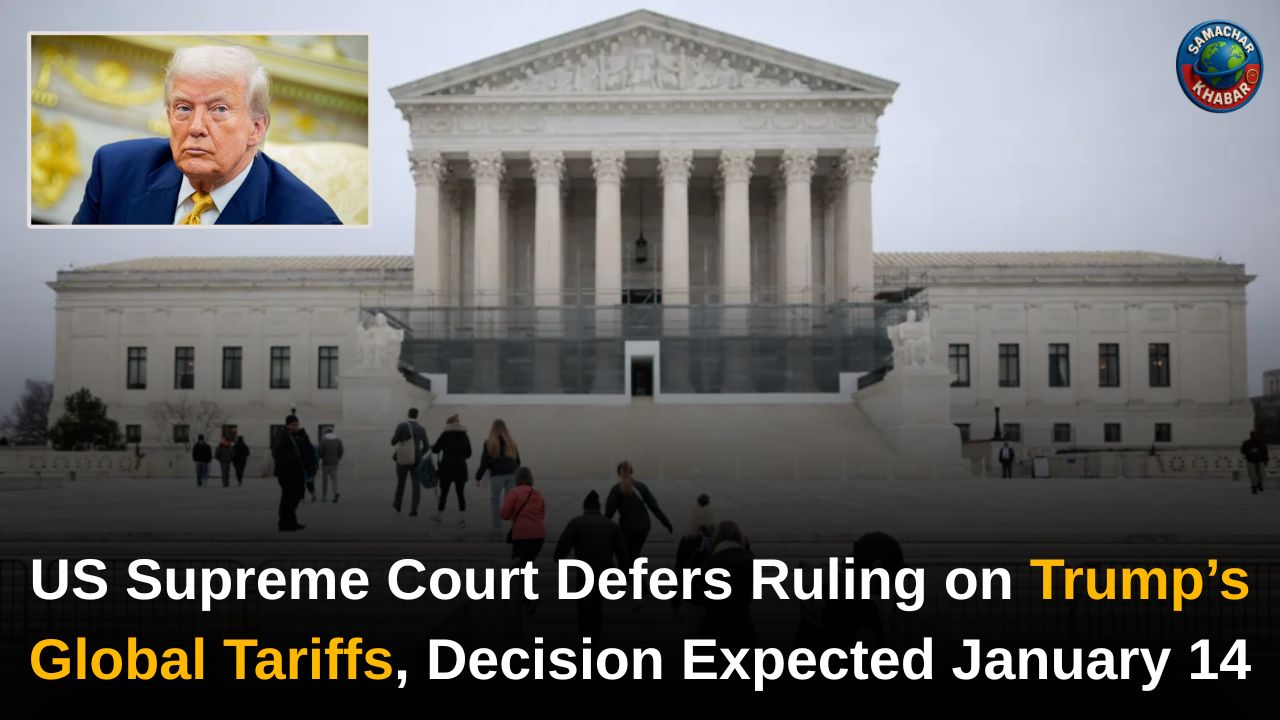
The US Supreme Court did not issue a ruling on Friday in a closely watched case challenging the legality of sweeping global tariffs imposed by Donald Trump under emergency powers. The decision, which will determine whether the president acted within his statutory authority, remains pending, with the court indicating that rulings could be issued when the justices next take the bench on January 14. The case tests presidential powers, the limits of emergency economic laws, and carries significant implications for global trade and financial markets.
Key Takeaways on Trump Tariffs Supreme Court Case
- The US Supreme Court does not rule on the Trump tariffs case on Friday
- The court may issue decisions when it reconvenes on January 14
- The case challenges Trump’s use of emergency powers to impose global tariffs
- Lower courts ruled that presidential authority was exceeded
- Tariffs remain in force during the appeal process
- The outcome is expected to affect global trade and financial markets
Supreme Court Holds Back Decision on High-Stakes Tariffs Case
The US Supreme Court did not issue a ruling on Friday in the legal challenge to tariffs imposed by President Donald Trump after his return to office in January 2025. While the court releases one ruling on Friday in an unrelated criminal case, it does not announce in advance which argued cases will be decided on any given day.
The court later indicates on its website that it could issue decisions in argued cases when the justices take the bench during a scheduled sitting next Wednesday, January 14. No specific date is confirmed for the tariffs ruling.
The case represents one of the most significant legal tests of presidential authority currently before the court.
Background: Trump’s Use of Emergency Powers for Tariffs
Within days of beginning his second term in January 2025, the Trump administration announces sweeping tariffs on a wide range of imported goods. The administration invokes the International Emergency Economic Powers Act, a statute enacted in 1977 that allows the US president to regulate economic transactions during a declared national emergency.
Trump uses the law to impose what the administration describes as “reciprocal” tariffs on goods imported from nearly every foreign trading partner. The administration argues that persistent US trade deficits, unfair trade practices, and supply-chain vulnerabilities constitute a national economic emergency.
Trump also invokes the same law to impose tariffs on China, Canada, and Mexico, citing the trafficking of fentanyl and other illicit drugs into the United States as a national emergency.
Legal Challenge and Lower Court Rulings
The tariffs are challenged by US importers, trade associations, and 12 US states, most of them governed by Democrats. The challengers argue that the International Emergency Economic Powers Act does not authorise the president to levy broad-based import tariffs and that the power to impose duties rests with the US Congress under the Constitution.
In 2025, lower courts rule against the government, holding that the emergency law has been stretched beyond its intended purpose. Despite these rulings, the tariffs remain in force while the Trump administration appeals the decisions to the Supreme Court.
The Supreme Court’s ruling will determine whether Trump acted within his statutory authority and whether the tariffs can legally stand.
Justices Express Doubts During Oral Arguments
During oral arguments held on November 5, conservative and liberal justices appear to cast doubt on the legality of the tariffs. Questions from the bench focus on whether the emergency powers law was intended to grant the president authority to impose sweeping import duties affecting nearly all US trading partners.
The case is widely seen as a test of the court’s willingness to check far-reaching assertions of presidential authority, particularly those made by Trump since returning to office.
The outcome is also expected to have a direct impact on the global economy.
Trump Defends Tariffs as Financially Beneficial
President Trump maintains that the tariffs have strengthened the United States financially. In a social media post dated January 2, Trump states that a Supreme Court ruling against the tariffs would be a “terrible blow” to the United States.
The administration continues to defend the use of emergency powers, arguing that the economic and national security concerns cited justify the measures taken under the 1977 law.
Market Reaction: Bitcoin and Prediction Markets Respond
Financial markets respond immediately to the delay in the Supreme Court’s ruling. Bitcoin climbs 2 percent after the court says it will not deliver a decision on the tariffs on Friday.
The world’s largest cryptocurrency trades at $89,925 at around 8:20 pm, surges to a high of $91,814 by 9:05 pm, and retreats to $91,513 by 9:10 pm. Traders interpret the delay as marginally improving the odds that the tariffs could ultimately survive judicial scrutiny.
Also Read: Trump’s $1M Gold Card Visa: Benefits, Price Breakdown and How to Apply for Fast-Track US Residency
Prediction market Polymarket also reflects shifting expectations. Odds of a Supreme Court ruling in favour of Trump’s tariffs remain in the mid-20 percent range throughout the day before jumping to more than 30 percent after no ruling is delivered at the scheduled 8:30 pm IST. The odds later corrected back to 25–26 percent.
Other Major Cases Awaiting Supreme Court Decisions
The tariffs case is one of several major matters pending before the Supreme Court, which has a 6–3 conservative majority.
Other cases awaiting rulings include a challenge to a key section of the Voting Rights Act of 1965, the landmark federal law enacted by Congress to prevent racial discrimination in voting.
Another pending case involves a free speech challenge to a Colorado law banning psychotherapists from conducting “conversion therapy” aimed at changing an LGBT minor’s sexual orientation or gender identity.
What the Pending Decision Means Going Forward
The Supreme Court’s eventual ruling will clarify the scope of presidential authority under emergency economic laws and define the limits of executive power in trade policy. With tariffs still in force during the appeal, businesses, states, and global markets remain closely focused on the court’s next move.
The court has not indicated when it will deliver its decision, but January 14 remains the next opportunity for rulings when the justices reconvene.
A Defining Test of Executive Power
The unresolved tariffs case places the US Supreme Court at the center of a critical constitutional question: how far presidential authority extends under emergency economic laws. With lower courts already ruling that statutory limits were exceeded, the pending decision carries consequences not only for US trade policy but also for the balance of power between Congress and the executive branch. As tariffs remain in force and markets respond to every signal from the court, the ruling is poised to shape legal precedent, economic policy, and global trade relations well beyond the current administration.
Spiritual Perspective on Authority
The ongoing legal debate over executive power and accountability highlights a deeper reflection on authority, responsibility, and restraint. Spiritual teachings often emphasise that true authority functions within defined limits and must align with ethical balance rather than unchecked power.
Tatvdarshi Sant Rampal Ji Maharaj explains that when governance, law, or leadership moves beyond its rightful boundaries, imbalance arises, affecting society at large. His Spiritual Knowledge encourages individuals and institutions alike to act within moral discipline, reminding that lasting stability comes from adherence to truth, lawful conduct, and higher ethical principles rather than force or emergency-driven control.
For more information visit our
- Website: www.jagatgururampalji.org
- YouTube: Sant Rampal Ji Maharaj
- Facebook: Spiritual Leader Saint Rampal Ji
- X (Twitter): @SaintRampalJiM
FAQs on US Supreme Court Trump Tariffs Case
1. Why did the US Supreme Court not rule on the tariffs case?
The court does not announce in advance which cases it decides and deferred the ruling without giving a new date.
2. When could the Supreme Court issue its decision?
The court indicates it could release rulings when it next sits on January 14.
3. What law did Trump use to impose the tariffs?
Trump invoked the International Emergency Economic Powers Act of 1977.
4. Who challenged the tariffs in court?
US importers, trade associations, and 12 US states challenged the tariffs.
5. Are the tariffs still in force?
Yes, the tariffs remain in force while the administration’s appeal is pending.