Every year on December 16, India observes Vijay Diwas to commemorate its historic victory in the 1971 Indo-Pak war and to honour the courage and sacrifice of its armed forces. The day marks the surrender of Pakistani forces in Dhaka, which brought a swift end to the 13-day conflict and led to the creation of Bangladesh.
Prime Minister Narendra Modi has paid tribute to the soldiers whose steadfast resolve and selfless service protected the nation and etched a moment of pride in India’s history. Vijay Diwas stands as a reminder of valour, discipline, unity, and the enduring impact of one of the most decisive moments in India’s military history.
Key Takeaways on Vijay Diwas 1971 Victory
- Vijay Diwas is observed every year on December 16
- It marks India’s victory over Pakistan in the 1971 war
- The war began on December 3, 1971, and lasted 13 days
- Around 93,000 Pakistani soldiers surrendered in Dhaka
- The surrender was led by General Ameer Abdullah Khan Niazi
- The victory led to the creation of Bangladesh
- Vijay Diwas honours the courage and sacrifice of Indian armed forces
- Prime Minister Narendra Modi paid tribute to the soldiers on Vijay Diwas
- Nationwide ceremonies are held to honour martyrs, veterans, and armed forces
- A Bangladeshi delegation is set to participate in Vijay Diwas events in 2025
Vijay Diwas and Its Place in India’s Military History
Vijay Diwas is observed annually on December 16 as a tribute to the Indian armed forces and a reminder of one of India’s most significant military victories. The day commemorates India’s triumph in the 1971 Indo-Pak war, a conflict that altered the course of South Asian history and led to the creation of Bangladesh.
The observance reflects national remembrance and recognition of the soldiers who fought on land, sea, and air, often under challenging conditions. Their efforts brought the conflict to a decisive close in just 13 days, making the 1971 war one of the shortest and most impactful wars in the region.
Prime Minister Narendra Modi’s Tribute on Vijay Diwas
On Vijay Diwas, Prime Minister Narendra Modi remembered the brave soldiers whose courage and sacrifice ensured India’s historic victory in 1971. He stated that their steadfast resolve and selfless service protected the nation and etched a moment of pride in India’s history.
The Prime Minister noted that Vijay Diwas stands as a salute to the valour of the armed forces and serves as a reminder of their unmatched spirit. He added that the heroism displayed during the war continues to inspire generations of Indians. His remarks highlighted the enduring relevance of the sacrifices made by the soldiers during the conflict.
How the 1971 Indo-Pak War Unfolded
The India-Pakistan war of 1971 began on December 3, 1971, after Pakistan launched air strikes on Indian airfields. What started as escalating tensions soon developed into a full-scale war between the two countries.
Also Read: Vijay Diwas 2025: History and Significance of the Bangladesh Liberation War 1971
India responded across both the western and eastern fronts. The eastern front witnessed swift military action, with Indian forces advancing rapidly towards Dhaka. The conflict lasted for 13 days, making it a short but intense war that resulted in a decisive outcome.
Surrender in Dhaka and the Creation of Bangladesh
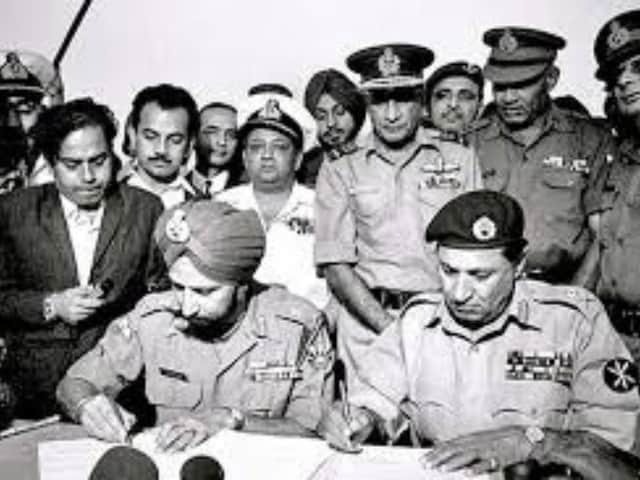
On December 16, 1971, Pakistani forces formally surrendered in Dhaka to the Indian Army and allied forces, including Bangladesh’s Mukti Bahini. The surrender was led by Pakistani military commander General Ameer Abdullah Khan Niazi.
Around 93,000 Pakistani soldiers laid down their arms, marking one of the largest military surrenders since World War II. This moment officially ended the war and led to the creation of Bangladesh as an independent nation. The event reshaped South Asia’s political map and established India as a regional power.
Humanitarian Crisis and India’s Intervention
The conflict was rooted in a humanitarian crisis in East Pakistan, now Bangladesh. During military actions by Pakistani forces, civilians faced widespread violence, leading to a large-scale displacement of people. Millions were affected, and many were forced to flee their homes.
India intervened to support the people of East Pakistan in their struggle for freedom. What initially appeared as a regional crisis soon transformed into a full-fledged war between India and Pakistan, culminating in the decisive events of December 16, 1971.
Also Read: India vs Pakistan: Military Power, Budget & War Capabilities Compared
Sacrifice and Cost of the War
The 1971 war came at a significant human cost. It is estimated that around 3,900 Indian soldiers were martyred during the conflict, while several others were injured. Vijay Diwas serves as a reminder of the sacrifices made by the armed forces and the price paid for freedom and justice.
The day honours not only military success but also the courage, discipline, and determination shown by the soldiers throughout the war.
How Vijay Diwas Is Observed Across India
Vijay Diwas is marked across the country through various ceremonies and remembrance events. In New Delhi, the Prime Minister pays tribute to fallen soldiers at the Amar Jawan Jyoti near India Gate. Similar programmes are organised by the armed forces in different parts of the country.
Observances include:
- Wreath-laying ceremonies at war memorials
- Tributes by political leaders and the armed forces
- Events honouring veterans and families of soldiers
Messages, quotes, and images related to Vijay Diwas are widely shared, reflecting national remembrance and respect.
International Participation and Vijay Diwas 2025
As an international symbol linked to the 1971 war, a 20-member Bangladeshi delegation is scheduled to participate in Vijay Diwas programmes in 2025. The delegation is reported to include eight Mukti Joddhas who were part of the resistance during the war, two serving officers of the Bangladesh Army, and family members.
Even more than five decades later, Vijay Diwas remains a moment where history, sacrifice, and national pride converge.
Why Vijay Diwas Continues to Matter
Vijay Diwas is not only about remembering a past war. It highlights discipline, planning, and unity, while underlining the cost of freedom and the responsibility to remember those who protect it. For younger generations, the day provides an opportunity to understand why December 16 holds lasting importance in India’s military history.
Beyond War: A Spiritual Perspective on Conflict and Human Suffering
While wars have been fought throughout history and victories have been recorded, conflict has never been the ultimate solution to human suffering. The aftermath of war often leaves deep social wounds—families lose loved ones, many women are left widowed, and vulnerable individuals face exploitation and hardship. History shows that even kings and rulers engaged in wars driven by power, where injustice toward women and families became common, reflecting moral decline rather than true resolution.
From a spiritual perspective, true change begins with right knowledge. According to Tatvdarshi Sant Rampal Ji Maharaj, when humanity receives true spiritual knowledge, its outlook toward conflict transforms. He explains that wars occur under the influence of divine law and karmic consequence, and that even great deities like Brahma, Vishnu, and Mahesh were not exempt from this system, highlighting human limitations within it.
He says in His satsangs that birth in any nation or religion is temporary; a person born in one country today may be born in another in the next life. When this understanding develops, divisions based on nation, religion, or identity weaken. Such spiritual awareness, He explains, encourages humanity to move beyond violence toward a deeper sense of accountability, compassion, and universal brotherhood.
Visit our official platforms:
Website: www.jagatgururampalji.org
YouTube: Sant Rampal Ji Maharaj
Facebook: Spiritual Leader Saint Rampal Ji
X (Twitter): @SaintRampalJiM
FAQs on Vijay Diwas 2025
1. What is Vijay Diwas?
Vijay Diwas marks India’s victory over Pakistan in the 1971 war and honours the soldiers who secured the historic win.
2. When is Vijay Diwas observed?
Vijay Diwas is observed every year on December 16 across India.
3. Why is December 16 significant?
On December 16, 1971, Pakistani forces surrendered in Dhaka, ending the war and leading to Bangladesh’s creation.
4. How long did the 1971 Indo-Pak war last?
The war began on December 3, 1971, and lasted for 13 days.
5. How many Pakistani soldiers surrendered in 1971?
Around 93,000 Pakistani soldiers surrendered, one of the largest military surrenders since World War II.