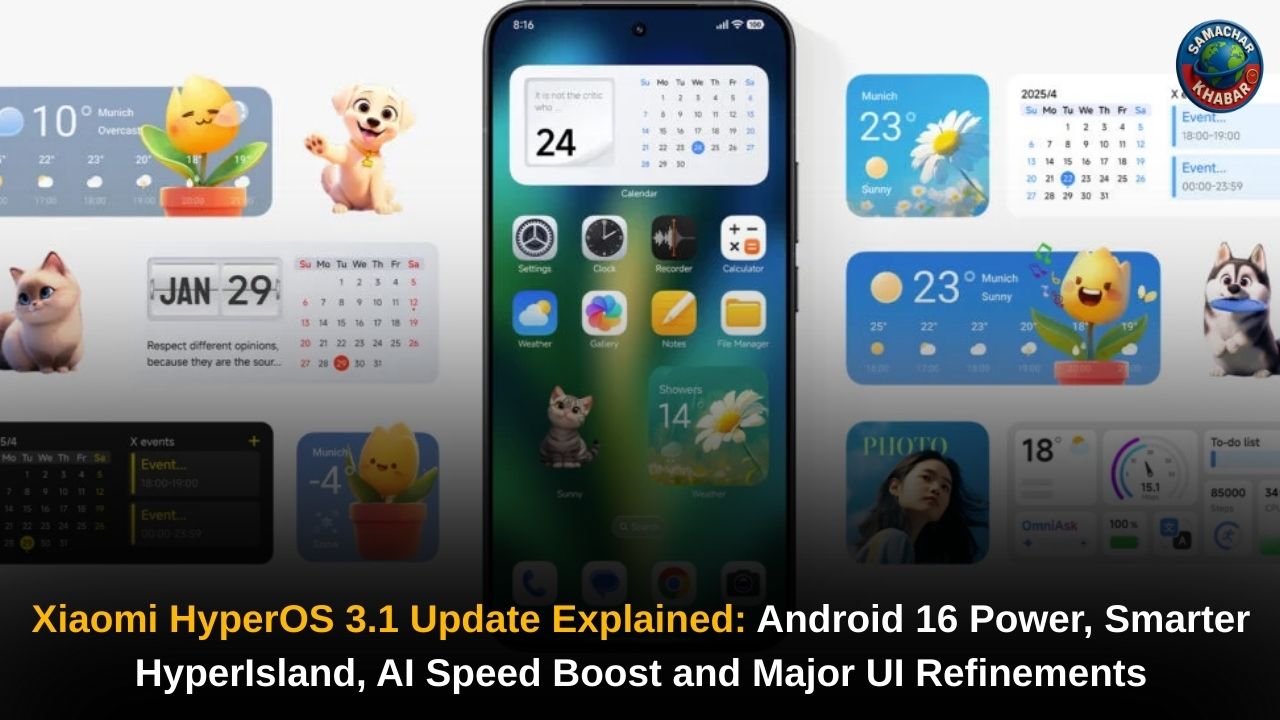
Xiaomi has officially begun shaping the future of its software ecosystem with the rollout of HyperOS 3.1, an Android 16–based update that focuses on performance, intelligence, and everyday usability rather than flashy redesigns. Following the global rollout of HyperOS 3.0, the new 3.1 version builds on that foundation with faster app launches, a smarter HyperIsland experience, refined multitasking, and deeper AI-driven optimizations.
While the update brings meaningful upgrades for newer flagship and recent mid-range devices, it also marks the end of major feature support for older hardware, making HyperOS 3.1 a defining moment in Xiaomi’s long-term software strategy.
HyperOS 3.1 Key Highlights and What This Update Brings to Xiaomi Devices
HyperOS 3.1 is not positioned as a dramatic visual overhaul. Instead, it is a carefully refined update that improves speed, stability, and user experience across supported devices. Built exclusively on Android 16, this version introduces system-level enhancements that are only possible on newer hardware, setting a clear line between legacy support and future-focused development.
Key Takeaways: Xiaomi HyperOS 3.1 Android 16 Update at a Glance
- HyperOS 3.1 is built only on Android 16, limiting availability to eligible newer devices
- App launch speeds improve by up to 30 percent through kernel and runtime optimizations
- HyperIsland becomes smarter with better live activity handling and new visual effects
- A redesigned, iOS-style stacked recent apps layout improves multitasking
- AI-powered features like SmartPay and AI Photo Lab work fully offline for privacy
- Advanced home screen, folder resizing, and lock screen editing enhance customization
- Devices launched before 2022 will not receive HyperOS 3.1, though security updates continue
Android 16 at the Core: Performance and System-Level Improvements
At the heart of HyperOS 3.1 lies Android 16, enabling Xiaomi to push deeper system optimizations. The update leverages a refined runtime environment and a re-engineered kernel, resulting in noticeably faster app launches and smoother transitions across the interface.
A new HyperBoost Scheduler dynamically manages CPU and GPU resources based on real-time usage. This approach improves multitasking, stabilizes gaming performance, and reduces unnecessary background load. Over extended use, these optimizations translate into fewer slowdowns and more consistent performance, especially on flagship devices.
Smarter HyperIsland and the New Recents Experience
HyperOS 3.1 significantly upgrades the HyperIsland, also referred to as the “Super Island.” It now surfaces live information from navigation apps, delivery services, timers, and media playback more intelligently, reducing the need to open full applications repeatedly.
The media playback progress bar on the Super Island gains new lighting effects, while a dedicated settings page allows users to control which apps can interact with the feature. These refinements focus on usability rather than spectacle, helping users miss fewer alerts and manage ongoing activities more efficiently.
Alongside this, Xiaomi introduces a stacked recent apps layout, replacing the traditional grid with horizontally stacked cards. This design makes app switching smoother and previews clearer, particularly during heavy multitasking.
AI-Driven Features Focused on Privacy and Daily Convenience
Artificial intelligence plays a quiet but important role in HyperOS 3.1. Xiaomi integrates AI directly into the system while keeping most processing on-device.
SmartPay uses on-device language models to detect payment prompts across messaging apps, QR scanners, and voice assistants. It then suggests the appropriate payment method without sending biometric or financial data to the cloud.
AI Photo Lab, built into the native Gallery app, enables generative fill, portrait enhancements, and background replacement without relying on third-party software. Both features function offline, balancing advanced capabilities with privacy protection.
UI Refinements, Home Screen Flexibility and Lock Screen Tools
Visually, HyperOS 3.1 continues the design language introduced in version 3.0, but with smoother animations and more consistent transitions. The interface adopts a cleaner, glass-like aesthetic that feels more polished during daily use.
Home screen customization sees notable improvements. Users can now resize folders using drag-and-drop gestures, with new 2×1 and 1×2 folder formats and page-turning support inside folders. This allows denser app organization without sacrificing accessibility.
Also Read: Is OnePlus Shutting Down in India? The Truth Behind ‘Dismantled’ Rumours
Lock screen tools receive incremental upgrades as well. Depth effects, flexible clock styles, and wallpaper editing become more stable, reducing random stutters and inconsistencies during unlocking.
Quality-of-Life Enhancements Across the System
HyperOS 3.1 introduces several under-the-hood improvements designed to reduce everyday friction:
- Redesigned multi-volume adjustment for easier control of media, ringer, and alarms
- Improved Bluetooth connection memory for more reliable device pairing
- Optimized copy and one-step access functions for faster interactions
- Enhanced AI-based app management to reduce background battery drain
Individually, these changes may seem subtle, but together they create a noticeably smoother and more dependable user experience over time.
Device Eligibility, Rollout Timeline and Update Size
The HyperOS 3.1 beta recruitment began in China on January 22, 2026, with the first wave targeting recent flagship devices. Global testing has also started, with an initial batch including models such as the Xiaomi 17 series and select POCO devices.
POCO and Redmi devices that qualify for Android 16 are expected to receive the update in staged rollouts through 2026. Eligible devices will see a “HyperOS 3.1 available” banner in the Software Update menu.
The OTA package is approximately 3.2 GB and requires at least 4 GB of free storage, along with a stable Wi-Fi connection. Xiaomi recommends a full data backup before installation.
End of the Line for Older Hardware
HyperOS 3.1 will not be offered to devices launched before 2022, including several older Xiaomi, Redmi, and POCO models. While these devices will continue receiving security patches for up to two more years, they will miss out on Android 16–based features, AI enhancements, and the updated UI framework.
This decision reflects Xiaomi’s shift toward longer-term performance optimization on newer hardware rather than stretching advanced features across unsupported platforms.
What HyperOS 3.1 Means for Xiaomi Users Going Forward
HyperOS 3.1 represents a strategic refinement rather than a dramatic transformation. By focusing on Android 16–powered performance gains, smarter UI behavior, and privacy-first AI tools, Xiaomi delivers an update that improves daily usability in meaningful ways. For users on recent flagship and high-end devices, the benefits become more apparent over time through smoother multitasking, better battery management, and a cleaner interface.
For those on older hardware, the update signals a transition phase, encouraging a move toward newer devices designed to fully support Xiaomi’s evolving software vision.
FAQs on Xiaomi HyperOS 3.1 Update (Android 16, Features, Devices & Rollout)
1. What is Xiaomi HyperOS 3.1?
Xiaomi HyperOS 3.1 is an Android 16–based update focused on faster performance, smarter HyperIsland features, AI optimizations, and refined UI for newer Xiaomi, Redmi, and POCO devices.
2. Which Android version is required for HyperOS 3.1?
HyperOS 3.1 works only on devices eligible for Android 16, meaning older models stuck on Android 15 will not receive this update.
3. What are the key new features in HyperOS 3.1?
Major features include faster app launches, smarter HyperIsland, stacked recent apps layout, offline AI tools, folder resizing, improved lock screen editing, and system-level performance optimizations.
4. Which devices will receive the HyperOS 3.1 update?
The update starts with recent flagship and select mid-range models, including newer Xiaomi, Redmi, and POCO devices that qualify for Android 16.
5. When will HyperOS 3.1 roll out globally?
The rollout began with beta testing in China on January 22, 2026, followed by phased global releases across eligible devices during 2026.