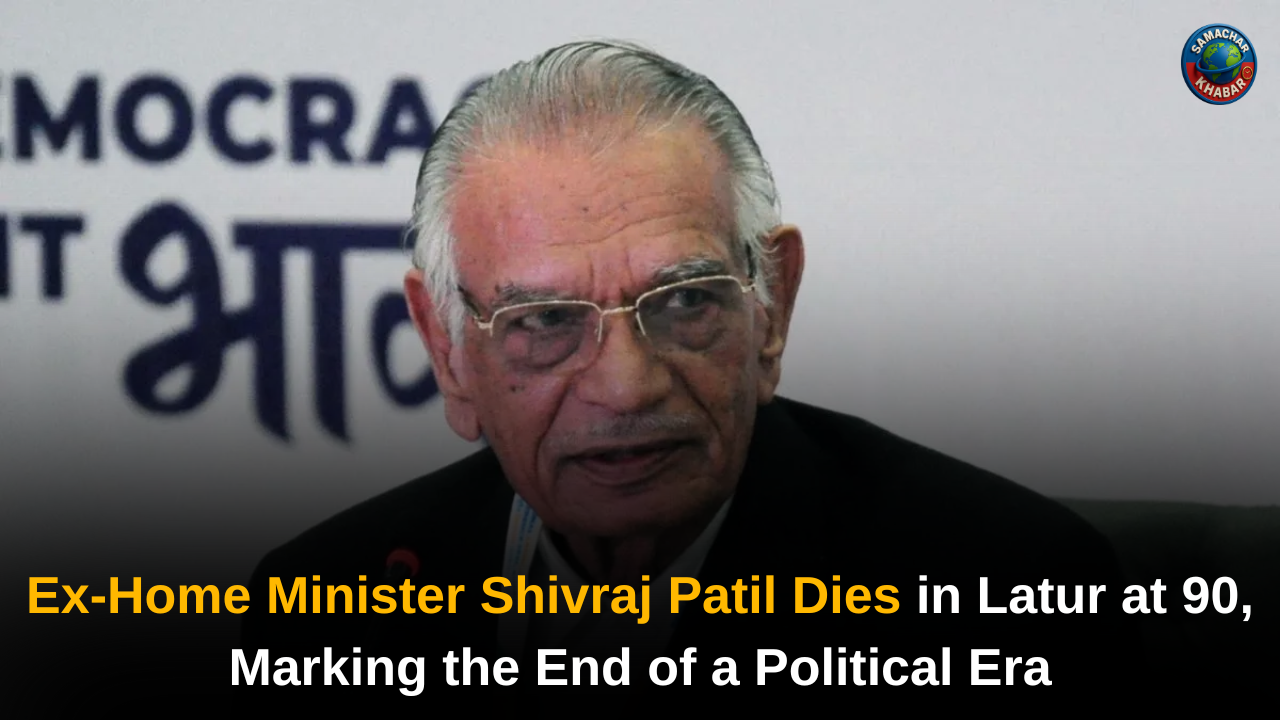
Senior Congress leader and former Union Home Minister Shivraj Patil passed away on Friday morning at his residence ‘Devghar’ in Latur, Maharashtra. He died at the age of 90 after a brief, age-related illness, family sources confirmed. Patil, whose public life spanned over four decades, served in some of the most influential positions in Indian politics — from Home Minister and Lok Sabha Speaker to Governor of Punjab and Administrator of Chandigarh.
He leaves behind a legacy marked by dignity, scholarship, and decades of uninterrupted parliamentary and administrative service.
Key Takeaways on the Life and Legacy of Former Home Minister Shivraj Patil
- Shivraj Patil passed away at 90 at his Latur residence on December 12, 2025.
- Served as Union Home Minister (2004–2008); resigned after the 26/11 Mumbai attacks.
- Served as 10th Speaker of the Lok Sabha (1991–1996) and modernized parliamentary procedures.
- Represented Latur in the Lok Sabha seven consecutive times from 1980 to 1999.
- Served as Governor of Punjab and Administrator of Chandigarh from 2010 to 2015.
- Began political career as municipal council chief of Latur before rising through state and central politics.
- Known for his calm conduct, deep constitutional knowledge, and command over Marathi, Hindi, and English.
- Survived by his son Shailesh Patil, daughter-in-law Archana, and two granddaughters.
Early Life: From Chakur Village to Maharashtra’s Political Landscape
Born on October 12, 1935, in Chakur village of Latur district, Shivraj Patil grew up in the Marathwada region before pursuing higher education. He earned a Science degree from Osmania University, Hyderabad, followed by a law degree from Bombay University.
His initial public service began at the local level during 1967–69 in Latur Municipality. Senior leaders Keshavrao Sonawane and Manikrao Sonawane encouraged and supported his entry into electoral politics.
Patil belonged to the Panchamsali Lingayat community and was a devoted follower of Sathya Sai Baba. He married Vijaya Patil in 1963 and had two children — a son and a daughter.
Rise in State Politics: A Steady Administrative Climb
Shivraj Patil’s political career took root in Maharashtra’s Legislative Assembly, where he served two terms:
- 1972–1978
- 1978–1980
During these years, he held several significant posts:
- Deputy Minister for Law & Judiciary, Irrigation, and Protocol
- Chairman, Public Undertakings Committee
- Deputy Speaker, Maharashtra Assembly
- Speaker, Maharashtra Assembly
This period established Patil as a disciplined administrator with a thoughtful and methodical approach to governance.
Seven-Time Lok Sabha MP: Latur’s Most Dominant Parliamentarian
In 1980, Patil entered national politics by winning the Latur Lok Sabha seat, beginning a historic run of seven consecutive victories:
| Election Year | Outcome |
| 1980 | Won |
| 1984 | Won |
| 1989 | Won |
| 1991 | Won |
| 1996 | Won |
| 1998 | Won |
| 1999 | Won |
His stronghold over Latur spanned two decades. In 2004, he lost the seat to BJP’s Rupatai Patil Nilangekar, though he remained influential in national politics.
Key Roles in Central Government: Four Decades of Responsibility
Shivraj Patil held some of the most prominent portfolios in successive Congress governments led by Indira Gandhi and Rajiv Gandhi. His wide-ranging ministerial responsibilities included:
- Minister of State for Defence (1980–82)
- Independent charge of Commerce (1982–83)
- Minister for Science & Technology, Atomic Energy, Electronics, Space, Ocean Development (1983–84)
- Vice-President, CSIR (1983–86)
- Minister for Personnel, Defence Production, Civil Aviation, Tourism under Rajiv Gandhi
He also served on several key parliamentary committees related to Defence, External Affairs, Finance, and MP allowances.
Also Read: Kerala Local Body Elections 2025: State Gears Up for Decisive Two-Phase Polling on December 9 and 11
Speaker of the Lok Sabha: A Reform-Oriented Tenure
As the 10th Speaker of the Lok Sabha (1991–1996), Patil oversaw significant modernization in parliamentary operations. His contributions include:
- Introducing the Parliament Library Building
- Enhancing computerisation for MPs
- Launching live telecast of Question Hour
- Strengthening information dissemination systems for legislators
He also introduced the Outstanding Parliamentarian Award in 1992, which continues to be one of Parliament’s most respected honours.
Home Minister During 26/11: Resignation and Public Scrutiny
Shivraj Patil served as Union Home Minister from 2004 to 2008 during the UPA-I government. His tenure was heavily tested during the 26/11 Mumbai terror attacks. Facing criticism over lapses in security and preparedness, he resigned on November 30, 2008, taking moral responsibility for the incident.
In earlier controversies, Patil faced criticism for appearing in different outfits on the night of the 2008 Delhi serial blasts. In a later interview, he defended his composure, stating that leaders must remain calm in crises and that criticism should target policies, not personal appearance.
Role as Governor of Punjab and Administrator of Chandigarh (2010–2015)
Following his resignation as Home Minister, Patil continued his public service career as:
- Governor of Punjab
- Administrator of the Union Territory of Chandigarh
His administrative guidance during this period added further depth to a political career already spanning decades.
A Leader Remembered for Grace, Intellect, and Discipline
Known for his soft-spoken nature and dignified presence, Shivraj Patil never engaged in personal attacks — whether in speeches or private conversations. Party colleagues admired his calm temperament, extensive reading habits, and articulate command over Marathi, Hindi, and English.
His deep understanding of constitutional matters made him one of the most respected parliamentarians of his time.
Patil is survived by:
- Son: Shailesh Patil
- Daughter-in-law: Archana Patil (BJP leader)
- Granddaughters: Two
Large groups of citizens and party workers gathered outside his residence on Friday morning to pay their respects.
Spiritual Insight: Understanding Life and Its Purpose Through the Knowledge of Saint Rampal Ji Maharaj
In moments like the passing of senior leaders, society often reflects on the deeper meaning of life, responsibility, and human conduct. The spiritual knowledge explained by Saint Rampal Ji Maharaj offers a clear understanding of the purpose of human life, the transient nature of worldly positions, and the ultimate path to salvation.
His teachings emphasize that true peace and liberation come only through devotion to the Supreme God as described in the holy scriptures, guiding individuals to lead a disciplined, compassionate, and righteous life beyond material achievements.
Shivraj Patil’s Enduring Impact on Indian Public Life
Shivraj Patil’s death marks the end of a long and disciplined political journey that touched nearly every pillar of governance — from Parliament and ministries to state assemblies and governorship. His career reflected a rare blend of constitutional depth, administrative experience, and personal restraint.
Through decades of public service, he shaped parliamentary practices, represented Latur with unwavering consistency, and held some of the nation’s highest offices. His legacy remains firmly etched in India’s contemporary political history, remembered for both his contributions and his unwavering commitment to dignified public life.
FAQs on the Death of Former Home Minister Shivraj Patil
1. Who was Shivraj Patil?
Shivraj Patil was a senior Congress leader, former Union Home Minister, Lok Sabha Speaker, and seven-time MP from Latur with a four-decade political career.
2. When and where did Shivraj Patil die?
He died on December 12, 2025, at 6:30 am at his residence ‘Devghar’ in Latur, Maharashtra, after a brief age-related illness.
3. What major positions did Shivraj Patil hold?
He served as Union Home Minister, Lok Sabha Speaker, Governor of Punjab, Administrator of Chandigarh, and held various key ministries in Indira and Rajiv Gandhi governments.
4. Why did Shivraj Patil resign as Home Minister?
He resigned on November 30, 2008, taking moral responsibility for security lapses during the 26/11 Mumbai terror attacks.
5. How many times did Shivraj Patil win the Latur Lok Sabha seat?
He won the Latur Lok Sabha seat seven consecutive times between 1980 and 1999 before losing in 2004.