The National Lok Adalat in Delhi will now be held on January 10, 2026, offering vehicle owners a one-day opportunity to resolve eligible traffic challans through a simplified legal process. Originally scheduled for December 13, 2025, the Lok Adalat was postponed after that date was declared a court sitting day by the High Court of Delhi, following a decision by the Executive Chairman of the Delhi State Legal Services Authority (DSLSA).
The Lok Adalat will be conducted across all Delhi District Court Complexes, allowing eligible motorists to settle minor, compoundable traffic offences without lengthy court proceedings. Online registration and token issuance remain mandatory, and only challans listed on official portals will be taken up.
Key Takeaways: National Lok Adalat January 10, 2026
- National Lok Adalat in Delhi will be held on January 10, 2026
- Earlier scheduled for December 13, 2025, later postponed
- Decision taken by the Executive Chairman, DSLSA
- Lok Adalat will be conducted at all Delhi District Court Complexes
- Only minor, compoundable traffic challans are eligible
- Online registration and token issuance are mandatory
- Serious offences and cases from other states are excluded
- Cases can be resolved in a single sitting on the same day
National Lok Adalat Rescheduled to January 10, 2026
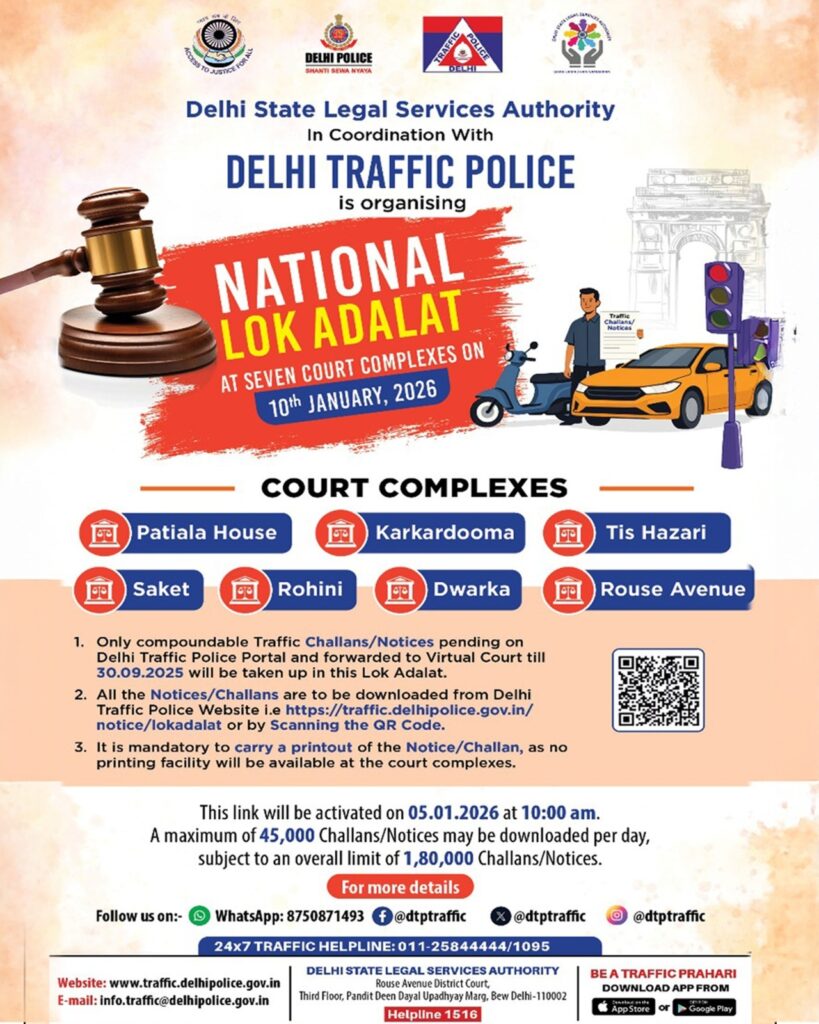
Source: DTP
The National Lok Adalat in Delhi will now take place on January 10, 2026, the second Saturday of the month. The event was earlier scheduled for December 13, 2025, but the date was revised after December 13 was declared a court sitting day by the High Court of Delhi. The postponement was formally announced following a decision by the Executive Chairman of the Delhi State Legal Services Authority.
The Lok Adalat aims to provide quick legal relief to vehicle owners burdened with minor traffic challans by offering a one-day window for settlement without prolonged court hearings or repeated visits.
Where the National Lok Adalat Will Be Held
On January 10, the National Lok Adalat will be conducted across all Delhi District Court Complexes, ensuring city-wide access for eligible applicants. These include:
- Tis Hazari Court Complex
- Dwarka Court Complex
- Rohini Court Complex
- Saket Court Complex
- Patiala House Court Complex
- Karkardooma Court Complex
- Rouse Avenue Court Complex
In addition, the Lok Adalat will also be held at the High Court of Delhi and Permanent Lok Adalats, allowing broader coverage for dispute resolution.
Step-by-Step Guide to Settle Traffic Challans in Lok Adalat
Step 1: Check Pending Traffic Challans
Vehicle owners must first check whether any traffic challans are pending. This can be done through the Delhi Traffic Police website or the Parivahan portal by entering the vehicle registration number or challan number. Only challans visible on official portals are eligible.
Step 2: Confirm Challan Eligibility
Only minor and compoundable traffic offences qualify for settlement under Lok Adalat. Serious violations such as drunk driving or hit-and-run cases are excluded and will not appear for settlement.
Step 3: Register Online for Lok Adalat
Eligible applicants must complete online registration in advance through the Delhi Traffic Police website or the DSLSA Lok Adalat registration page. Applicants are required to enter vehicle details, challan numbers, and contact information carefully. Walk-in cases are generally not accepted.
Step 4: Download Token and Appointment Letter
After successful registration, a token number and appointment or confirmation slip are generated. These documents must be downloaded and printed, as they are mandatory for entry and case listing at the Lok Adalat.
Step 5: Visit the Assigned Court on January 10
On the day of the Lok Adalat, applicants must visit the court complex mentioned in the appointment letter. The following original documents must be carried:
- Vehicle registration certificate
- Driving licence
- Insurance papers
- Pollution certificate
- Challan receipts
Step 6: Case Hearing and Settlement
The case is heard by a Lok Adalat bench, usually comprising a judicial officer and a legal services authority representative. Depending on the nature of the offence, the bench may reduce the fine or waive it fully.
Step 7: Pay the Revised Fine
If a settlement is reached, payment must be made on the same day at the designated counter. An official receipt is issued, and the challan is marked as resolved in the system.
Also Read: पैन-आधार लिंक डेडलाइन खत्म, 1 जनवरी 2026 से पैन कार्ड हुआ निष्क्रिय, जानें एक्टिव करने का तरीका
Eligibility: Traffic Challans That Can Be Settled
Minor traffic offences eligible for settlement include:
- Driving without a helmet or seatbelt
- Over-speeding
- Jumping red lights
- Wrong parking
- Driving without a valid PUC certificate
- Ignoring traffic signs
- Missing number plates
- Incorrectly issued challans
In limited cases, driving without a licence may also be considered.
Only compoundable traffic challans/notices pending on the Delhi Traffic Police portal and forwarded to Virtual Court till 30.09.2025 will be taken up.
Traffic Challans Not Eligible for Waiver
The Lok Adalat does not consider serious or criminal offences. These include:
- Drunk driving
- Hit-and-run cases
- Death due to negligent driving
- Driving by minors
- Unauthorised racing
- Vehicles used in criminal activities
- Challans already pending in regular courts
- Challans issued in other states
The focus remains strictly on minor violations that do not endanger life.
Also Read: How to Clear Cache on Any Device
Token Registration and Important Instructions
Notices and challans must be downloaded from the Delhi Traffic Police Lok Adalat portal or by scanning the official QR code. The registration link is activated on 05.01.2026 at 10:00 am.
Key instructions include:
- A printout of the notice/challan is mandatory
- No printing facilities will be available at court complexes
- Cases are taken up strictly as per token numbers
- Applicants are advised to arrive early to avoid queues
Why the National Lok Adalat Matters
Unlike regular court proceedings, the Lok Adalat focuses on amicable settlement. Cases are taken up in a single sitting, fines may be reduced or waived, and matters are closed the same day under the Legal Services Authorities Act, 1987. However, only challans listed on official portals and registered in advance are considered.
Spiritual Discipline and the Value of Limits
Every system functions through rules and discipline, and the same principle applies to spiritual life. Just as legal processes follow defined procedures to protect people’s interests, spiritual practice also moves within boundaries meant for human welfare. Scriptures and history repeatedly highlight the importance of maryada—spiritual discipline.
When limits are crossed, imbalance follows. Saints therefore explain discipline before guiding devotees on the spiritual path. In the present time, Tatvdarshi Sant Rampal Ji Maharaj explains that true spiritual rules are framed only for the benefit and safety of human life. He teaches that discipline in daily conduct and worship protects devotees from harm and confusion.
According to His teachings, real spiritual benefit is attained only through scripture-based devotion, not through practices that lack scriptural foundation. Discipline, when followed with understanding, brings clarity, balance, and purpose to human life.
FAQs on National Lok Adalat January 10, 2026
Q1. When will the National Lok Adalat be held in Delhi?
It will be held on January 10, 2026.
Q2. Why was the Lok Adalat postponed from December 13?
December 13 was declared a court sitting day by the High Court of Delhi.
Q3. Are serious traffic offences eligible for settlement?
No, only minor and compoundable offences are eligible.
Q4. Is online registration mandatory for Lok Adalat?
Yes, advance online registration and token issuance are mandatory.
Q5. Which courts will conduct the Lok Adalat?
All Delhi District Court Complexes, the High Court of Delhi, and Permanent Lok Adalats.