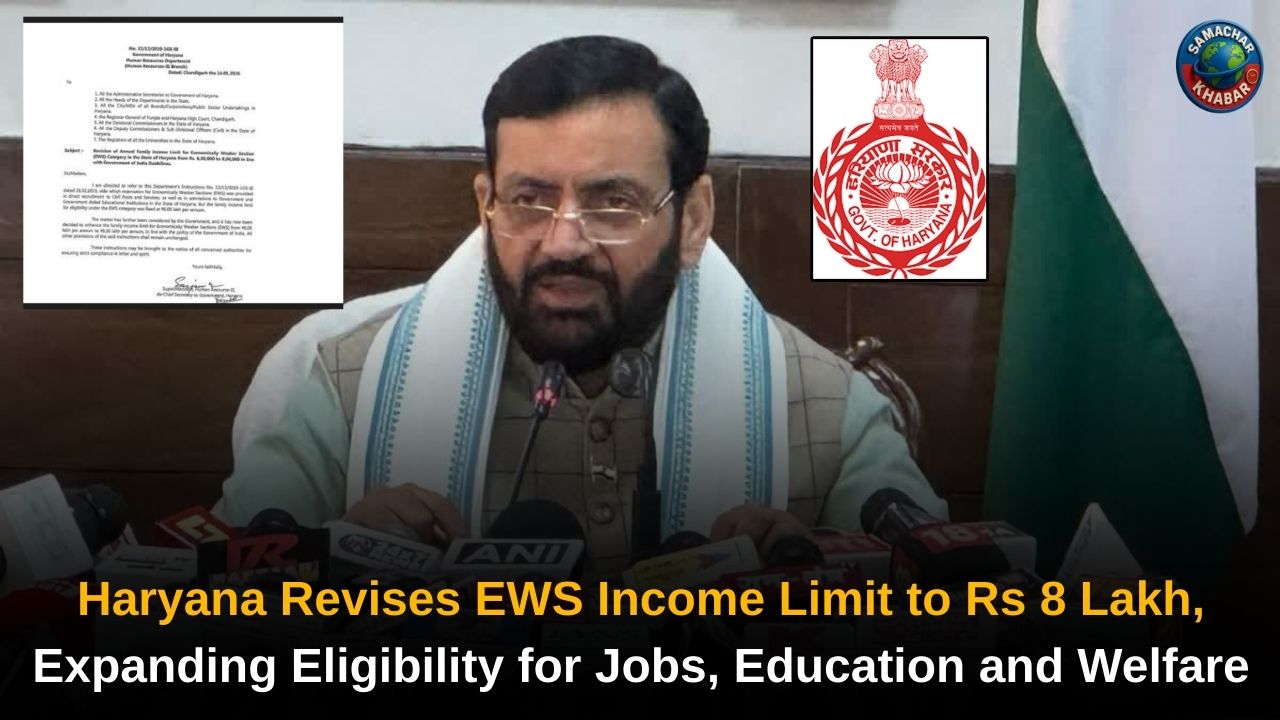
The Haryana government has revised the annual family income limit for the Economically Weaker Section (EWS) category from Rs 6 lakh to Rs 8 lakh, aligning the state’s policy with the Central Government’s guidelines. The decision, communicated through a letter issued by the Chief Secretary’s Office, applies to reservations in direct recruitment to civil posts and services, as well as admissions to government and government-aided educational institutions. The revised criterion replaces the earlier income ceiling fixed in February 2019 and is expected to bring more families within the ambit of EWS benefits, including reservations, education support, and housing-related welfare measures.
Key Takeaways: Haryana EWS Income Limit Revision
- Haryana revises EWS annual family income limit from Rs 6 lakh to Rs 8 lakh
- Decision aligns state policy with Central Government guidelines
- Applies to government jobs, civil services, and admissions
- Earlier income limit was fixed on February 25, 2019
- All other EWS-related instructions remain unchanged
- EWS beneficiaries continue to receive reservation, education, and housing benefits
Haryana Aligns EWS Policy With Central Guidelines
The Haryana government has revised the annual family income limit for the Economically Weaker Section (EWS) category, increasing it from Rs 6 lakh to Rs 8 lakh per annum. The move brings the state’s EWS income criteria in line with the guidelines issued by the Central Government.
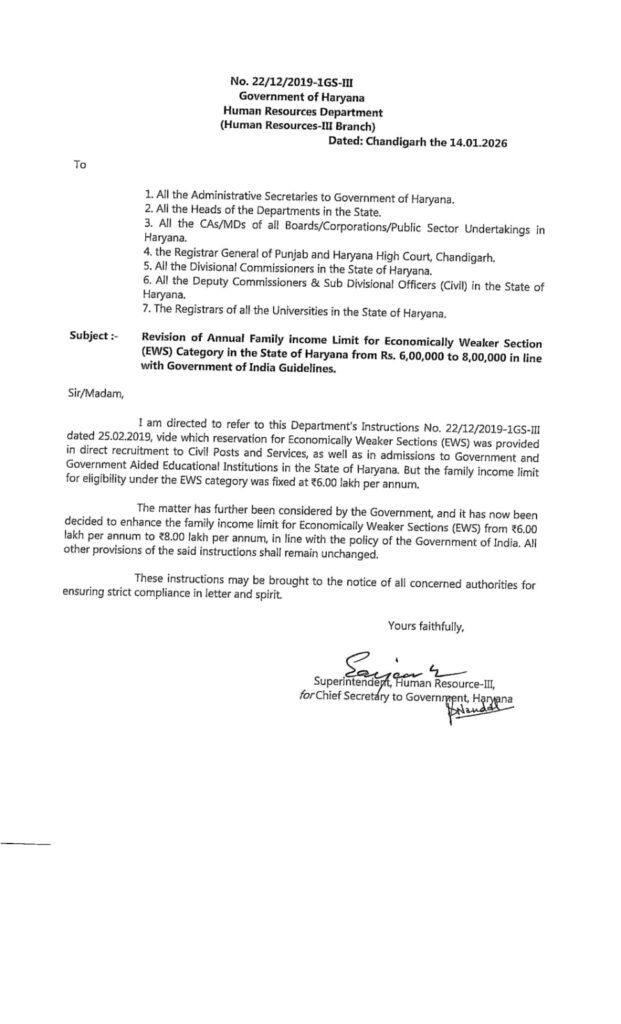
An official statement confirmed that a letter regarding the revision has been issued by the Chief Secretary’s Office. The decision follows a review of the earlier income threshold and reflects the state government’s updated assessment of eligibility norms for the EWS category.
The revised income ceiling is applicable across key areas where EWS reservations are implemented in Haryana.
Applicability to Jobs and Educational Admissions
According to the official communication, the updated income criterion will apply to:
- Reservations in direct recruitment to civil posts and services in the state
- Admissions to government educational institutions
- Admissions to government-aided educational institutions
The revised income limit ensures uniformity with Central Government norms while continuing the implementation of EWS reservations in both employment and education sectors across Haryana.
Officials clarified that apart from the enhancement in the income ceiling, all other existing instructions related to the EWS category will remain unchanged.
Earlier Income Limit and Policy Review
The earlier income limit for the EWS category in Haryana was fixed at Rs 6 lakh per annum under instructions issued on February 25, 2019. Following a review of the matter, the state government decided to revise the threshold to Rs 8 lakh annually.
Also Read: Blinkit Removes 10-Minute Delivery Claim After Labour Ministry Intervention
The review process led to the conclusion that an enhanced income ceiling was required to ensure broader inclusion of economically weaker families within the EWS framework. The revised limit replaces the earlier benchmark without altering other eligibility conditions.
Expansion of EWS Welfare Measures
With the revision of the income limit, a larger number of families are expected to fall under the ambit of EWS benefits. These benefits extend beyond reservation in jobs and education and include access to welfare schemes implemented by the Haryana government.
EWS beneficiaries in the state are entitled to:
- 10 per cent reservation in government jobs
- 10 per cent reservation in educational institutions
- Free education under the Right to Education (RTE) Act for Classes 1 to 3
- Financial assistance under the CHIRAG scheme for Classes 4 to 12
- Access to housing schemes and related subsidies
These measures continue to remain applicable under the revised income criteria.
EWS Housing Policy Introduced in October 2025
In October 2025, the Haryana government rolled out a dedicated housing policy for EWS families aimed at supporting home ownership among economically weaker sections.
Under this policy:
- 20 per cent of plots in licensed colonies are reserved for the EWS category
- 15 per cent of flats in group housing societies are reserved for EWS beneficiaries
The policy targets families living in rented houses, slums, or temporary accommodations and seeks to integrate EWS households into mainstream urban developments.
Validity of EWS Certificate
As per existing provisions, the EWS certificate issued to beneficiaries in Haryana is generally valid for one year. The certificate must be renewed annually to continue availing reservation and welfare benefits under the EWS category.
Also Read: Top 15 Best Educational Websites: Learn Anything Anytime, Anywhere
The validity norms remain unchanged following the revision of the income ceiling.
Official Source and Attribution
The information regarding the revision of the EWS income limit has been issued through an official statement and a letter from the Chief Secretary’s Office. The report has been generated from PTI news service. ThePrint has stated that it holds no responsibility for the content of the auto-generated report.
Policy Impact and Administrative Continuity
The enhancement of the EWS income limit reflects an administrative decision aimed at aligning Haryana’s reservation framework with Central Government guidelines. While the income ceiling has been revised, the government has maintained continuity in all other operational aspects of the EWS policy. The updated criterion now governs eligibility for reservations, admissions, and welfare access across sectors, ensuring consistency in implementation while expanding the coverage of the EWS category within the state.
Compassion Reaching the Unreached
Beyond policy frameworks, there remain extremely poor families whom formal systems often fail to reach. In this context, the humanitarian efforts led by Tatvdarshi Sant Rampal Ji Maharaj reflect a spiritually driven response to material distress. Through the Annapurna Muhim, impoverished families are receiving monthly ration support.
For those without homes, houses are being constructed, and for families without even land to live on, land is arranged and homes are built to ensure dignity and stability. While governments continue their efforts within administrative limits, His Mission operates as a broader social movement, active across India and extending to Pakistan, Nepal, the United States, and other regions. This initiative reflects a vision where poverty gradually diminishes and ethical living rises, symbolising the beginning of Satyug in Kalyug.
FAQs on Haryana EWS Income Limit Revision
1. What is the revised EWS income limit in Haryana?
The annual family income limit for EWS in Haryana has been revised from Rs 6 lakh to Rs 8 lakh.
2. When was the earlier EWS income limit fixed?
The earlier income limit of Rs 6 lakh was fixed under instructions issued on February 25, 2019.
3. Where does the revised income limit apply?
It applies to government jobs, civil services recruitment, and admissions to government and government-aided institutions.
4. Are other EWS rules changed along with the income limit?
No, all other existing instructions related to the EWS category remain unchanged.
5. How long is an EWS certificate valid in Haryana?
An EWS certificate is generally valid for one year and must be renewed annually.