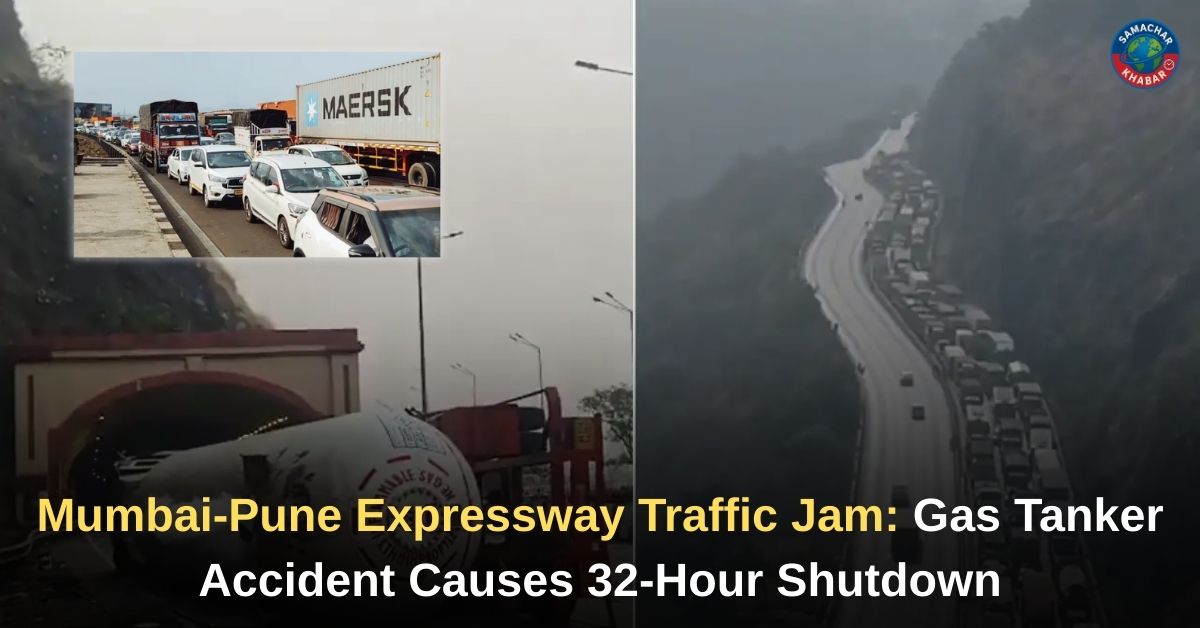
Mumbai-Pune Expressway Traffic Jam: The Mumbai-Pune Expressway, one of India’s busiest and most critical transport corridors, witnessed unprecedented disruption after a gas tanker overturned in the ghat section, bringing traffic to a near standstill for more than a day. The accident, which occurred near the Adoshi tunnel in the Khandala stretch, led to massive congestion, leaving thousands of commuters stranded for extended hours and raising serious questions about highway safety and emergency preparedness. This article provides a detailed record of the sequence of incidents and the current situation.
Highlights
- In a rare traffic situation at the Mumbai-Pune Expressway, road traffic came to a standstill for almost 32 hours before it began easing out.
- A gas tanker overturned and began leaking on 3rd February 2025 evening. The exact time is unknown, though some sources state it could most likely be post 5 PM.
- The leak of the polypropylene gas caused panic among bystanders prompting authorities to stop vehicular movement immediately to prevent further mishaps.
- What ensued was a snake-like trail of vehicles stalled for a stretch of over 20 kms.
- With the tanker now moved away from the site after about 32 hours, the traffic is expected to ease out slowly as the day progresses.
Mumbai-Pune Expressway Incident and Immediate Risk
The accident took place on Tuesday, 3rd February 2026, evening when a tanker transporting propylene gas, a highly flammable industrial substance, lost control while navigating the steep descent of the ghat section near Adoshi tunnel, Khandala.
- The vehicle overturned, resulting in a gas leak that immediately posed a significant explosion hazard.
- Given the volatile nature of the gas, authorities acted swiftly to secure the area and prevent a potential catastrophe.
- As a precaution, traffic on the affected stretch of the Mumbai-bound carriageway was completely halted.
- Emergency services cordoned off the area, while movement in both directions was restricted to minimise risk to motorists and rescue personnel.
The leak meant that normal accident-clearing procedures could not be followed, as even a minor spark could have resulted in a serious disaster.
Traffic Paralysis and Scale of Disruption at the Mumbai-Pune Expressway
What followed was one of the worst traffic jams the expressway has seen in recent years.
- Vehicles began piling up within minutes, and queues soon stretched across several kilometres.
- By late night, the congestion had intensified, with reports indicating traffic jams extending up to 20 kilometres in some sections.
- Commuters travelling between Mumbai and Pune found themselves stuck for anywhere between 8 and 32 hours.
- All kinds of vehicles, including emergency vehicles were immobilised for long periods.
Many travellers spent the entire night inside their vehicles, without access to food, drinking water or toilet facilities. Families with children and elderly passengers were particularly affected, leading to widespread frustration and distress.
Diversions Added to the Chaos
Authorities diverted traffic towards the old Mumbai-Pune Highway (NH48) in an attempt to manage the backlog. However, the sudden redirection of thousands of vehicles overwhelmed the already narrow and winding road. This resulted in severe congestion on the alternative route as well, effectively paralysing both the expressway and the old highway simultaneously.
Railway services between Mumbai and Pune saw a surge in demand as stranded travellers abandoned road travel altogether. Some commuters reported cancelling journeys or turning back mid-way, while others sought unconventional means to reach their destinations. Several social media accounts posted videos of passengers jumping onto already overcrowded trains.
Emergency Response and Clearance Efforts
Due to the hazardous nature of the cargo, the clearance operation was complex and very time-consuming.
- Teams from the State Disaster Response Force (SDRF), local fire brigades, police units and technical experts were deployed at the site.
- Specialists worked carefully to contain the gas leak before attempting to remove the overturned tanker.
- Authorities initiated a controlled process to transfer the remaining gas from the damaged tanker into secure containers.
- Only after the gas was neutralised could recovery operations proceed. This delicate operation extended well into the next day and day three too, delaying the restoration of normal traffic flow.
Partial movement was allowed intermittently once officials deemed certain sections safe, but full normalisation of traffic was possible only after the tanker was removed entirely and the road inspected for residual risk.
Public Anger and Political Reactions
The prolonged standstill sparked anger among commuters, many of whom voiced their frustration on social media. Complaints ranged from the lack of real-time traffic updates to the absence of basic amenities for those stranded for hours. Several motorists described the experience as exhausting and unsafe, particularly during the night.
Political reactions also followed, with leaders questioning the preparedness of authorities and the absence of effective contingency planning for hazardous cargo accidents on such a vital highway.
The incident has reignited debate around accountability, infrastructure resilience, and crisis management on major expressways.
Also Read: Cities Without Cars: How Countries Are Redesigning Urban Mobility for a Greener Future
Current Situation: Expressway Reopens After 32-Hour Shutdown, Traffic Still Slow
Traffic on the Mumbai-Pune Expressway has resumed after a prolonged 32-hour closure caused by a gas tanker accident in the Khandala ghat section. While the expressway is now operational, traffic movement remains slow and regulated as authorities continue post-incident safety checks near the Adoshi tunnel, where the tanker overturned.
- Emergency teams allowed traffic to resume only after the gas was safely neutralised and transferred, making the clearance process complex and time-consuming.
- Controlled Movement and Residual Congestion: Traffic restoration is being carried out in phases, with speed restrictions still in force near the accident site. Although vehicles are moving, commuters are experiencing residual congestion, particularly during peak hours, as the backlog from the shutdown gradually clears.
- The extended closure left thousands of commuters stranded, including senior citizens, families with children and patients requiring medical care. Many remained stuck for over a day without access to food, water or sanitation, drawing criticism over the lack of emergency support during the crisis.
- Advisories Remain in Place: While major diversions have been lifted, authorities continue to advise motorists to avoid non-essential travel through the ghat section until traffic fully stabilises. Emergency teams remain deployed to monitor the area and ensure there is no residual risk from the gas leak.
- Conditions on the expressway are steadily improving, but the incident has raised fresh concerns about emergency preparedness and the handling of hazardous cargo on one of India’s busiest highways. Normal traffic flow is expected to return gradually as monitoring and cleanup operations conclude.
Safety and Infrastructure Concerns About the Mumbai-Pune Expressway
The accident has highlighted long-standing vulnerabilities in the Mumbai-Pune Expressway, particularly in its ghat sections. With limited diversion options and high traffic density, even a single accident involving hazardous material can cripple movement for an entire day or longer.
Also Read: M23 Traffic Gatwick: Don’t Let it Ruin Your Trip
Experts have pointed out the need for stricter regulation of hazardous goods transport, improved emergency response protocols and better coordination between agencies. The lack of designated safety lay-bys, emergency access routes, and rapid evacuation mechanisms has once again come under scrutiny.
When Catastrophe Was Avoided: The Unseen Power of Supreme God Kabir
Despite the seriousness of the gas tanker accident, many are thankful that the leakage did not lead to an explosion. Given the highly flammable nature of the gas, the outcome could have been catastrophic.
Such a moment reflects the unseen protection of Supreme God Kabir, Who safeguards all, whether they recognise Him or not. And when one follows the true path of worship under a Tatvdarshi Saint, this divine protection becomes stronger and more enduring.
Jagatguru Tatvdarshi Sant Rampal Ji Maharajis the true Tatvdarshi Saint of our time, imparting authentic worship of God Kabir as guided by sacred scriptures. Learn more about the impenetrable protection of God Kabir by visiting: