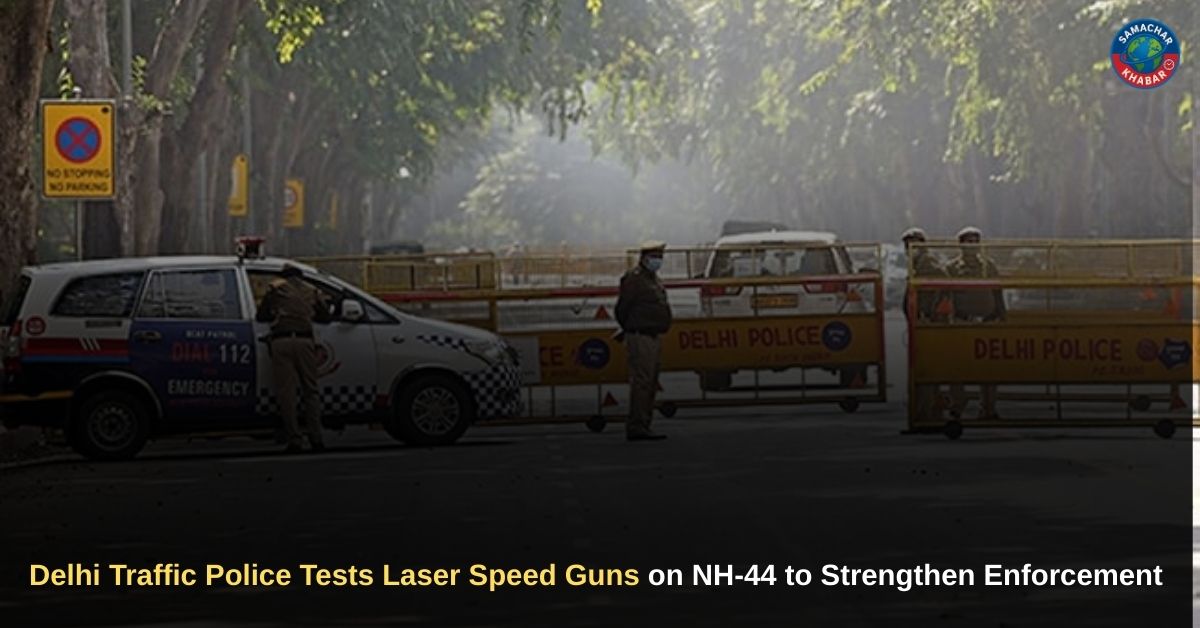
Delhi Traffic Police has intensified its efforts to improve road safety by testing handheld laser speed guns along the NH-44 corridor near Libaspur Bus Stand, an area identified as accident-prone due to heavy commercial traffic and frequent overspeeding. The trial, conducted as part of a focused enforcement drive, aims to enhance speed monitoring and reduce fatal crashes on one of the city’s high-risk stretches.
During the exercise, officials tested advanced speed detection devices and issued 151 challans to violators, highlighting the authorities’ growing emphasis on stricter enforcement, awareness initiatives, and evidence-based safety interventions to improve compliance and protect vulnerable road users.
Key Highlights of Delhi Traffic Police Laser Speed Gun Enforcement on NH-44
- Delhi Traffic Police conducted trials of handheld laser speed guns at Libaspur Bus Stand on NH-44.
- Five handheld laser speed cameras were tested during the enforcement drive.
- A total of 151 challans were issued for overspeeding violations.
- Libaspur, located in an industrial zone with heavy truck movement, has recorded significant road accidents.
- Between 2018 and 2023, the area reported 68 accidents, including 28 fatal incidents.
- Overspeeding, poor lane discipline, and unsafe pedestrian crossings were identified as major causes of crashes.
- The initiative aims to strengthen enforcement in high-risk and high-speed corridors across Delhi.
- The devices were donated by the Global Road Safety Partnership under the Bloomberg Philanthropies Initiative for Global Road Safety.
Speed Enforcement Trials Conducted at Accident-Prone Libaspur Stretch
The Delhi Traffic Police carried out trials of handheld laser speed guns at the Libaspur Bus Stand area as part of a targeted effort to address rising safety concerns on NH-44. Officials stated that the corridor has emerged as one of the city’s most accident-prone stretches, requiring focused monitoring and stricter enforcement measures.
The Libaspur area lies within an industrial belt and witnesses heavy movement of trucks and commercial vehicles throughout the day. This continuous flow of high-speed traffic has contributed to a significant number of crashes over the years, prompting authorities to introduce more accurate speed detection tools.
During the trial conducted on Friday, five handheld laser speed cameras were deployed to monitor vehicle speeds. The enforcement drive resulted in 151 challans being issued to drivers found violating speed limits, reflecting the scale of overspeeding concerns on the corridor.
Accident Data Highlights Need for Stronger Monitoring on NH-44
According to Delhi Traffic Police data, 68 road accidents were recorded in the Libaspur area between 2018 and 2023. Out of these, 28 incidents were fatal, underlining the seriousness of the safety challenge in the region.
Officials noted that overspeeding remains one of the primary causes of crashes on NH-44. Poor lane discipline and unsafe pedestrian crossings have further increased risks, particularly along stretches with dense settlements and mixed traffic movement. The presence of heavy commercial vehicles adds to the complexity of traffic conditions, making accurate speed enforcement essential.
A senior police officer emphasized that enforcement alone is not sufficient and must be supported by awareness initiatives and infrastructure interventions to effectively reduce fatalities on accident-prone roads.
Role of Advanced Laser Speed Guns in Improving Enforcement Accuracy
The newly tested handheld laser speed guns are designed to detect vehicles exceeding permissible speed limits with greater accuracy. Police officials said the devices would help strengthen enforcement at vulnerable locations, especially in industrial zones and high-traffic corridors where traditional monitoring methods may be less effective.
The initiative is part of a broader effort to improve compliance with speed regulations and encourage safer driving behaviour. Targeted enforcement at specific high-risk locations, such as Libaspur, is expected to contribute to reducing road deaths and injuries by ensuring consistent monitoring and deterrence.
Infrastructure Gaps and Safety Concerns Along the Corridor
DCP Traffic (Northern Range) Sandhya Swamy stated that NH-44 has emerged as one of Delhi’s most accident-prone corridors. She highlighted that overspeeding, poor lane discipline, and unsafe pedestrian crossings remain major contributing factors to accidents.
She also pointed out that existing speed-control infrastructure is insufficient to cover the entire 15-kilometre high-settlement stretch of the highway. Currently, only one Over Speed Violation Detection (OSVD) zone operates near Swaroop Nagar, making additional enforcement measures necessary to ensure wider coverage and improved road safety outcomes.
According to officials, focused enforcement at locations like Libaspur is essential to protect vulnerable road users and reduce fatalities.
Collaboration with Global Road Safety Partnership Under BIGRS Initiative
The handheld laser speed cameras used in the trial were donated by the Global Road Safety Partnership (GRSP) under the Bloomberg Philanthropies Initiative for Global Road Safety (BIGRS). The collaboration aims to support evidence-based safety interventions and strengthen road safety enforcement mechanisms.
GRSP Asia Pacific Manager Brett Harman stated that effective speed enforcement plays a critical role in reducing road deaths and injuries worldwide. He welcomed the continued collaboration with the Delhi Traffic Police, noting that speeding remains one of the leading causes of road accidents globally and that targeted enforcement measures are essential for improving road behaviour.
Spiritual Perspective: Road Safety, Human Responsibility and the True Knowledge of Saint Rampal Ji Maharaj Ji
Beyond enforcement and regulations, road safety also reflects human responsibility, discipline, and awareness in daily life. The teachings of Saint Rampal Ji Maharaj emphasize that a balanced and conscious lifestyle helps individuals develop patience, self-control, and respect for others — values that naturally promote responsible behaviour on roads and in society.
According to His spiritual knowledge, when individuals follow righteous conduct and remain mindful of their actions, they contribute to collective safety and harmony. Such spiritual awareness complements social efforts aimed at protecting human life, reminding society that true progress lies not only in technological enforcement but also in moral and spiritual awakening.
Strengthening Road Safety Through Focused Enforcement and Awareness
The laser speed gun trials on NH-44 reflect Delhi Traffic Police’s ongoing effort to address overspeeding and improve safety on high-risk corridors through accurate enforcement and coordinated safety measures. With accident data highlighting the urgency of intervention in areas such as Libaspur, authorities are focusing on combining enforcement, awareness initiatives, and infrastructure improvements to reduce fatalities.
The initiative signals a shift towards data-driven road safety strategies aimed at protecting commuters, commercial drivers, and pedestrians alike while encouraging responsible driving behaviour across one of the capital’s busiest highway stretches.
FAQs on Delhi Traffic Police Testing Laser Speed Guns on NH-44
1. Why is Delhi Traffic Police testing laser speed guns on NH-44?
Delhi Traffic Police tested laser speed guns to curb overspeeding, improve speed enforcement accuracy, and reduce road accidents on the accident-prone NH-44 stretch near Libaspur.
2. Where were the laser speed gun trials conducted in Delhi?
The trials were conducted near Libaspur Bus Stand on the NH-44 corridor, an industrial area with heavy truck movement and a history of road accidents.
3. How many challans were issued during the NH-44 enforcement drive?
Delhi Traffic Police issued 151 challans during the enforcement drive after testing five handheld laser speed cameras to detect overspeeding vehicles.
4. Why is the Libaspur area considered accident-prone?
Between 2018 and 2023, Libaspur recorded 68 road accidents, including 28 fatal incidents, mainly due to overspeeding, poor lane discipline, and unsafe pedestrian crossings.
5. Who provided the laser speed cameras to Delhi Traffic Police?
The laser speed cameras were donated by the Global Road Safety Partnership under the Bloomberg Philanthropies Initiative for Global Road Safety to support evidence-based road safety enforcement.