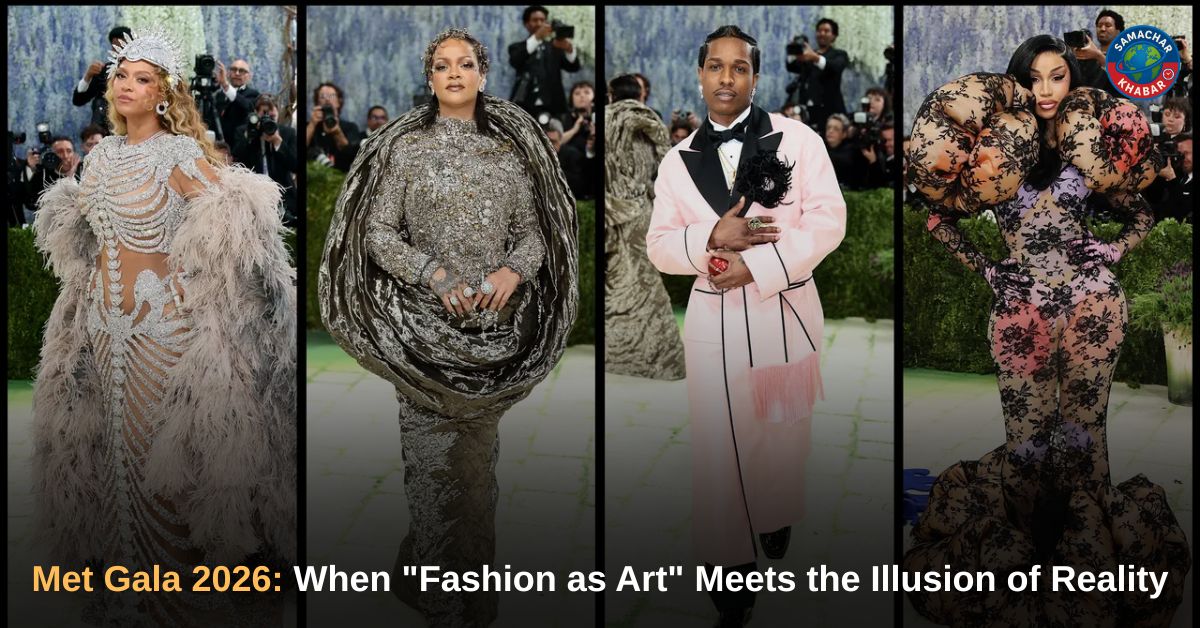
The first Monday of May has once again descended upon us, and with it, the high-priests of pop culture gathered at the Metropolitan Museum of Art for the Met Gala 2026. This year’s theme, “Costume Art,” paired with the dress code “Fashion is Art,” promised a deep dive into the relationship between the dressed body and the canvas. What we got, however, was a masterclass in the very vanity that keeps humanity tethered to the cycle of birth and death, a spectacle that would make any spiritual seeker chuckle at the sheer effort put into “packaging” a temporary body.
Key Highlights: The Intersection of Glamour and Reality
- The Illusion of Permanence: How the 2026 theme “Fashion is Art” attempts to immortalize the physical form, contrasting with the spiritual truth that the body is a temporary vessel.
- The “Clay Doll” Concept: A professional critique of spending millions to decorate what Sant Rampal Ji Maharaj identifies as a perishable “doll of clay.”
- The High Cost of Vanity: An analysis of the $75,000 entry fee vs. the “breath-wealth” (Saas-Saas ki punji) wasted on worldly display.
- A Shift in Perspective: Moving the focus from the “Runway of Dust” to the eternal elegance of Sat-Bhakti and the path to Satlok.
- The Paradox of Art: Why portraying “The Aging Body” as a costume ignores the
The Canvas of Chaos: Red Carpet Highlights
The 2026 red carpet was literally a canvas, inspired by the swirling, turbulent brushwork of Vincent van Gogh. It was a fitting start for an evening defined by expensive restlessness.
Beyoncé arrived in a crystalline skeleton gown, an “anatomical study” by Olivier Rousteing. It was technically brilliant, yet ironically served as a glittering reminder of the skeletal frame we all inhabit though most of us don’t cover ours in million-dollar crystals. Madonna took things a step further, channeling surrealism as “The Temptation of St. Anthony,” complete with a ship headpiece and six masked “ladies in waiting” to carry her train. One couldn’t help but wonder: if it takes six people to help you walk through a door, are you wearing the art, or has the art become a burden?
Then there was Bad Bunny, who leaned into the “Mortal Body” category of the exhibition with a prosthetic look inspired by “The Aging Body.” While Hollywood praised the “bravery” of looking old for a night, it highlighted a profound disconnect. In the worldly view, aging is a costume to be played with; in reality, it is the inevitable progression of the Kaal Chakra (the wheel of time).
The Sarcasm of the “Stunning”
The internet, as usual, lost its collective mind. There was a viral moment where a man in a feathered mermaid gown was mistaken for NFL star Travis Kelce, only for the world to realize it was actually Sam Smith. The fact that we have reached a point where a professional athlete and a pop singer are interchangeable behind layers of tulle and feathers says everything you need to know about the “identity” fashion provides.
Sarah Paulson walked the carpet with a dollar bill covering her eyes, part of a collection titled “The One Percent.” It was meant to be a critique of wealth, worn at an event where tickets cost more than a mid-sized family home. The irony was so thick you could carve it with a palette knife.
The Spiritual Lens: A Perspective from Sant Rampal Ji Maharaj
While the fashion world celebrates these “transformations,” the teachings of Sant Rampal Ji Maharaj offer a grounding correction to the madness. In the spiritual discourse of Tatvdarshi saints, this physical body is often compared to a temporary garment. The Met Gala’s theme, “Fashion is Art,” suggests that the body is a canvas to be decorated. However, as Sant Rampal Ji explains, we are spending our precious “breath-wealth” (Saas-Saas ki punji) on decorating a “clay doll” that will eventually return to the earth.
“Manush janam durlabh hai, mile na barambaar, taruvar se patta toot gire, bahur na lagta dhaar.”
(Human birth is rare and won’t be found again and again; once a leaf falls from a tree, it cannot be reattached.)
The celebrities at the Met Gala spend months preparing for a few hours of flashbulbs. They seek “immortality” through digital archives and museum exhibits. But as per the spiritual laws taught by Sant Rampal Ji, true beauty isn’t found in a Schiaparelli gown or a custom Balenciaga suit. True beauty lies in Bhakti (devotion) and the pursuit of Satlok, the eternal place where the “body” does not age, wither, or require a $75,000 ticket to be recognized.
The Illusion of “Artistic Expression”
The exhibition featured mannequins with polished steel heads, designed by Samar Hejazi, intended to let visitors “see themselves” in the garments. Spiritually, this is a perfect metaphor for the ego. We see ourselves in the clothes we wear, the brands we flaunt, and the status we project. We are so busy looking at the “steel reflection” of our outward persona that we forget the soul residing within.
Sant Rampal Ji Maharaj emphasizes simplicity and the removal of social evils like ostentatious spending and the “show-off” culture (dikhavat). While the Met Gala is the world’s ultimate “show-off,” it serves as a stark contrast to the path of a true devotee, who finds grace in humility rather than a 20-foot train.
From the Runway of Dust to the Path of Truth
As the flashbulbs fade and the 2026 Met Gala concludes, we are left with a collection of photos and a mountain of fabric. While the world calls this “art,” the spiritual wisdom of Sant Rampal Ji Maharaj invites us to look toward a more permanent masterpiece.
There is a positive realization waiting for us behind the sarcasm: our human life is the greatest “ticket” we have ever been granted. Unlike a Met Gala invite, which costs thousands and lasts a night, our human birth is an opportunity to achieve Moksha (salvation) , a state of being that no designer can replicate.
The “Fashion is Art” theme reminds us that we are all creative beings, but our greatest creation should be a life dedicated to Sat-Bhakti and selfless service. True elegance is not found in what we put on the body, but in the purity we find inside it. When we trade the fleeting “trends” of this world for the eternal truth provided by a True Guru, we find a style that never goes out of fashion. Let us celebrate the soul’s journey back to its original home, Satlok, where the light of a single soul is more radiant than sixteen suns. That is the only red carpet worth walking.
To explore the depth of true spiritual knowledge and discover the path to eternal peace, download the ‘Sant Rampal Ji Maharaj’ app from the Play Store and read transformative books such as Gyaan Ganga and Jeene Ki Raah written by Sant Rampal Ji Maharaj.
FAQs Related to Met Gala 2026
1. What was the theme of Met Gala 2026?
The theme was “Costume Art,” where the human body was treated as a canvas to explore the intersection of fashion and museum-grade artistry.
2. How does Sant Rampal Ji’s wisdom critique the event?
His teachings suggest that while society polishes the “clay doll” (the body) with expensive fashion, it neglects the soul’s eternal need for Sat-Bhakti and salvation.
3. What is the “Runway of Dust” metaphor?
It refers to the fleeting nature of material glory. Spiritually, every expensive gown and red-carpet moment is temporary and will eventually return to dust.
4. Why is the event described as a “Painting the Skeleton” moment?
It highlights the irony of decorating a mortal frame with millions of dollars in jewels while ignoring the inevitable reality of aging and death.
5. What is the ultimate takeaway for the reader?
The article encourages shifting focus from outward “show-off” culture (dikhavat) to finding a True Guru and securing a place in the eternal realm of Satlok.