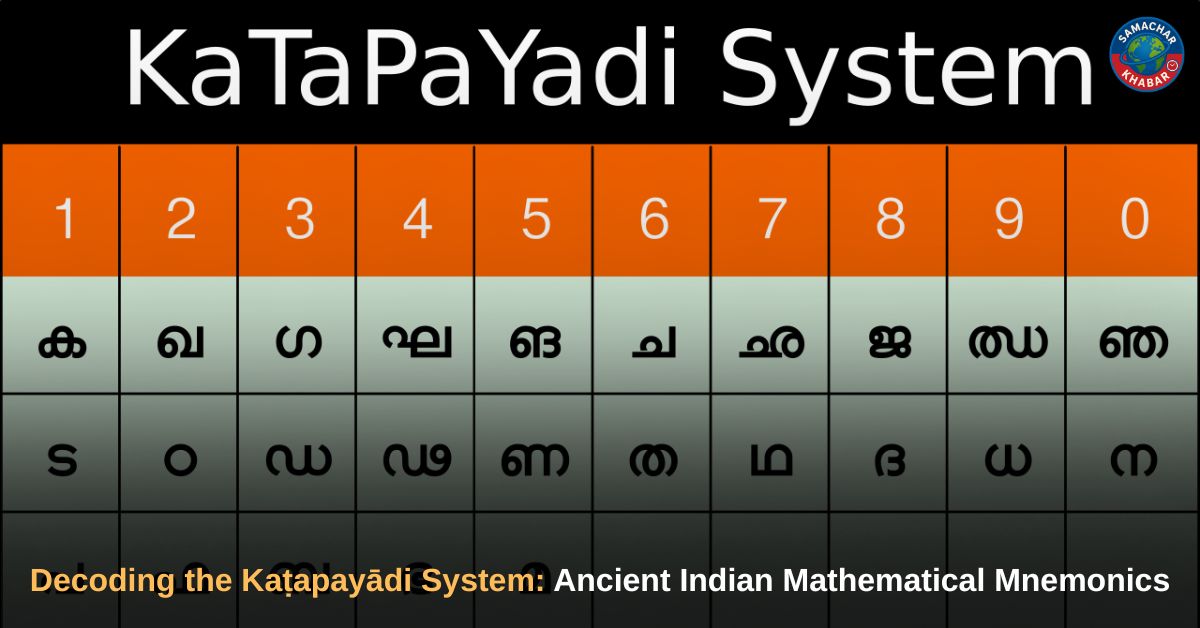
The Kaṭapayādi system is a remarkable ancient Indian mnemonic technique that harmonized literature with mathematics. By mapping Sanskrit consonants to specific digits, scholars could encode vast astronomical data and mathematical constants within the aesthetic beauty of poetries.
Why Does It Exist?
Ancient Indian scholars needed to reliably store long sequences of numbers for astronomical and mathematical work. By mapping Sanskrit consonants to specific digits, they transformed dry numerical data into beautiful, rhythmic verses. This allowed a devotee reciting a hymn to Lord Krishna, for example, to unknowingly preserve the value of π to 31 decimal places. The name Katapayadi comes from first four consonants: Ka, ṭa, pa, ya. Oldest known use: Haridatta’s work (683 CE). Kerala School (14th-19th century) developed it.

The Core Rules
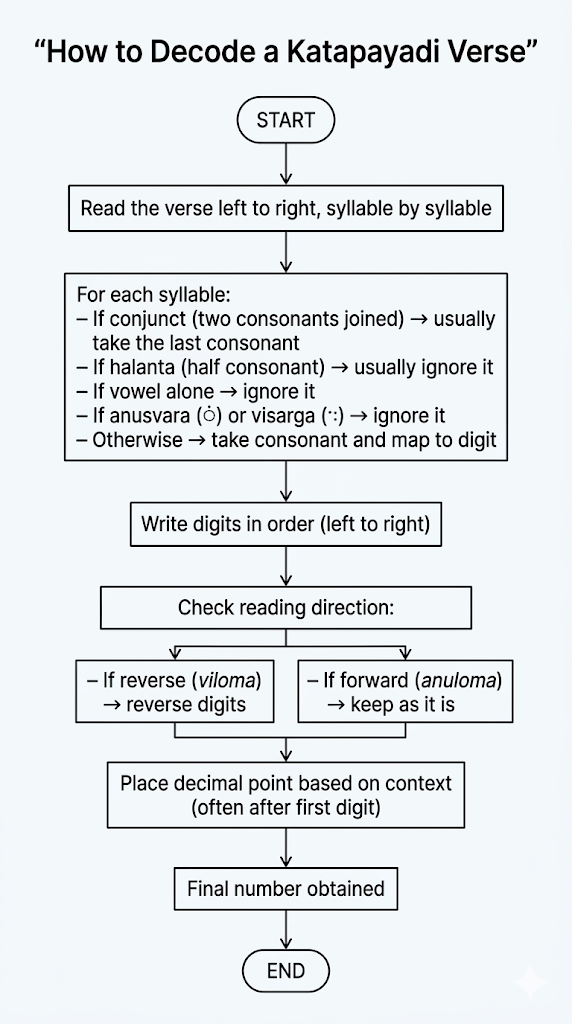
Rule 1: Consonants carry digits; vowels carry nothing. Each Sanskrit consonant maps to a specific digit from 0 to 9 (see chart below). The vowels (अ, आ, इ, ई, उ, ऊ, ए, ऐ, ओ, औ) have no numerical value. Their only job is to make words sound like real Sanskrit and carry meaning.
Rule 2: In conjuncts, only the last consonant counts. A conjunct is two or more consonants joined without a vowel between them. When you see this, ignore all but the final consonant. For example, ग्य (g-y) uses only य, which is 1. The ग is ignored. In ञ्च (ñ-ch), only च counts as 6.
Rule 3: A bare half-consonant is ignored. If a consonant ends a word with no vowel attached (marked with a halanta/virama), it contributes no digit. This is different from being inside a conjunct; it simply disappears.
Rule 4: ञ and न represent zero. Both of these consonants are the “zero consonants.” Some practitioners treat standalone vowels at the start of a word as zero too, but in most mathematical texts they simply don’t appear in positions that matter.
Rule 5: Ignore anusvāra (ं) and visarga (ः). These diacritical marks contribute nothing.
Rule 6: The standard direction is right-to-left. You read the verse left to right, extract consonants and their digits, then reverse the digit string. This follows the classical rule: “numbers proceed to the left” (aṅkānāṃ vāmato gatiḥ).The first consonant you encounter represents the units place (10⁰). This means extracting left-to-right yields digits in reverse magnitude order. Reversing this string produces the number in familiar high-to-low notation.
Rule 7: Some verses break this rule. A small number of verses, especially later compositions, are read left-to-right without reversal. This is the exception, and scholars always note when it applies.
The Katapayadi Chart
| Digit | Consonants | Transliteration |
| 1 | क, ट, प, य | ka, ṭa, pa, ya |
| 2 | ख, ठ, फ, र | kha, ṭha, pha, ra |
| 3 | ग, ड, ब, ल | ga, ḍa, ba, la |
| 4 | घ, ढ, भ, व | gha, ḍha, bha, va |
| 5 | ङ, ण, म, श | ṅa, ṇa, ma, śa |
| 6 | च, त, ष | ca, ta, ṣa |
| 7 | छ, थ, स | cha, tha, sa |
| 8 | ज, द, ह | ja, da, ha |
| 9 | झ, ध | jha, dha |
| 0 | ञ, न | ña, na |
Note: The Dravidian consonant ळ (ḷa, Malayalam: ള) is used in some Kerala texts including Mādhava’s sine table and is also assigned digit 3 (same column as ल).
How to Decode a Kaṭapayādi Verse
Why Does the Reversal Rule Exist?
In ancient Indian mathematics including Aryabhata’s system, numbers were written with the smallest place first (units, then tens, then hundreds). This is opposite to modern notation. Katapayadi follows this convention: the first consonant encodes the units place. To recover numbers in the format we’re used to (hundreds, tens, units), the digit string must be reversed.
This design had a practical advantage: if a mathematician needed to add more digits of precision, he could simply append another syllable to the end of the existing verse. The whole poem didn’t need to be rewritten. Encoding the most significant digit first would require inserting at the beginning, destroying the entire structure and meaning of the poem.
Example: encoding 3437:
| Position | Digit | Place value |
| 1st consonant | 7 | 10⁰ (units) |
| 2nd consonant | 3 | 10¹ (tens) |
| 3rd consonant | 4 | 10² (hundreds) |
| 4th consonant | 3 | 10³ (thousands) |
Reading left to right: 7, 3, 4, 3. Reversed: 3437.
Example 1: A Teaching Verse (Meta-Verse)
This verse from Śaṅkara Varman’s Sadratnamālā (1819 CE) states the rules of the system itself, and also encodes a number. It is the classical summary of Katapayadi:
“नञावचश्च शून्यानि संख्याः कटपयादयः।
मिश्रे तूपान्त्यहल् संख्या न च चिन्त्यो हलस्वरः॥”
Translation: Na, ña, and vowels represent zero. The nine integers are represented by the consonant group beginning with ka, ṭa, pa, ya. In a conjunct, the last consonant alone counts. A consonant without a vowel is to be ignored.
This verse is not primarily decoded for a number; it is the rule statement. But it demonstrates that the system is self-describing: the verse that teaches the rules is itself written in the system.
Example 2: Decoding π (The Gopibhāgya Verse)
The verse beginning “Gopībhāgya madhuvrāta…” is famous for hiding the value of π to 30 decimal places (31 matching significant figures). Scholars debate its exact age and creator. It is not from the ancient Rigveda as a persistent internet rumor claims, but a much later classical Sanskrit hymn written in praise of Lord Krishna. Because it represents a continuous fractional sequence (π = 3.14159….), the digits are read sequentially from left to right as the verse is spoken, matching the chronological order of the decimals.
The π verse:
“गोपीभाग्यमधुव्रात-शृङ्गिशोदधिसन्धिग।
खलजीवितखाताव-गलहालारसन्धर॥”
Transliteration:
gopībhāgya madhuvrāta-śṛṅgiśodadhi sandhiga |
khala jīvita khātāva gala hālā rasandhara ||
Step-By-Step Decoding (Sequential Left-to-Right Digit Mapping)
| Syllable | Analysis | Consonant taken | Digit |
| गो (go) | ग + vowel ओ | ग | 3 |
| पी (pī) | प + vowel ई | प | 1 |
| भा (bhā) | भ + vowel आ | भ | 4 |
| ग्य (gya) | conjunct ग् + य | य (last consonant) | 1 |
| म (ma) | म + inherent अ | म | 5 |
| धु (dhu) | ध + vowel उ | ध | 9 |
| व्रा (vrā) | conjunct व् + र + vowel आ | र (last consonant) | 2 |
| त (ta) | त + inherent अ | त | 6 |
| शृ (śṛ) | श + vowel ृ | श | 5 |
| ङ्ग (ṅga) | conjunct ङ् + ग | ग (last consonant) | 3 |
| शो (śo) | श + vowel ओ | श | 5 |
| द (da) | द + inherent अ | द | 8 |
| धि (dhi) | ध + vowel इ | ध | 9 |
| स (sa) | स + inherent अ | स | 7 |
| न्धि (ndhi) | conjunct न् + ध + vowel इ | ध (last consonant) | 9 |
| ग (ga) | ग + inherent अ | ग | 3 |
| ख (kha) | ख + inherent अ | ख | 2 |
| ल (la) | ल + inherent अ | ल | 3 |
| जी (jī) | ज + vowel ई | ज | 8 |
| वि (vi) | व + vowel इ | व | 4 |
| त (ta) | त + inherent अ | त | 6 |
| खा (khā) | ख + vowel आ | ख | 2 |
| ता (tā) | त + vowel आ | त | 6 |
| व (va) | व + inherent अ | व | 4 |
| ग (ga) | ग + inherent अ | ग | 3 |
| ल (la) | ल + inherent अ | ल | 3 |
| हा (hā) | ह + vowel आ | ह | 8 |
| ला (lā) | ल + vowel आ | ल | 3 |
| र (ra) | र + inherent अ | र | 2 |
| स (sa) | स + inherent अ | स | 7 |
| न्ध (ndha) | conjunct न् + ध | ध (last consonant) | 9 |
| र (ra) | र + inherent अ | र | 2 |
As a decimal: 3.1415926535897932384626433832792…
This matches π = 3.14159265358979323846264338327950288… to 31 places. The small difference in the last two digits reflects the verse’s length; it encodes π accurately to at least 30 decimal places, an extraordinary achievement for any age.
Mādhava’s Sine Table (14th Century)
Mādhava of Saṅgamagrāma (c. 1340-1425 CE, Kerala) computed sine values for 24 angles from 3.75° to 90° in steps of 3.75°, encoding each in Katapayadi. This represents one of the most precise trigonometric tables in the pre-modern world.
Rather than using decimal fractions (which didn’t exist in that form), Mādhava scaled his results using a fixed radius (R) of approximately 3437.747 units. He calculated R × sin(θ), producing whole numbers called jyā values. These were then encoded in Katapayadi verses for easy memorization.
Decoding Method
- For a Katapayadi word, take only the last consonant from each conjunct, then extract all remaining consonants.
- Write their digits in order.
- Reverse the digit string (this is the standard rule; Mādhava’s table follows it.
- That reversed number is the Rsin(θ) value.
- Divide by R (≈ 3437.747) to get the actual sine.
- Each table entry gives the angle: first entry is 3.75°, second is 7.5°, and so on.
Concrete Example
For sin(15°), the Rsin(θ) value in Mādhava’s table is 889 (in arc-minute units).
If the encoding word gives digits [9, 8, 8] left to right, reversing gives [8, 8, 9] → 889.
Sine(15°) = 889 ÷ 3437.747 ≈ 0.2588 (true value: 0.25882…)
The table achieves accuracy comparable to six decimal places, extraordinary for the 14th century.
Encoding Your Own Number in Katapayadi
To hide a number inside a verse, reverse the encoding process:
- Write your number (e.g., 2.71828 for Euler’s number e).
- Remove the decimal point: 271828.
- Reverse the digits: 828172.
- For each digit, choose any consonant matching that digit value.
- Add vowels to form pronounceable, ideally meaningful words.
Encode 271828:
Reversed digits: 8, 2, 8, 1, 7, 2
| Digit | Choose consonant |
| 8 | ज (ja) |
| 2 | र (ra) |
| 8 | ह (ha) |
| 1 | क (ka) |
| 7 | स (sa) |
| 2 | र (ra) |
Add vowels: जरहकसर (jarahakasara)
When someone reads this back – consonants left to right → [8,2,8,1,7,2], reversed → [2,7,1,8,2,8] → 2.71828.
9. Two Famous Mathematical Constants, Encoded
Euler’s Number e = 2.718281828459045…
First 10 digits: 2718281828 → Reverse: 8281828172
| Digit | Consonant chosen |
| 8 | ह |
| 2 | र |
| 8 | ह |
| 1 | क |
| 8 | ह |
| 2 | र |
| 8 | ह |
| 1 | क |
| 7 | स |
| 2 | र |
Encoded word: हरहकहरहकसर (harahakahara-hakasara)
Golden Ratio φ = 1.6180339887…
First 10 digits: 1618033988 → Reverse: 8893308161
| Digit | Consonant chosen |
| 8 | ह |
| 8 | ह |
| 9 | झ |
| 3 | ग |
| 3 | ग |
| 0 | न |
| 8 | ह |
| 1 | क |
| 6 | च |
| 1 | क |
Encoded word: हहझगगनहकचक (hahajhagaganahakacaka)
Summary of All Rules
| Sr. No. | Rule |
| 1 | Each consonant maps to a digit 0-9 (see Katapayadi chart). |
| 2 | Vowels carry no digit value; they are filler. |
| 3 | In a conjunct consonant cluster, take only the last consonant. |
| 4 | A bare half-consonant (halanta, no following vowel) is ignored entirely. |
| 5 | ञ and न = 0. Anusvāra and visarga are ignored. |
| 6 | Standard rule: read digit string right to left (reverse after extracting). |
| 7 | Some specific verses are read left to right – this is the exception and must be established from context. |
| 8 | The decimal point is placed by mathematical context, not encoded in the system. |
Like many historical knowledge systems, Katapayadi shows small variations depending on the region, author, and purpose of the text
Common Mistakes to Avoid
- Taking the first consonant of a conjunct instead of the last. Always use the final one.
- Forgetting to reverse most verses. The standard rule requires reversal; apply it unless context clearly states otherwise.
- Reversing the Gopibhāgya π verse. This specific verse is the well-known exception, leave it unreversed.
- Treating anusvāra (ं) as a consonant. It is not; ignore it.
- Using base-10 scaling for Mādhava’s sine table. Use R ≈ 3437.747, not 10⁴.
Katapayadi Compared to Other Ancient Encoding Systems
Katapayadi was not the only alphanumeric system in the ancient world. Comparing it with peers reveals both strengths and limitations.
Aryabhata’s Numeration (c. 500 CE)
This is the closest Indian cousin of Katapayadi, but they work differently. Aryabhata’s system assigns fixed values to consonants based on phonetic groups (1-25 or 30-100) and uses vowels to determine place value; a syllable’s meaning changes with vowel choice, making poetic flexibility nearly impossible. Katapayadi, by contrast, treats each consonant as an independent digit and vowels as meaningless filler, giving poets complete freedom to craft beautiful, meaningful verses. Aryabhata works best for compact technical notation; Katapayadi excels at mnemonic encoding for memorization.
The Power of the Sequence: Kaṭapayādi vs. Gematria & Isopsephy
One number emerges per word: this reality shapes Greek (Α=1 through Ω=800) and Hebrew systems. All letters get added together.
Why These Systems Are Limited
Three problems destroy this for science:
- First obstacle: precision fails. Suppose you want π to 31 decimal places (3.14159265358979323846264338327950…). The complete number without decimal point is 314159265358979323846264338327950, which is 32 digits long. Finding any word whose letters sum to exactly 314159265358979323846264338327950? This is virtually impossible.
- Second barrier: words command the outcome. You select language, then discover what number results. Reversing it by taking your target sequence and forming vocabulary around it cannot work. The sequence cannot dictate the words.
- Third flaw: actual mathematics got excluded. Only numerology adopted this, chasing “lucky” names and hidden spiritual messages. Scientists steered clear.
The Contrast with Kaṭapayādi
Katapayadi breaks this pattern. Letters become individual digits in sequences. You list them rather than combine them. This capacity permits storing any number, regardless of length or specificity.
Arabic Abjad Numerals
Arabic abjad employs 28 letters with values spanning 1-1000. Despite this range, it still adds values together. The same limitation emerges: hold one total per word, not chains of digits.
The Structural Advantage of Katapayadi
What truly distinguishes Katapayadi is its digit-sequence model. Each consonant contributes one independent digit. Unlike systems that sum letters, Katapayadi allows you to encode any number of any length by simply using more syllables. A standard Sanskrit śloka (anuṣṭubh meter) contains 32 syllables in four lines of 8 syllables each. If composed carefully to maximize digit density, a single verse can encode 32 decimal digits.
“The Gopibhāgya π verse achieves exactly this: 32 syllables yielding 32 digits of π, a tight encoding that itself suggests the verse was engineered as a mathematical artifact rather than an organic composition. There is no upper bound on the number that can be encoded; simply add more verses, add more digits.
How Many Digits Can a Verse Hold?
A standard Sanskrit śloka is a hard structural container: 32 syllables arranged as four 8-syllable lines. However, not every syllable contributes a digit. A syllable that begins with only a vowel contributes no digit value. In contrast, if a word begins with the consonant ञ or न, each of these represents the digit zero and should be counted as such. A poet maximizing digit density would avoid standalone vowels and unnecessary conjuncts.
The Gopibhāgya π verse’s achievement of 32 digits from 32 syllables represents nearly perfect encoding efficiency, which is unusual and points to deliberate mathematical engineering. Memory advantage comes from semantic association rather than rote rehearsal. A meaningful devotional hymn anchors complex data to existing knowledge structures. By memorizing a hymn, a student preserves vast numerical information through narrative and spiritual connection.
The Kerala School’s Computational Pipeline
The Kerala School of Mathematics used Katapayadi as the final stage of a sophisticated workflow:
The 5-Step Workflow
| Step | Phase | Simple Action |
| 1 | Observation | Used gnomon and armillary sphere to measure celestial angles. |
| 2 | Computation | For 24 angles, computed R·sin(θ) using Mādhava’s infinite series (precursor to Taylor Series). |
| 3 | Encoding | Reversed the digit sequence, selected consonants from the Katapayadi chart, built meaningful verses. |
| 4 | Transmission | Embedded mathematical data inside devotional hymns for oral preservation and memorization. |
| 5 | Decoding | Recited the verse, extracted consonants, reversed them to retrieve the integer, divided by R ≈ 3437.747. |
The “Read-Only Memory” Analogy
This pipeline is remarkable because it mimicked a modern software workflow exactly.
- Heavy lifting (computation): The mathematician did the series expansion once, inside their brain. That step was like “compiling” source code.
- Storage (a fixed table): The final number was kept in an unchangeable, tiny verse. That verse worked as a Read‑Only Memory (ROM) chip.
- Retrieval (runtime): Reciting and decoding the verse gave instant data without redoing complex series expansions during live sky watching.
Important note: The verse (carrier) and the number (payload) were kept separate. Even if the reciter forgot the technical derivation, the mathematical constant remained perfectly intact.
Tatvagyan: Decoding Spiritual Secrets with a Tatvadarshi Sant
Like the Katapayadi system encodes numbers in language, holy books like the Vedas and Gita Ji contain hidden spiritual knowledge that only a true Satguru can decode. A Tatvadarshi Sant, blessed by Supreme God Kabir, reveals this knowledge.
The Mystery of the Inverted Pipal Tree
Bhagavad Gita 15:1-4 describes the world as an inverted tree. The one who explains it fully is a Tatvadarshi Saint. Sant Rampal Ji Maharaj is the saint teaching Tatvagyan and the true path to salvation using scripture.
Discover More
Learn why Sant Rampal Ji Maharaj is called a complete saint and why Amar Granth Sahib is called “Suksham Ved.” Read free books on the Sant Rampal Ji Maharaj App.
FAQ on Kaṭapayādi System
Can we classify Katapayadi as encryption?
No. It is actually steganography, defined as masking data in plain view. Your content stays logical and flows well. Privacy arises because an average person misses the fact that a mathematical framework supports the verses. Since the chart linking consonants and numerals is open to anyone and has no locked key, the technique relies on obscurity instead of unbreakable scrambling.
What concepts in data theory does this show?
Three vital themes:
- Asymmetric encoding/decoding: Extracting numbers from verse is mechanical and predictable, while encoding numbers into verse requires creative linguistic choices to sort through various letter options for every number.
- Detached storage: The numerical payload is entirely detached from the actual meaning or devotional content of the passage.
- Open protocols: Information is protected by following shared, public mapping tables instead of private, restricted codes.
What is the reason for the right-to-left versus left-to-right shift?
Ancient Indian mathematicians followed the rule ‘digits proceed toward the left’ (aṅkānāṃ vāmato gatiḥ), which meant they recorded whole numbers beginning with the units place and proceed leftward through tens, hundreds, and thousands. However, for precise decimal sequences like π, scholars abandoned this approach and instead read the verse left to right, capturing each digit in its correct sequential order as it appeared in the poem.
What happens with stacked consonants?
A digit is assigned solely to the ultimate consonant in a cluster. Every preceding character in the stack is skipped entirely. Take the pair gya as an illustration: the initial sound g is disregarded, meaning only the final ya represents the number 1.
How does it stack up against Gematria?
Gematria combines the value of all letters to form a singular total sum. Katapayadi processes characters in order to create a long string of individual digits. Thus, Katapayadi allows for the recording of infinite, highly specific fractional sequences, rather than being stuck with just one sum for every word.
Is this usable in other tongues?
Yes. Even though it began within Sanskrit, it was commonly applied in Malayalam, known there as “Paralppēru.” Because that language uses the same phonetic systems and character groupings as Sanskrit, the process worked flawlessly without requiring any tweaks to the alphabet.