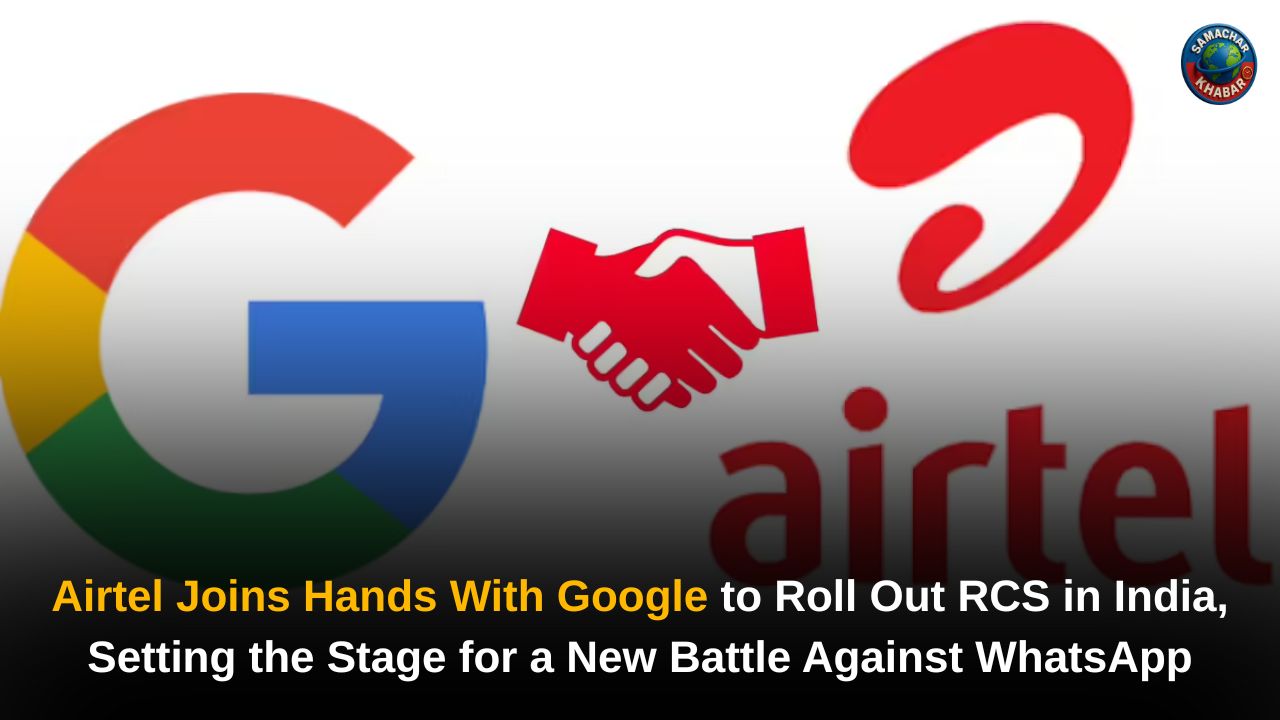
Bharti Airtel has formally partnered with Google to launch Rich Communication Services (RCS) messaging in India, marking a decisive shift in the country’s telecom-led messaging ecosystem. The move brings Airtel in line with Reliance Jio and Vodafone Idea, making all three major Indian telecom operators supporters of RCS. After staying away for nearly a year due to concerns around spam and encrypted channels, Airtel agreed to the partnership following Google’s commitment to integrate RCS with Airtel’s AI-based spam filtering systems. The development is widely seen as a strategic effort to challenge WhatsApp’s dominance in business messaging.
Source: The Economic Times
Key Highlights of Airtel–Google RCS Partnership in India
- Bharti Airtel has signed a pact with Google to offer RCS messaging on its network in India.
- Airtel will charge Rs 0.11 per RCS message under an 80:20 revenue-sharing model with Google.
- Google has agreed to integrate RCS with Airtel’s intelligent, AI-based spam filters.
- With Airtel’s entry, all three major Indian telcos, Airtel, Jio, and Vodafone Idea, now support RCS.
- The move is expected to intensify competition with WhatsApp in enterprise and business messaging.
- Industry experts see RCS as the next major revenue segment for telecom operators after SMS.
Airtel Reverses Its Stand on RCS After a Year of Resistance
Bharti Airtel’s decision to partner with Google comes after nearly a year of hesitation over enabling RCS on its network. Unlike Reliance Jio and Vodafone Idea, Airtel had earlier declined to work with Google or Apple to roll out RCS services. The company had expressed concerns that encrypted, OTT-style communication channels could expose users to increased spam.
Airtel had also approached the telecom regulator, seeking stricter anti-spam regulations for OTT communication platforms. These concerns, according to industry sources, were central to Airtel’s earlier reluctance to adopt RCS.
The breakthrough came after Google agreed to integrate RCS messaging with Airtel’s existing intelligent spam-filtering systems. An Airtel spokesperson confirmed that the company is working closely with Google to implement stringent guidelines to ensure RCS messages pass through its AI-driven spam filters before full-scale deployment.
Also Read: Jio, Airtel, BSNL Users Can Now Call Without Signal – A Game-Changer
Commercial Terms: Pricing and Revenue-Sharing Model
As part of the agreement, Airtel will charge Rs 0.11 per RCS message, according to industry executives quoted in reports. The revenue generated from RCS messaging will be shared between Airtel and Google in an 80:20 ratio, with Airtel retaining the larger share.
This pricing structure positions RCS as a premium alternative to traditional SMS, especially for enterprises looking for richer engagement features such as media sharing, read receipts, and interactive messaging, while still remaining under telecom-controlled pricing and rules of service.
Why RCS Matters in India’s Messaging Landscape
Rich Communication Services, or RCS, is a global messaging standard developed by the GSMA in 2007 as a successor to SMS. The technology enables features similar to internet-based messaging apps, including:
- Read receipts and typing indicators
- File, photo, and video sharing
- Group chats
- Location sharing
- Message encryption
Unlike traditional SMS, RCS operates over mobile data or Wi-Fi, offering a more interactive and modern messaging experience. The original goal behind RCS was to create a universal, carrier-based messaging standard capable of competing with apps like WhatsApp, iMessage, and WeChat.
However, global adoption remained slow for years due to fragmented implementation by telecom operators. In 2019, Google bypassed carriers and enabled RCS directly through its Google Messages app, starting with the UK and France. Today, Google Messages is the primary driver of RCS adoption worldwide, handling around one billion RCS messages daily.
Also Read: Airtel Network Down in Delhi-NCR: Are You Facing Issues?
All Major Indian Telcos Now on Board
With Airtel’s decision, India’s three largest telecom operators: Airtel, Reliance Jio, and Vodafone Idea have now embraced RCS. Industry experts believe this unified adoption could finally give RCS the scale it needs to compete meaningfully with WhatsApp in the enterprise messaging segment.
The next phase, according to experts, will involve negotiations between telecom operators to enable off-net RCS interoperability. This could lead to the introduction of an interconnect usage charge (IUC) for RCS, similar to the traditional telecom interconnection model.
Experts point out that while RCS is a GSMA standard and not regulated by telecom authorities, it is emerging globally as a telco-controlled channel in terms of pricing and service rules. As RCS volumes grow, operators are expected to negotiate commercial interconnection agreements among themselves.
Growing Market Opportunity in Business Messaging
India’s communication-platform-as-a-service (CPaaS) market is witnessing rapid expansion. According to Mordor Intelligence, the Indian CPaaS market is estimated at $1.01 billion in 2025 and is projected to grow to $3.06 billion by 2030. Earlier estimates by Gartner suggested the market would reach $3.2 billion by 2028, up from $1.3 billion in 2023.
Gartner also estimates that WhatsApp and RCS together could form a $1.6 billion market, capturing nearly half of India’s commercial messaging value share. A joint report by Omdia and Infobip projects that RCS alone could generate $544 million in revenue by 2029, driven by 21 billion RCS messages from India, accounting for 25% of RCS revenues across Asia and Oceania.
WhatsApp’s Pricing Moves and Industry Pushback
The competitive landscape has intensified further after WhatsApp made customer service messaging free for businesses late last year. The move was aimed at boosting AI chatbot interactions and expanding WhatsApp’s enterprise footprint in India, where traditional SMS still dominates messaging volumes.
India’s enterprise messaging market is estimated at around Rs 2,500 crore, with traditional SMS accounting for nearly 90% of volumes, or 55–60 billion messages per month, according to industry estimates.
The Cellular Operators Association of India (COAI), which represents Airtel, Jio, and Vodafone Idea, has raised concerns over the growing use of WhatsApp for enterprise messaging. In a letter to the telecom ministry, COAI accused global technology firms such as Microsoft and Amazon of bypassing licensed telecom routes by using WhatsApp for enterprise communications, allegedly causing a Rs 3,000-crore annual revenue loss to the government and service providers.
What the Airtel–Google Move Signals for the Future
The Airtel–Google partnership signals a renewed push by telecom operators to reclaim relevance in India’s rapidly evolving messaging ecosystem. By combining telecom-grade controls, AI-driven spam filtering, and rich messaging features, RCS is being positioned as a credible alternative to OTT platforms for enterprise communication.
As adoption grows and interoperability discussions progress, RCS could emerge as a key pillar of India’s next phase of digital business messaging, reshaping how enterprises and customers interact across networks.
A Spiritual Perspective on Communication and Human Life
Beyond technological advancement and digital communication, the ultimate purpose of human life remains a subject of deep reflection. Tatvdarshi Saint Rampal Ji Maharaj , through His unique spiritual knowledge based on holy scriptures, explains that while tools of communication may evolve, from letters to SMS and now RCS, the true transformation of human life depends on correct spiritual understanding.
According to Saint Rampal Ji Maharaj Ji, human birth is extremely precious and granted by the grace of Supreme God. If this rare life is spent only in material pursuits without true devotion, the soul remains trapped in the cycle of birth and death. He emphasizes that real progress is achieved when knowledge, technology, and life itself are guided by true spiritual wisdom, leading to liberation and lasting peace rather than temporary convenience.
For more information about the spiritual teachings and unique knowledge of Tatvdarshi Saint Rampal Ji Maharaj Ji:
- Website: www.jagatgururampalji.org
- YouTube: Sant Rampal Ji Maharaj
- Facebook: Spiritual Leader Saint Rampal Ji
- ‘X’ handle: @SaintRampalJiM
FAQs on Airtel–Google RCS Messaging Launch in India
1. What is Airtel and Google’s RCS partnership in India?
Airtel has partnered with Google to launch RCS messaging in India, enabling rich, data-based messaging services as an advanced alternative to traditional SMS.
2. How much will Airtel charge for RCS messages?
Airtel will charge Rs 0.11 per RCS message under an 80:20 revenue-sharing agreement with Google, according to industry executives.
3. Why did Airtel earlier oppose RCS messaging?
Airtel had raised concerns about spam and encrypted OTT channels and sought regulatory safeguards before agreeing to launch RCS.
4. How does RCS compete with WhatsApp in India?
RCS offers rich features like media sharing and read receipts under telecom control, positioning it as a direct competitor to WhatsApp in business messaging.
5. Which telecom operators in India support RCS now?
All major Indian telcos, Airtel, Reliance Jio, and Vodafone Idea, now support RCS messaging services.