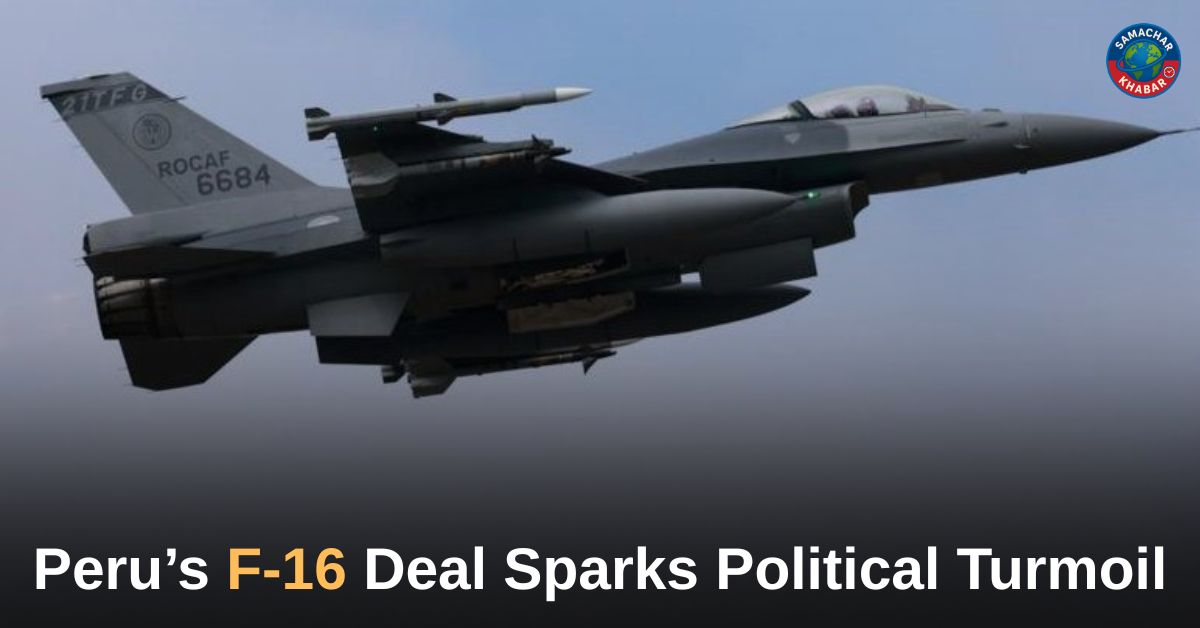
Peru’s proposed acquisition of U.S.-made F-16 fighter jets has triggered a major political crisis, leading to the resignation of key ministers and raising questions about governance during a transitional administration. The multi-billion dollar deal, involving advanced F-16 Block 70 aircraft, became controversial after interim President José María Balcázar decided to defer the decision to the next government. Despite the uncertainty, a $462 million payment was made, intensifying tensions within the country’s leadership and drawing international attention.
Key Takeaways: Peru F-16 Fighter Jet Deal
- Peru planned a $3.5 billion deal for 24 F-16 Block 70 jets
- Interim President José María Balcázar deferred the decision to the next government
- Defense Minister Carlos Díaz and Foreign Minister Hugo de Zela resigned over the issue
- Government made a $462 million initial payment despite uncertainty
- Deal involves U.S.-based Lockheed Martin with competing bids from Saab and Dassault
- Political instability deepens ahead of June presidential runoff
Peru’s F-16 Deal Sparks Political Instability
Peru is facing significant political turbulence following developments surrounding its planned purchase of F-16 fighter jets from the United States. The deal, valued at approximately $3.5 billion, involves the acquisition of 24 advanced F-16 Block 70 aircraft manufactured by Lockheed Martin.
However, the process has been disrupted by internal disagreements within the government. Interim President José María Balcázar announced that the decision to proceed with the purchase should be left to the next administration, citing concerns about the legitimacy of a transitional government making such a major financial commitment.
Also Read: Historic First: Israeli F-35I Downs Iranian Jet YAK-130 Over Tehran Amid Escalating Conflict
This move has placed the deal in uncertainty and triggered a chain of political consequences.
Ministerial Resignations Deepen the Crisis
The situation escalated when Peru’s Defense Minister Carlos Díaz and Foreign Minister Hugo de Zela resigned from their positions.
Their resignations followed disagreements with the interim president’s decision to defer the purchase. According to reports, the ministers opposed delaying the deal, arguing that it could negatively impact national interests and Peru’s credibility as a partner in international agreements.
The resignations highlight a growing divide within the government over how to handle the defense acquisition.
$462 Million Payment Amid Uncertainty
Despite the political uncertainty, Peru proceeded with a $462 million payment as the first installment of the deal.
This payment indicates that administrative and financial processes related to the acquisition had already advanced significantly, even as political disagreements continued. The move further intensified scrutiny over the decision-making process and raised questions about coordination within the government.
Debate Over Transitional Authority
At the center of the controversy is the role of Peru’s transitional government. President Balcázar, who assumed office in February and is set to leave in July, emphasized that committing billions of dollars should be the responsibility of a fully elected government.
He stated that the incoming administration would have “full legitimacy” to decide whether to proceed with the purchase.
This stance reflects broader concerns about governance and accountability during periods of political transition.
International and Strategic Context
The proposed deal involves U.S.-based defense manufacturer Lockheed Martin and represents a major step in Peru’s military modernization. The F-16 Block 70 is among the most advanced versions of the aircraft, featuring updated avionics and systems.
The procurement process also included competing bids from Sweden’s Saab and France’s Dassault Aviation, highlighting the strategic importance of the decision.
Additionally, U.S. Ambassador Bernie Navarro warned of potential consequences if Peru were perceived as negotiating in bad faith, underscoring the diplomatic sensitivity surrounding the deal.
Political Uncertainty Ahead of Elections
The controversy unfolds against the backdrop of Peru’s upcoming presidential runoff election scheduled for June 7.
The country has experienced ongoing political instability, with frequent leadership changes in recent years. The F-16 deal has now become part of this broader political landscape, raising questions about policy continuity and governance.
With the transitional government nearing its end, the future of the fighter jet acquisition remains uncertain and is likely to be decided by the incoming administration.
Structured Overview of the Deal
| Aspect | Details |
| Total Deal Value | $3.5 billion |
| Aircraft | 24 F-16 Block 70 jets |
| Manufacturer | Lockheed Martin |
| First Payment | $462 million |
| Political Impact | Minister resignations, policy dispute |
| Decision Status | Deferred to next government |
Implications for Governance and Defense Policy
The F-16 fighter jet deal has evolved into more than a defense procurement issue, reflecting deeper challenges in Peru’s political system. The combination of ministerial resignations, financial commitments, and leadership disagreements underscores the complexity of decision-making during a transitional period. As the country approaches a presidential runoff, the responsibility for resolving the issue will shift to the next administration. The outcome is expected to influence both Peru’s defense strategy and its approach to international partnerships.
Spiritual Reflection on Duty and Wisdom
The ongoing developments around Peru’s F-16 deal highlight how major decisions, especially those involving national interest and large financial commitments, can create conflict when clarity and collective understanding are lacking. In such situations, spiritual wisdom often emphasizes balance, responsibility, and ethical decision-making beyond immediate power struggles.
In the present era, Tatvdarshi Sant Rampal Ji Maharaj is guiding society through initiatives focused on harmony and service. Through His teachings, He emphasizes that true progress is not only measured by material strength but also by unity, peace, and righteous action. His ongoing Annpurna Muhim and large-scale Bhandara reflect a vision of social equality and shared well-being, where people are encouraged to come together and experience a life of contentment and purpose.
Such perspectives offer a broader context, suggesting that alongside policy and governance, inner awareness and ethical clarity remain essential for sustainable progress.
For more information visit our
Website: www.jagatgururampalji.org
YouTube: Sant Rampal Ji Maharaj
Facebook: Spiritual Leader Saint Rampal Ji
X (Twitter): @SaintRampalJiM
FAQs on Peru F-16 Fighter Jet Deal
1. What is the value of Peru’s F-16 deal?
The deal is valued at approximately $3.5 billion.
2. How many aircraft are included in the deal?
The plan involves the purchase of 24 F-16 Block 70 fighter jets.
3. Why did ministers resign?
They resigned over disagreement with delaying the deal.
4. Has Peru made any payment?
Yes, a $462 million initial payment has been made.
5. Who will take the final decision?
The next elected government will decide on the deal.