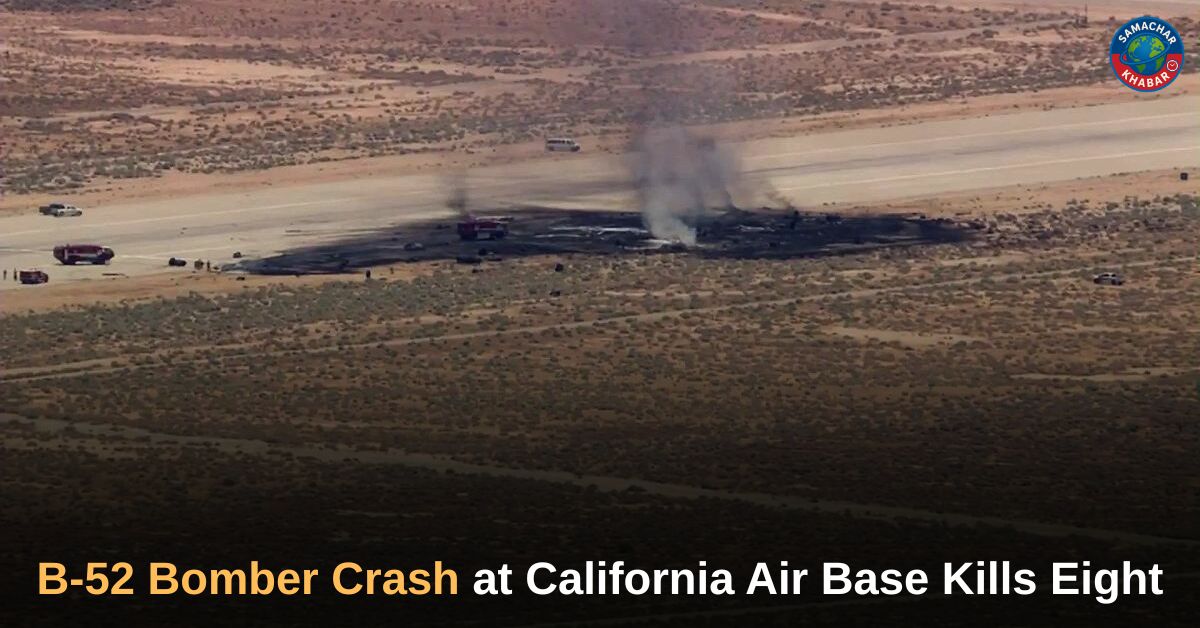
Eight people were killed after a US Air Force B-52 bomber crashed shortly after take-off from Edwards Air Force Base in California’s Mojave Desert on Monday. Authorities said initial indications suggested the crash was not survivable, while investigators began examining the circumstances that led to the accident. The incident has drawn attention to the Boeing B-52 Stratofortress, one of the US Air Force’s principal long-range bombers, which has remained in service for more than seven decades and continues to play a key role in military operations.
Key Takeaways: B-52 Bomber Crash at Edwards Air Force Base
- Eight people were killed after a B-52 bomber crashed shortly after take-off.
- The crash occurred at Edwards Air Force Base in California’s Mojave Desert on Monday.
- Authorities said initial indications suggested the crash was not survivable.
- An investigation has been launched to determine the cause of the accident.
- The Boeing B-52 Stratofortress entered service in 1955 and remains a key US Air Force bomber.
- Aviation safety expert Jeff Guzzetti suggested the crash may have involved a controllability issue, though no official cause has been identified.
Eight Killed After B-52 Bomber Crashes Following Take-Off
A US Air Force B-52 bomber crashed shortly after take-off from Edwards Air Force Base in California’s Mojave Desert on Monday, killing all eight people on board.
“We lost eight great Americans,” James Hayes, the deputy commander at Edwards Air Force Base, said, according to news agency AP.
Earlier, the US Air Force said there was little hope of survivors.
“Initial indications are that the crash was not survivable,” Edwards Air Force Base said in a social media post.
Also Read: Peru’s F-16 Fighter Jet Deal Triggers Political Crisis and Ministerial Resignations
Officials have not yet released details about the crew. Soon after the crash, authorities launched an investigation into the cause of the accident.
Emergency Response and Crash Scene
Emergency teams were dispatched after the bomber came down at around 11.20am.
Footage from the area showed thick black smoke billowing from a large scorched section of desert close to what appeared to be a runway. Emergency vehicles were deployed around the crash site as rescue and response operations got underway.
Aerial images from the scene showed extensive damage, with almost no visible remains of the aircraft.
The military has not confirmed whether the aircraft was carrying any weapons.
Following the crash, operations at the airfield were halted. All incoming aircraft were redirected elsewhere, while base authorities suspended non-commercial visitor access to prioritise emergency response efforts.
Edwards Air Force Base and Its Aviation Legacy
Located about 161 kilometres north of Los Angeles, Edwards Air Force Base serves as a major centre for aircraft testing and development.
The installation is home to the 412th Test Wing, which oversees the evaluation of Air Force aircraft, weapons systems, software and components throughout their service life.
The base is also known for its role in aviation history. In 1947, test pilot Chuck Yeager broke the sound barrier there, reaching a speed of Mach 1.05.
What Is the Boeing B-52 Stratofortress?
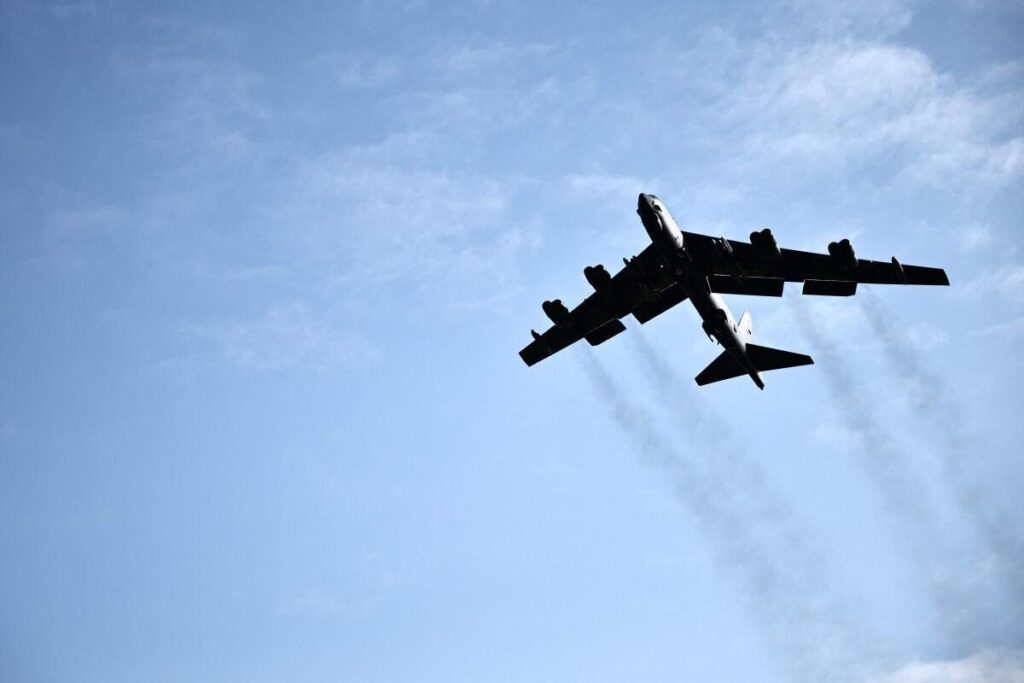
The Boeing B-52 Stratofortress is a long-range bomber that entered service in 1955. Designed to carry both conventional and nuclear weapons, it has been used by the US military in conflicts from Vietnam to those involving Iran.
Typically crewed by five personnel, the aircraft has been operated by the US Air Force since the 1950s. According to a US Air Force fact sheet, each aircraft costs about $84 million.
The bombers played a key role in Operation Desert Storm in the early 1990s and have also been deployed in operations involving Iran, striking targets such as air defence systems and command centres.
Also Read: 1 जून से घरेलू उड़ानें घटाएंगी Air India और IndiGo, बढ़ सकती हैं हवाई टिकट की कीमतें
In conventional operations, the B-52 can undertake strategic attacks, close air support, air interdiction, offensive counter-air and maritime missions.
B-52 Bomber Specifications
| Specification | Details |
| Aircraft | Boeing B-52 Stratofortress |
| Entered Service | 1955 |
| Wingspan | About 185 feet (56 metres) |
| Length | 159 feet (48 metres) |
| Typical Crew | Five members |
| Combat Range | Up to 8,800 miles |
| Maximum Altitude | Up to 50,000 feet |
| Weapons Capability | Conventional and nuclear weapons |
According to the US Air Force, the aircraft is usually crewed by an aircraft commander, pilot, radar navigator, navigator and electronic warfare officer.
The B-52 can carry a wide range of weapons, including bombs and cruise missiles. It can also deploy gravity bombs, cluster munitions, precision-guided missiles, joint direct attack munitions and nuclear warheads.
For more than six decades, B-52 bombers have formed the backbone of the United States’ strategic bomber fleet.
B-52H Remains the Only Operational Variant
The B-52 is a heavy bomber that first flew in 1954 and was originally designed for war with the Soviet Union.
At present, only the B-52H variant remains operational. These aircraft are stationed with the 5th Bomb Wing at Minot Air Force Base in North Dakota and the 2nd Bomb Wing at Barksdale Air Force Base in Louisiana.
Modern Upgrades and Advanced Capabilities
Although the aircraft was originally designed during the Cold War, it has undergone continuous upgrades to remain operational.
In 2025, Boeing delivered a B-52 equipped with a modern Active Electronically Scanned Array (AESA) radar system to Edwards Air Force Base. Testing was scheduled through 2026 to support future production decisions, according to the US Air Force.
It remains unclear whether that aircraft was involved in Monday’s crash.
B-52 bombers are also equipped with advanced targeting pods that enhance long-range detection, identification and surveillance capabilities. These systems improve operational effectiveness across missions, including close air support, during both day and night operations and in adverse weather conditions.
The aircraft’s aerial refuelling capability significantly extends its range, making it limited largely by crew endurance. Its unrefuelled range exceeds 8,800 miles, or about 14,080 kilometres.
Expert Points to Possible Flight-Control Issue
Aviation safety expert Jeff Guzzetti said the circumstances of the crash suggested a possible flight-control problem, given how quickly the aircraft came down after take-off.
“I think it was definitely a controllability issue. Now, whether that was tied to an engine failure, a flight control failure, or some new testing device failure, I’m not sure,” said Guzzetti, who previously investigated air accidents for both the Federal Aviation Administration and the National Transportation Safety Board.
He said a number of factors could have contributed to such a failure, including maintenance issues, a major engine malfunction or a fault involving equipment undergoing testing.
Although the B-52 has been in service for more than seven decades, Guzzetti noted that testing new systems on aircraft can introduce additional risks.
“A flight test is always riskier than normal operations, so that’s why you have specially trained test pilots, and you should have other safety protocols,” Guzzetti said.
Investigation Focuses on Cause of Fatal Crash
With all eight people on board confirmed dead, investigators are now working to determine what caused the bomber to crash shortly after take-off from Edwards Air Force Base.
While questions remain about the sequence of events that led to the accident, officials have not released details about the crew and have yet to determine the cause. The investigation is expected to focus on the aircraft, its systems and the circumstances surrounding the flight as authorities seek answers following one of the deadliest incidents involving a B-52 bomber in recent years.
Reflection on Life and Responsibility
Incidents involving the loss of human lives often prompt reflection on the value of life, duty, and human limitations. While investigations focus on determining the cause of such events, many people also turn to spiritual teachings for guidance and perspective during difficult times.
According to the spiritual teachings of Tatvdarshi Sant Rampal Ji Maharaj, human life is precious and should be lived with awareness, responsibility, and devotion to God. His Spiritual Knowledge emphasizes understanding the purpose of life and maintaining a balanced outlook during both favorable and challenging circumstances. Such teachings encourage individuals to reflect on life with humility, wisdom, and respect for humanity.
For more information visit our
Website: www.jagatgururampalji.org
YouTube: Sant Rampal Ji Maharaj
Facebook: Spiritual Leader Saint Rampal Ji
X (Twitter): @SaintRampalJiM
FAQs on B-52 Bomber Crash
1. Where did the B-52 bomber crash occur?
The crash occurred at Edwards Air Force Base in California’s Mojave Desert.
2. How many people were killed in the crash?
Eight people were killed after the aircraft crashed shortly after take-off.
3. What is the B-52 Stratofortress?
It is a long-range US Air Force bomber capable of carrying conventional and nuclear weapons.
4. Has the cause of the crash been identified?
No. Authorities launched an investigation and have not yet determined the cause.
5. What did aviation expert Jeff Guzzetti say?
He suggested the crash may have involved a controllability issue but said the exact cause remains unclear.